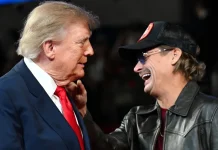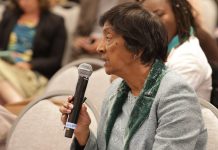
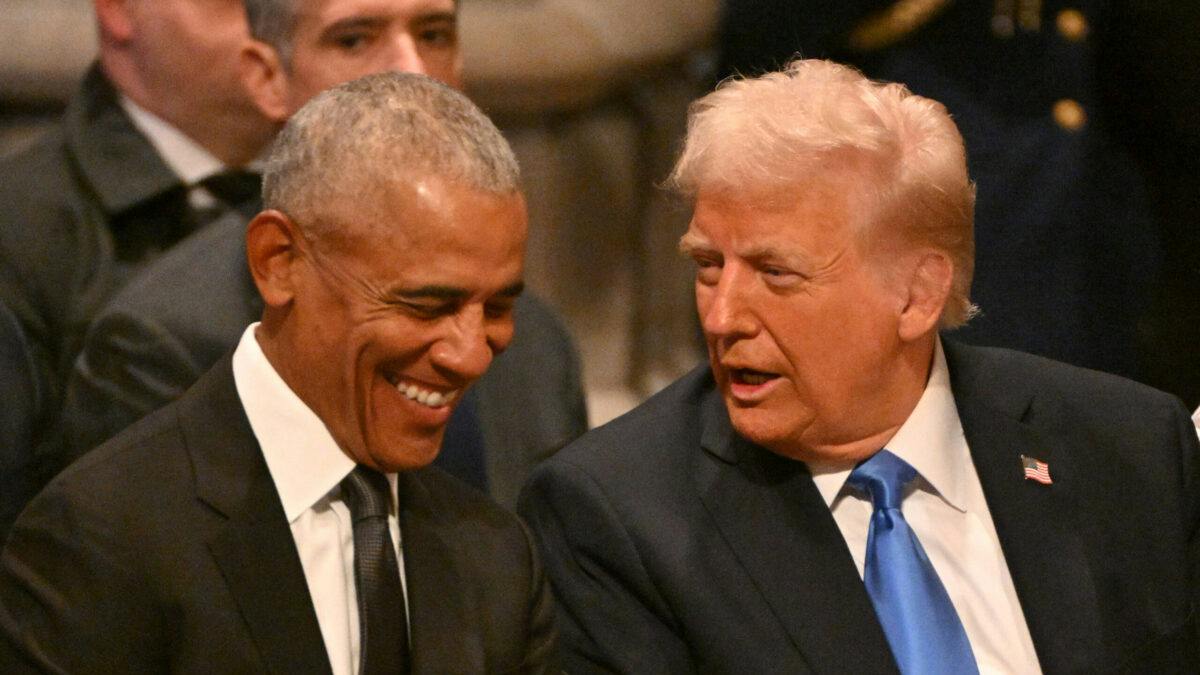
Former President Barack Obama floated his fantasy of women running every government on Earth for two years. President Donald Trump had a quick answer Saturday.
“I love women. I think they’re great,” Trump told reporters. “But what a ridiculous statement that is, right?”
The exchange highlights a fundamental difference in how the two presidents approach questions of gender and leadership. While Obama has repeatedly engaged in theoretical discussions about women’s potential superiority in governance, Trump has largely avoided such philosophical speculation, preferring to focus on individual qualifications and results. The contrast between their rhetorical styles was on full display in this brief but revealing exchange.
Obama made the claim Monday during a conversation with historian Doris Kearns Goodwin at Salem State University in Massachusetts. Reflecting on leadership and giving younger generations opportunities to lead, Obama recalled wondering what would happen if women temporarily took over every government in the world.
“Even when I was president, I sometimes fantasized about if you put women in charge of every government for like two years and then just kind of saw, all right, how are things going? I have a strong belief that things would — they wouldn’t be perfect. But they’d be better. I’m confident about that. I really do.”
This was not the first time Obama pushed this theory. He made the same argument in 2019, telling an audience in Singapore that women were “better than us [men]” and that putting women in charge of every nation for two years would produce “a significant improvement” in living standards and outcomes.
The consistency of Obama’s message over the years suggests it represents a deeply held belief rather than a casual observation. His willingness to repeat the sentiment in different forums and to different audiences indicates he views it as an important perspective on leadership and governance. The former president has often positioned himself as a champion of women’s advancement in politics and business, making these comments part of a broader pattern in his post-presidency public appearances.
Former President Obama on hypothetical of women in charge of every government for two years: “I have a strong belief that things would… they wouldn’t be perfect, but they’d be better. I’m confident about that.” pic.twitter.com/Ss4bgKRfmp
— CSPAN (@cspan) September 24, 2026
Trump’s response was considerably less philosophical.
The president’s quick dismissal of Obama’s theory reflects his general skepticism toward abstract discussions of group characteristics and his preference for evaluating people as individuals. Throughout his political career, Trump has maintained that merit and capability matter more than demographic categories, though critics have often questioned whether his actions match that rhetoric.
But there’s an irony in the exchange: Trump’s own White House has put women in some of the most powerful positions in government.
Trump made history by selecting Susie Wiles as his White House chief of staff, making her the first woman ever to hold the position. Wiles remains one of the most powerful people in the administration, serving as Trump’s top aide and managing the White House operation.
The significance of the chief of staff role cannot be overstated. Often described as the second-most-powerful position in Washington, the chief of staff controls access to the president, manages the flow of information, coordinates policy implementation across agencies, and serves as a key advisor on virtually every major decision. By placing a woman in this role for the first time in American history, Trump accomplished something that eluded all of his predecessors, including Obama.
Trump’s second administration also began with women holding several Cabinet and Cabinet-level posts, including Attorney General Pam Bondi, Homeland Security Secretary Kristi Noem, Agriculture Secretary Brooke Rollins, Education Secretary Linda McMahon, Small Business Administrator Kelly Loeffler, and Director of National Intelligence Tulsi Gabbard. Karoline Leavitt became the youngest White House press secretary in history.
These positions represent some of the most consequential roles in the federal government. The Attorney General leads the Justice Department and serves as the nation’s top law enforcement official. The Homeland Security Secretary oversees border security, immigration enforcement, and domestic threat prevention. The Director of National Intelligence coordinates the entire intelligence community and briefs the president on threats to national security. Together, these appointments demonstrate that women occupy seats at the table where the most critical decisions about America’s future are being made.
So while Trump clearly isn’t signing onto Obama’s two-year experiment in worldwide female government, his administration has hardly operated on the premise that women shouldn’t be in positions of power.
Trump’s picks speak louder than Obama’s hypotheticals.
The contrast reveals a broader truth about political leadership: actions often matter more than words. While Obama articulates theories about gender and governance, Trump has quietly assembled one of the most gender-diverse leadership teams in recent presidential history. Whether this difference reflects contrasting philosophies or simply different communication styles, it underscores that promoting women’s leadership can take many forms beyond public speculation about universal female governance.