President Donald Trump met with Irish President Catherine Connolly at her official residence in Dublin over the weekend — a notable encounter given Connolly’s history of sharp public criticism toward Trump.
The Saturday meeting represented a significant diplomatic moment in U.S.-Irish relations, bringing together two leaders whose public positions on international conflict and foreign policy have often diverged. Connolly has been an outspoken voice on issues of war and human rights during her tenure, while Trump has pursued what he characterizes as a more transactional approach to international diplomacy.
The meeting at Áras an Uachtaráin in Phoenix Park appeared cordial on the surface. Trump later described Connolly as “terrific” during remarks at the U.S. ambassador’s residence.
Yet beneath the diplomatic pleasantries, the encounter highlighted the delicate balance Ireland maintains in its relationship with the United States — a bond rooted in centuries of immigration, cultural exchange, and shared history, but one that has occasionally been tested by differing views on global affairs and military intervention.
But the gifts Connolly presented during the Saturday visit carried pointed symbolism: a St. Brigid’s Cross — recognized as a symbol of peace — alongside a collection of poetry featuring Michael Longley’s famous sonnet “Ceasefire.”
The selection of these particular gifts was widely interpreted by observers as a carefully calibrated diplomatic message. St. Brigid is one of Ireland’s patron saints, and her cross has long been associated with protection and reconciliation. Longley’s poem, which draws on Homer’s Iliad to explore themes of loss and the human cost of conflict, has become a touchstone in Irish literature for discussions of peace and the aftermath of violence.
Connolly told Trump that “normalization of war and genocide can never be accepted,” adding that the “deep connection” between the U.S. and Ireland “allows us to speak openly to one another.”
The frankness of Connolly’s remarks underscored Ireland’s traditional foreign policy stance of neutrality and its longstanding commitment to international peacekeeping efforts through the United Nations. Ireland has not been a member of NATO and has historically positioned itself as a voice for smaller nations in international forums.
After standing at attention for the U.S. and Irish national anthems, Connolly introduced Trump to a delegation of Irish dignitaries, including Garda Commissioner Justin Kelly and Chief of Staff of the Irish Defence Forces Lieutenant General Rossa Mulcahy.
Trump introduced Connolly to his own delegation — which included his son, Donald Trump Jr.
President Donald J. Trump with the President of Ireland, Catherine Connolly, and Taoiseach Micheál Martin in Dublin, Ireland. 🇺🇸🇮🇪 pic.twitter.com/NljWJphf7Y
— The White House (@WhiteHouse) September 13, 2026
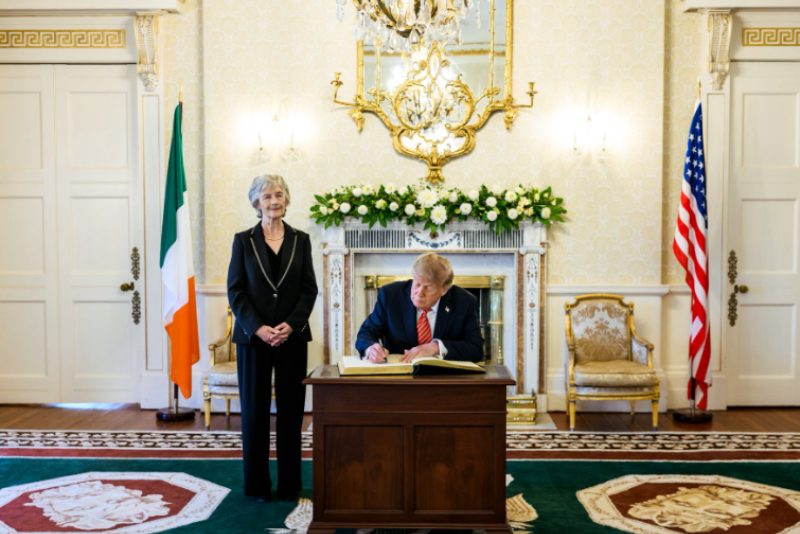
Trump left a message in the visitor’s book that read, “It is a great honor to be here thank you,” according to the Independent.
The brevity and informal tone of Trump’s inscription stood in contrast to the more elaborate entries typically left by visiting heads of state in the historic guestbook, which has been signed by numerous world leaders over the decades.
In a statement after the meeting, Connolly emphasized that “the normalization of war and genocide can never be accepted.” She added that Ireland would support those who “build a shared peace in all those parts of the world currently suffering from such horrific war and violence.”
“As a country which has suffered famine, colonization and the violence of the Troubles, but also the importance of the long and challenging road to peace, I emphasized the unique insight which Irish people can bring to the resolution of conflict,” Connolly said.
Her invocation of Ireland’s own turbulent history served as a reminder of the nation’s complex relationship with conflict and peacebuilding. The reference to the Troubles — the decades-long sectarian conflict in Northern Ireland that only concluded with the Good Friday Agreement in 1998 — and to Ireland’s colonial past under British rule provided context for the country’s contemporary foreign policy positions and its moral authority on questions of peace and reconciliation.
During the encounter, Trump emphasized that he would “love” to see a united Ireland and later doubled down on those comments Sunday at the Irish Open.
Trump’s remarks on Irish reunification represented a potentially consequential statement on one of the most sensitive political questions in Irish and British politics. The issue of Northern Ireland’s constitutional status remains carefully managed through the framework established by the Good Friday Agreement, and American presidents have typically approached the topic with considerable caution to avoid appearing to take sides in what remains a delicate matter.
Trump did not answer reporters’ questions about the meeting’s specifics when he paused briefly to speak with press after the visit.