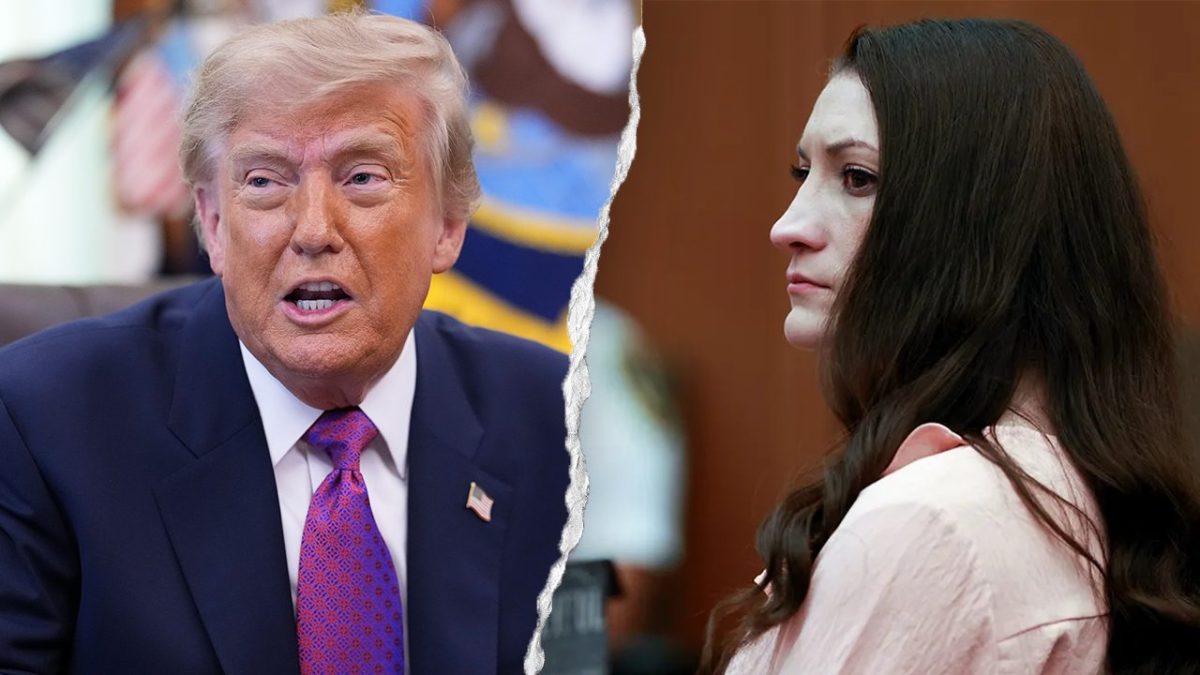
President Donald Trump says Lindsay Clancy will still have to pay “the price” for the deaths of her three small children after a Massachusetts jury deadlocked 11-1 and a mistrial was declared Friday.
During an Oval Office press gaggle, Trump weighed in on the case that has divided the nation — and exposed a stark partisan divide over justice. The president’s comments mark a rare direct intervention into an ongoing state criminal matter, underscoring how deeply the Clancy case has penetrated the national consciousness and become a flashpoint in broader debates about mental health, maternal care, and criminal accountability.
“It’s a horrible tragedy,” Trump told reporters. “I see what’s happened, and it looks like it’s a hung jury.”
“I ASSUME THERE’S GOING TO BE ANOTHER TRIAL. IT’S A TERRIBLE SITUATION. LOOK, SHE DID A HORRIBLE, HORRIBLE THING. CAN’T BE WORSE. BUT YOU’LL FIND OUT WHAT THE PRICE TO PAY IS. THERE’LL BE A PRICE. IT’S GOING TO BE [A] MENTAL INSTITUTION OR JAIL OR SOMETHING.” — PRESIDENT DONALD TRUMP
Clancy’s defense did not deny that she strangled her three children — Cora, 5, Dawson, 3, and Callan, 8 months — with exercise bands in January 2023. Instead, attorneys argued she was not guilty by reason of insanity, claiming postpartum psychosis disconnected her from reality. The insanity defense, one of the oldest and most controversial elements of criminal law, requires the defense to prove that a defendant could not understand the nature or wrongfulness of their actions due to severe mental illness at the time of the offense.
After nearly a week of deliberations, the jury of nine women and three men deadlocked: eleven jurors voted to acquit Clancy, while one holdout refused to join them. The lopsided vote reflects how persuasive the defense’s presentation of postpartum psychosis evidence was to the overwhelming majority of the jury panel, even as it failed to achieve the unanimity required for a verdict under Massachusetts law.
Judge William Sullivan declared a mistrial.
The outcome has triggered fierce Republican backlash — while Democratic leaders, including those from Massachusetts, have stayed silent. The partisan split over the case mirrors broader national divisions over questions of personal responsibility, mental health as a mitigating factor in criminal justice, and how society should treat mothers suffering from severe postpartum conditions. The silence from Massachusetts officials is particularly notable given that the case unfolded in their jurisdiction and has generated intense national attention.
“Out of 12 people, only ONE had the courage to hold a serial killer accountable for her actions,” Rep. Michael Rulli, R-Ohio, posted on X. “That’s not just bravery. That’s a hero.”
Sen. Mike Lee, R-Ohio, posted: “Holdout juror’s going to need security. Sad.”
Florida Governor Ron DeSantis called it a “miscarriage of justice.”
“THE VICTIMS DESERVED FAR, FAR BETTER THAN A KANGAROO COURT.” — GOV. RON DESANTIS
Rep. Nancy Mace, R-S.C., who has been vocal against Clancy’s supporters gathered outside the courthouse, suggested Clancy would not have this support if she were Black. Her comments highlighted longstanding concerns about racial disparities in how the criminal justice system treats defendants, particularly regarding who receives empathy and who is afforded the benefit of mental health defenses.
“This case is not about the excuses for why she committed murder,” Mace posted on X. “This is about justice for the three beautiful souls whose lives were taken after their mother strangled them with her bare hands and workout bands.”
Clancy’s defense argued she was a devoted mother desperately seeking help. They alleged the cocktail of medications she was on worsened her mental state. Clancy had been prescribed 13 psychiatric medications — more than 30 prescriptions — in the four months leading up to the deaths. The medication regimen became a central focus of the defense’s argument, with expert witnesses testifying about the potential dangers of polypharmacy — the simultaneous use of multiple medications — particularly in treating postpartum psychiatric conditions. The sheer volume of prescriptions raised questions about the adequacy of her medical oversight and whether proper protocols were followed in monitoring her deteriorating condition.
Patrick Clancy, her ex-husband, is suing for wrongful death and medical malpractice against Clancy’s providers. Clancy also filed a separate lawsuit alleging negligence and medical malpractice. The parallel civil litigation suggests that accountability questions extend beyond the criminal case to encompass the healthcare system’s response to a clearly struggling new mother.
“Lindsay was struggling. We were all very concerned,” Susan Clancy, Clancy’s mother-in-law, told jurors. “She was very nurturing, very loving. She was a wonderful mother. Wonderful.”
Clancy is due back in court Sept. 29 for a status hearing, trial assignment, and a defense motion. Prosecutors must now decide whether to retry the case, knowing that eleven of twelve jurors found the insanity defense credible enough to vote for acquittal. The decision will likely hinge on whether the prosecution believes they can overcome the substantial evidence of severe mental illness that persuaded the vast majority of the first jury.
The charges remain allegations. The case has not been proven in court.