
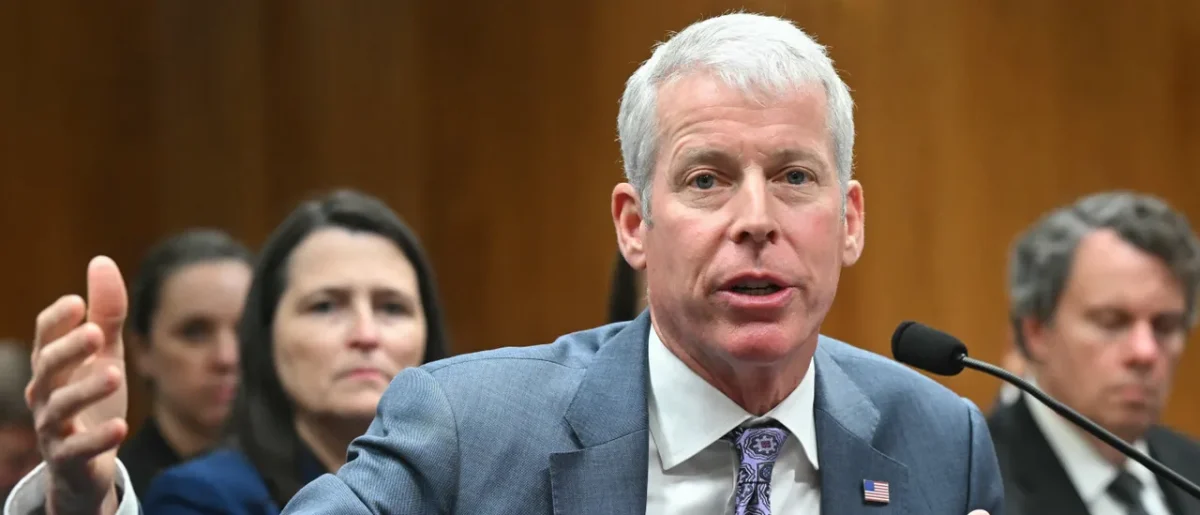
Energy Secretary Chris Wright just ordered two Indiana coal plants to keep running — one week after a federal court ruled the Trump administration overstepped its emergency powers trying the exact same move in Michigan.
Wright issued emergency orders Sept. 19 requiring units at Indiana’s R.M. Schahfer and F.B. Culley coal plants to remain available through Dec. 18, according to the Energy Department. That came just seven days after the U.S. Court of Appeals for the D.C. Circuit struck down Wright’s first emergency order — the one that kept Michigan’s J.H. Campbell coal plant running past its planned retirement.
The administration isn’t backing down.
“DOE disagrees with the decision and is working with DOJ to assess potential rehearing and appeal options.”
Wright said in the department’s release that forcing coal generation off the grid “would compromise energy reliability and needlessly raises energy costs for Americans.”
Judge Cornelia Pillard — an Obama appointee — wrote for the panel that states “bear the responsibility to plan for and avert reliability risks on an ongoing basis.” She ruled the department exceeded its statutory authority.
But the Trump administration argues the court got it wrong — and that coal plants are the only thing standing between American families and blackouts.
The Campbell plant ran at more than 650 megawatts every day from Jan. 21 to Feb. 1 during Winter Storm Fern, Energy Department Press Secretary Ben Dietderich said. Coal generation in affected regions rose 25% at the storm’s peak compared with the same time the previous year.
“The emergency orders, including at Campbell, prevented blackouts and likely saved hundreds of lives during peak capacity events this past year,” Dietderich said.
Democrat Michigan Attorney General Dana Nessel — whose office is challenging the orders in court — framed the fight differently. She said after the ruling that “this administration does not get to invent fake emergencies to bypass the rule of law.”
The Campbell ruling carries weight beyond Michigan. Colorado’s Craig Station Unit 1 is also under emergency orders, and the D.C. Circuit paused that challenge until 60 days after the Campbell ruling. Tri-State Generation and Transmission Association and co-owner Platte River Power Authority have since filed three petitions challenging the department’s orders for Craig — the latest on Sept. 22.
Republican Indiana Gov. Mike Braun praised Wright’s latest orders, saying they would “help protect Hoosiers from higher energy costs and keep the power on.”
Northern Indiana Public Service Company — which owns Schahfer — told the Indiana Capital Chronicle that both units covered by the orders remain offline for inspections, maintenance and repairs. The utility asked federal regulators in August to approve about $38 million in cost recovery for the first quarter of 2026.
CenterPoint Energy, which owns Culley, said in a statement that it is “reviewing” the Campbell ruling and “evaluating its potential implications for Culley 2,” but that the decision “does not change” the department’s direction for the unit and that it will continue to comply.
“At this time, there are no direct bill impacts to CenterPoint customers, but we remain committed to keeping customer affordability top-of-mind as we plan for recovery of costs associated with operating the unit,” the company said.
Keeping the Campbell plant open past its May 2025 retirement date cost about $259 million as of Sept. 11, according to financial filings cited by the Associated Press. But the plant earned about $33.7 million selling electricity between late May and June 30, 2025 — leaving owner Consumers Energy with a profit of nearly five million dollars for that period, The Washington Free Beacon reported.
“The missing person in this coalition is the ratepayer, whose bills go up when environmentalists and utilities team up to shut down existing plants.”
Travis Fisher, director of energy and environmental policy studies at the Cato Institute, said Congress designed the emergency authority “for wartime emergencies” and that the D.C. Circuit “correctly found” the department’s reliance on a possible future power shortfall “too open-ended.”
But Jason Hayes, a senior research fellow in the Heritage Foundation’s Center for Energy, Climate and Environment, said the ruling limits how the department can write future orders but does not remove the Midwest grid’s elevated risk of reliability problems.
“The court did not find that the Midwest has spare firm power,” Hayes said, referring to power plants that can run whenever they are needed.
He said Campbell’s closure was moved up 15 years and that Schahfer’s retirement appears to be following a similar timeline, with state regulators approving plans to replace coal with wind and solar.
“People angry about the cost of keeping the Schahfer and Campbell plants running should actually be angry at the policies that retire dispatchable plants before a reliable replacement option is proposed,” Hayes said.
Energy analyst and writer David Blackmon went further: “Not only are Secretary Wright and DOE doing the right thing ordering operators of these coal plants to maintain their availability in times of baseload constraints, the Trump administration should be doing more.”
Blackmon said the administration should also approve new coal plants in areas where natural gas and other dispatchable power sources are not feasible because the infrastructure is lacking.
“America’s regional grid operators can no longer afford to pretend that intermittent generation is a viable substitute for real baseload,” he said.
The department’s emergency orders also cover coal plants in Colorado, Florida and Washington state. The Energy Department said in its Sept. 19 release that more than 17 gigawatts of coal generation were kept from going offline in 2025.
The latest Campbell order runs through Nov. 14.
As Americans prepared for Winter Storm Fern, @ENERGY located 35GW of unused backup generation to be made available as needed.
This administration remains committed to doing everything in our power to mitigate blackouts and lower energy costs for the American people. pic.twitter.com/DTdVK5uoAf— Secretary Chris Wright (@SecretaryWright) January 28, 2026