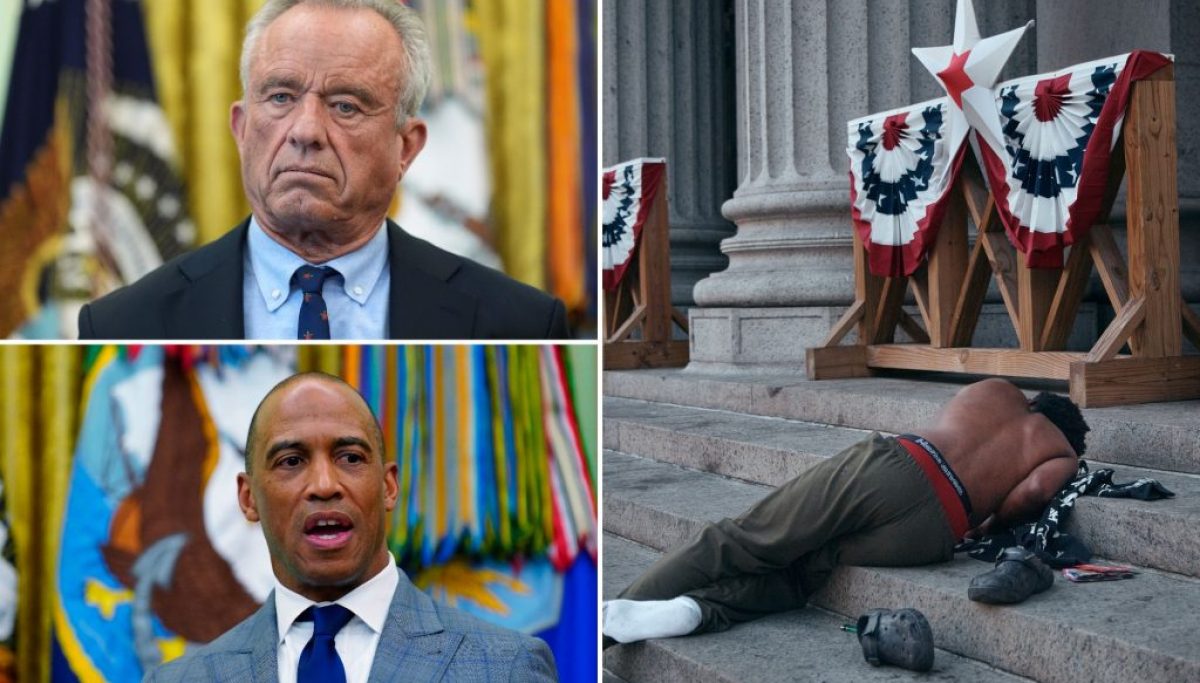
The Trump administration just handed local leaders a blueprint for tackling America’s twin crises of addiction and homelessness — and it puts recovery before housing.
Health and Human Services Secretary Robert F. Kennedy Jr. and Housing and Urban Development Secretary Scott Turner released a 40-page toolkit Wednesday offering federal, state, and local organizations a roadmap to incorporate addiction treatment as the foundation of homeless assistance programs.
The comprehensive guidance represents the administration’s most detailed policy framework to date on addressing the intersection of substance abuse and housing instability. It marks a significant departure from federal policy established over the past two decades and signals the administration’s commitment to fundamentally restructuring how communities approach these interconnected challenges.
The approach flips the script on the dominant “housing first” model favored by blue states and cities — which emphasizes permanent shelter without requiring sobriety.
That prevailing model, which gained traction in the early 2000s and became federal policy under previous administrations, operates on the premise that stable housing is a prerequisite for addressing other issues like addiction and mental illness. Critics of that approach have long argued it enables continued substance abuse by removing consequences and failing to address root causes. The debate over which model proves more effective has divided policymakers, researchers, and advocates for years, with billions of dollars in public spending hanging in the balance.
“Treatment must come first. Recovery begins when we connect people with effective care, not leave them trapped in addiction and homelessness.”
Kennedy, who has been public about his own 14-year heroin addiction and recovery since 1983, said the new toolkit gives communities “practical, evidence-based strategies to expand treatment, support lasting recovery, and help people reclaim their independence.”
His personal experience with addiction and long-term recovery has positioned him as a uniquely credible voice on substance abuse policy within the administration. Kennedy’s willingness to discuss his past struggles openly has resonated with recovery advocates who believe firsthand experience provides valuable perspective often missing from policy discussions dominated by theoretical approaches.
The stakes couldn’t be higher.
More than 1.4 million Americans were homeless or living in taxpayer-subsidized housing in 2025, according to the toolkit. Non-elderly homeless people face a mortality rate 3.5 times higher than those with stable homes.
Roughly three-quarters of homeless individuals struggle with drug addiction, and nearly 8 in 10 suffer from mental health disorders, according to both HUD and HHS data.
These staggering statistics underscore the urgency of the crisis and the inadequacy of current interventions. The overwhelming prevalence of addiction and mental illness among the homeless population demonstrates that housing instability is rarely just about economics or affordability. Instead, the data reveals a complex web of interrelated challenges that simple shelter provision alone cannot resolve.
.@DrugCzar47: “We believe that treatment MUST come first with housing. It places a premium on evidence-based treatment that promotes sustained recovery, accountability, self-sufficiency, social connectedness, as well as family and community reintegration.” pic.twitter.com/KYbLh7e8kU
— HHS Rapid Response (@HHSResponse) August 12, 2026
Turner said housing alone doesn’t cut it.
“This toolkit gives communities a practical playbook designed by experts across the country to put treatment first and help more homeless Americans achieve lasting recovery, stability, and independence,” Turner said.
His remarks reflect growing frustration among some policymakers with outcomes in cities that have invested heavily in housing-first approaches while seeing homelessness numbers continue to climb. The toolkit aims to provide an alternative framework that addresses what the administration views as fundamental flaws in the current system.
The new toolkit critiques the current fragmented system, which separates addiction services from housing assistance and focuses on short-term band-aids instead of long-term solutions.
This fragmentation has created bureaucratic silos where individuals must navigate separate systems for housing, healthcare, mental health services, and substance abuse treatment. The lack of coordination often means people fall through the cracks or receive conflicting guidance from different agencies operating under different philosophies and funding streams.
The Trump model emphasizes a “whole-of-community” approach with coordinated care ranging from emergency crisis intervention to residential treatment and eventual self-sufficiency.
Key elements include offering substance-free housing to prevent relapses and phased housing tied to recovery progress — not unconditional apartments while active addiction continues.
This graduated approach treats housing as an incentive and milestone rather than an entitlement, creating what proponents describe as healthy accountability structures that encourage sustained recovery efforts. The model requires communities to develop integrated systems where housing providers, treatment facilities, social services, and support networks work in tandem rather than isolation.
The announcement builds on the Trump administration’s Great American Recovery Initiative, launched in January to coordinate the national response to addiction. Kennedy and HHS adviser Kathryn Burgum — wife of Interior Secretary Doug Burgum and a recovering alcoholic herself — announced in June that more than $700 million would flow into programs combating drug addiction, mental illness, and homelessness.
That substantial federal investment demonstrates the administration’s commitment to backing its policy vision with significant resources. The funding is intended to help communities implement the treatment-first model and build the necessary infrastructure to support coordinated care approaches.
White House Office of National Drug Control Policy Director Sara Carter said the toolkit offers community organizations a way to “offer hope and healing to Americans struggling with drug addiction and homelessness.”
“Under President Trump’s leadership, we will not abandon those in treatment and recovery from drug addiction because every American is worth fighting for,” Carter said.