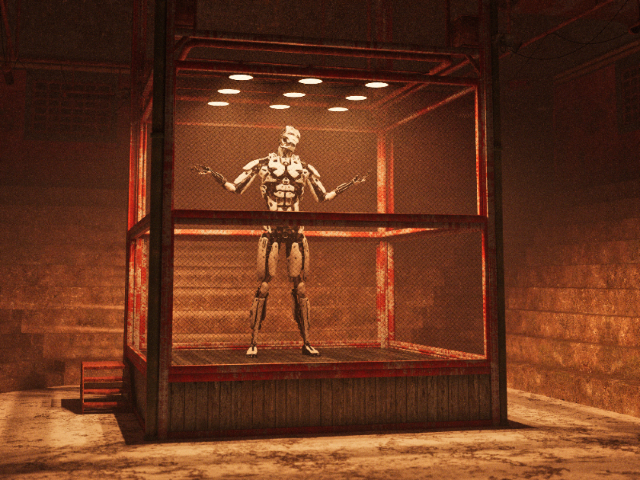
A content creator stepped into a cage with a six-foot robot—and got kicked to the floor within seconds.
Frankie Lapenna fought three robots in a series of matches organized by REK, a company that stages fights between remote-controlled machines. The bouts mark what could be the future of combat sports—or at least the wildest viral stunt of the year. As humanoid robotics technology advances rapidly and becomes more accessible to both companies and consumers, the prospect of humans physically competing against machines has shifted from science fiction to reality, raising questions about safety, entertainment value, and the limits of what should be attempted in the name of spectacle.
Combat sports have long pushed boundaries, from the early days of no-holds-barred fighting to the rise of mixed martial arts as a mainstream phenomenon. But pitting flesh and bone against metal and servos represents an entirely new frontier, one that blurs the line between athletic competition and technological demonstration. The fight comes at a time when robotics companies are racing to develop increasingly capable humanoid machines, with applications ranging from industrial work to military use.
Before Lapenna faced the largest robot, the announcer told the crowd, “For the first time in history, a human faces off against a six-foot-tall robot.” His coach was less thrilled. “I’m scared for you, man,” he said.
Video from the fight shows Lapenna throwing several punches before the robot lands a brutal kick, sending him to the floor. The stark difference between human reflexes and mechanical precision was immediately apparent, highlighting both the raw power these machines can generate and the vulnerability of human opponents facing them.
“For the first time in history, a human faces off against a six-foot-tall robot.”
The clip cuts off there, but REK CEO Cix Liv told the Daily Mail that Lapenna recovered, knocked the machine off balance, and managed to “rip its head off.” The outcome suggests that while robots may have advantages in strength and durability, they still have vulnerabilities that a determined human fighter can exploit, particularly in terms of balance and structural weak points.
Liv said Lapenna reached out to REK about two months earlier and initially wanted to fight without protective equipment. The company insisted he wear it. The initial request underscores both the content creator’s willingness to take risks for viral attention and the potential for serious injury that such an encounter poses. After seeing what the robot could do, Lapenna asked for more protection, Liv said. He ended up fighting in motorcycle gear and gloves designed to protect his hands. The evolution of his safety requirements throughout the planning process reveals that even those eager to take on such a challenge may underestimate the capabilities of modern robotics until confronted with them directly.
Lapenna first faced a smaller Unitree G1, then fought two modified ENGINEAI T800 robots, each about six feet tall. The progression from smaller to larger opponents mirrors traditional combat sports training, though the stakes and unpredictability differ significantly when the opponent operates on algorithms rather than instinct. REK says the larger machines can kick with 850 pounds of force. To put that in perspective, professional heavyweight boxers typically punch with around 1,300 pounds of force, but kicks from trained martial artists generally range from 600 to 1,000 pounds—meaning these robots are operating at levels comparable to elite human athletes, with none of the fatigue or hesitation that comes with biological systems. Lapenna injured his hand punching one of them but was otherwise unharmed, according to Liv. The hand injury illustrates the fundamental challenge of human-versus-robot combat: hitting metal and mechanical components carries inherent risks that don’t exist when fighting another person.
REK has yet to release the result of Lapenna’s final fight. Liv said the company had planned the human-versus-robot match as a one-time stunt, but it may hold another after hearing from people who want to try it. The apparent demand suggests a public appetite for this type of spectacle, though it also raises ethical questions about organizing events where human participants face significant injury risk from machines specifically designed to deliver powerful strikes.
“We’ll have to do it again,” he said.
The video drew jokes online as X users imagined what it would be like to face a robot of their own. The humorous reactions reflect both fascination with the technological achievement and a cultural processing of anxiety about increasingly capable machines, packaged in the relatively safe context of internet comedy.
Amateur fighter takes on humanoid robot in historic caged showdown https://t.co/yRMJ55LWdV pic.twitter.com/fH3n79wNzJ
— New York Post (@nypost) September 22, 2026
My Tesla Optimus robot after I’m late on 3 payments.
— Anton Rubaclini (@AntonRubaclini) September 22, 2026