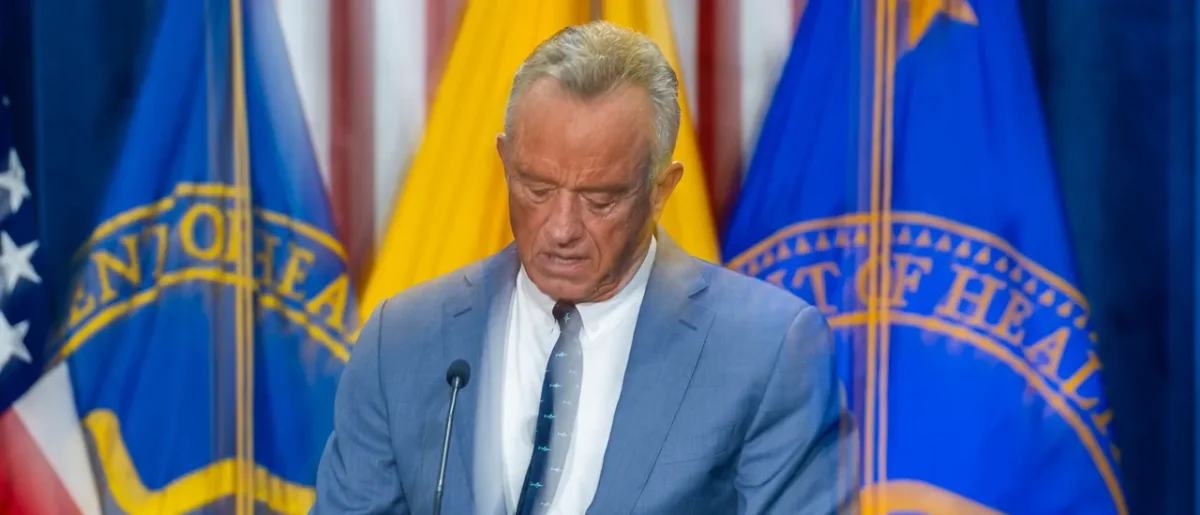
Health and Human Services Secretary Robert F. Kennedy Jr. posted a scorching criticism of Qatar, the Muslim Brotherhood, and anti-Israel propaganda on Wednesday — then deleted it within hours.
The incident, which unfolded on social media in real time, offers yet another case study in how cabinet-level officials navigate the treacherous intersection of personal opinion and public responsibility in an era where every post can become a geopolitical flashpoint. It also underscores the unique challenges facing an administration figure whose portfolio has nothing to do with foreign policy but whose public platform inevitably draws him into polarizing debates far outside his official purview.
The deleted post, captured in a screenshot by pro-Israel influencer Eitan Fischberger, showed RFK responding to someone named “John” with a forceful defense of Israel and a rebuke of what he called a “Qatari-funded global propaganda campaign.”
“The Muslim Brotherhood’s Qatari-funded global propaganda campaign makes Joseph Goebbels look like a piker. The Genocide charge against Israel is laughable on its face, but it is an effective permission structure for antisemitism.”
RFK’s post continued: “Most of the Westerners who parrot this charge are useful idiots deluded by this psyops campaign that hates Jews, Christians, Israel and the USA pretty equally.”
The language was characteristically blunt for Kennedy, who has built a political identity around unfiltered rhetoric and challenging establishment narratives. But in this case, the establishment he serves — the federal government — has carefully calibrated diplomatic relationships that don’t always align with off-the-cuff social media commentary, particularly when it involves sensitive geopolitical partners and adversaries in the Middle East.
The screenshot was posted by Fischberger, a former member of the Israel Defense Forces, who later added an update claiming “Qatar clearly made some angry phone calls.”
But the truth is likely far simpler.
Any cabinet secretary wading into Middle East politics on social media is stepping into a firestorm. RFK’s post drew immediate backlash from online users — and as HHS secretary, a position with zero foreign policy responsibilities, his team likely decided the controversy wasn’t worth the headache.
The deletion highlights the increasingly blurred lines between personal expression and official position for high-ranking government officials in the social media age. What might have been an off-hand remark at a dinner party in a previous era now becomes an international incident when posted to millions of followers. The pressure to walk back such statements doesn’t necessarily come from shadowy foreign influence, but from the much more mundane calculus of political damage control and interagency coordination.
The “phone call” narrative — the idea that a foreign government or lobby pressured RFK to delete the post — is a common online trope. It gets invoked whenever a prominent figure says something strong about Israel, Palestine, Qatar, or the broader Middle East.
This reflexive conspiracy thinking has become a predictable feature of Middle East discourse online, where every reversal, retraction, or deletion is interpreted through the lens of backroom pressure campaigns. The reality is almost always more prosaic: social media managers, communications directors, and White House liaisons stepping in to prevent a cabinet secretary from creating diplomatic headaches that other departments will have to clean up.
But no, Qatar’s emir Tamim bin Hamad Al Thani didn’t personally call RFK and demand he scrub the post. What happened is what always happens: a largely anonymous online swarm descended, the replies piled up, and the staffers behind the account hit delete to avoid a bigger PR crisis.
The episode also reveals the particular vulnerability of officials like Kennedy, whose confirmation was contentious and whose every move is scrutinized by both supporters hoping he’ll shake up the status quo and critics waiting for any misstep. A prolonged controversy over Middle East politics — an area completely outside his jurisdiction — serves neither his policy agenda nor his political standing within an administration that must balance competing domestic and international priorities.
Had RFK slammed Israel instead, the pro-Israel crowd would have been livid, forcing the same outcome. And the Israel critics would have said, “Ah, he must have gotten the phone call from Bibi.”
It’s not a conspiracy. It’s the reality of speaking out on the Middle East in 2026 — especially when you’re a cabinet secretary whose job is health policy, not foreign affairs.
The symmetry is telling: no matter which side of this debate a public figure takes, the opposing camp will immediately assume external pressure forced any subsequent backtracking. This mirror-image paranoia speaks to how deeply polarized and how inherently volatile Middle East discussions have become in American public discourse, where trust is so eroded that simple political calculation is routinely mistaken for sinister manipulation.
Update: RFK Jr. just deleted the post.
Qatar clearly made some angry phone calls https://t.co/DrbAOx82Tg pic.twitter.com/kvKINEBB9a— Eitan Fischberger (@EFischberger) October 7, 2026