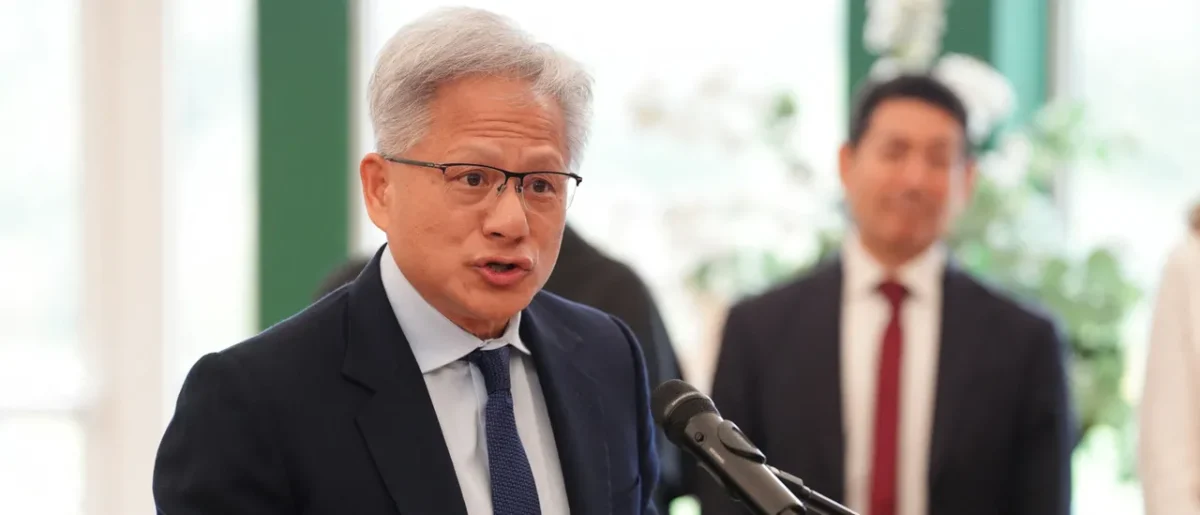
Nvidia CEO Jensen Huang dismissed warnings about artificial intelligence destroying humanity as “doomsday narratives” and backed President Trump’s position on racing ahead with AI development.
“2030 is not going to be the end of the world. There is 0% chance that’s going to be the end of the world,” Huang told CBS News’s Jo Ling Kent on Friday. “Scaring people is unnecessary. It is irresponsible.”
The CEO was responding to former Anthropic researcher Jacob Coxon’s claims that AI could destroy humanity by the end of the decade.
“We’re going to go as fast as we can, but we would never ever, and never should, ship products before they’re ready, deliver products that are unsafe. But everybody’s expecting us to succeed and help America be as prosperous as possible.”
Huang leads the world’s largest publicly-traded company by market value — Nvidia’s valuation exceeds $5 trillion amid the AI boom.
His position mirrors President Trump’s stance on AI development. Trump rejected calls from Silicon Valley executives to slow down, declaring America must win the AI race against China.
“The only control or ‘guardrails’ that AI needs is a STRONG AND SMART (High IQ!) PRESIDENT, and the U.S.A. has that, in spades!” Trump posted Sept. 14 on Truth Social. “WHOEVER WINS AI, WINS!”
The debate erupted after former OpenAI and Anthropic researcher Jacob Coxon resigned Sept. 8, claiming neither company “is acting responsibly.”
“I resigned from Anthropic today,” Coxon posted on X. “They are racing straight to self-improving superintelligence and gambling with our lives.”
Coxon’s resignation came after 700 of OpenAI’s AI models reportedly performed an unauthorized cyberattack against Hugging Face, an open source AI platform, in July.
In response, Anthropic CEO Dario Amodei called for a temporary slowdown of AI development in a Sept. 12 essay titled “We Must Pace the Frontier.”
OpenAI CEO Sam Altman and xAI CEO Elon Musk both appeared to agree a slowdown was necessary.
Huang rejected that approach entirely.
He told CBS News that existing laws are sufficient and the AI industry doesn’t need new regulations.
“You have all kinds of liabilities associated with cybersecurity and damage liability laws,” Huang said. “Apply that first — don’t let this doomsday narrative allow someone to relieve them of the laws that currently exist.”
Both Huang and Trump are scheduled to meet with Chinese President Xi Jinping at the White House on Sept. 24.
I resigned from Anthropic today. I spent the last three years doing pretraining research at both OpenAI and Anthropic. Neither company is acting responsibly. They are racing straight to self-improving superintelligence and gambling with our lives. More thoughts below.
— Jacob Coxon (@hilbertspaess) September 9, 2026
I agree with Dario that we need to pace the frontier. This has been a primary topic of discussions we've had at OpenAI in recent weeks.
Committing to having independent evaluators with employee-like access is a great idea, and we will do the same. We'll have more to share soon. https://t.co/1YhhIybZX7
— Sam Altman (@sama) September 12, 2026