
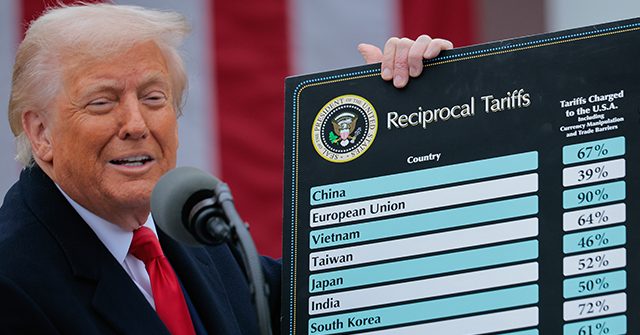
Manufacturing productivity surged in the first quarter of 2026 at an annualized rate of 3.2 percent — with durable goods manufacturing jumping 5.5 percent — even as President Donald Trump imposed the highest tariffs in over half a century.
The data from the Bureau of Labor Statistics delivered a death blow to decades of economic orthodoxy claiming tariffs damage productivity and make nations poorer.
For years, economists and their media allies insisted tariffs reduce efficiency by disrupting the “optimal” global allocation of resources. The Yale Budget Lab typified this view, declaring that tariffs “reduce productivity and thereby real U.S. income (even when including tariff revenue) by reducing the efficiency of resource allocation across countries.”
The record tells a different story.
Manufacturing productivity grew at 2.6 percent annually from 1949 to 1987, then accelerated during the Reagan reforms and dot-com boom. But from 2007 through 2019 — the era of low tariffs, free-trade deals, and the China shock — manufacturing productivity growth collapsed to just 0.1 percent per year. Real factory output actually fell 0.6 percent annually.
“The case that tariffs necessarily make American manufacturing less productive died this week.”
Last year, as Trump’s tariffs took effect, manufacturing productivity rose 1.8 percent. Durable goods productivity climbed 2.6 percent. The first quarter of 2026 brought the 3.2 percent surge — hardly the efficiency catastrophe the experts predicted.
The central error in the anti-tariff folklore was hiding in the baseline assumption. Tariff modelers assumed the pre-Trump allocation of global production was efficient — treating China’s subsidies, forced technology transfers, state-directed lending, and export mercantilism as background noise rather than active distortions.
That assumption did nearly all the work. Once removed, the orthodox conclusion no longer follows. A tariff imposed against a distorted global production system is not automatically a move away from efficiency.
The mythology also ignored that Trump’s trade policies solved a coordination problem, allowing U.S. companies to invest in domestic production without fear of being undercut by offshoring rivals. It refused to acknowledge the difference between 19th-century tariffs in an economy with mass immigration and rising labor supply versus 21st-century tariffs in an economy where capital investment drives output growth.
For decades, the folklore claimed free trade dispersed benefits while tariffs only helped protected special interests. But public choice theory offered the real answer: the decline of tariffs actually benefited special interests while the costs of globalization were dispersed. The global trading system had been moving toward trade managed in foreign capitals — Beijing, Berlin, and beyond — for the benefit of interests that controlled those governments.
The immunity to argument and evidence was astonishing. When critics pointed out that much of the world practiced optimal tariff theory against the U.S. — imposing barriers while American policymakers supplied the non-retaliation — the experts let myth prevail over fact.
Many economists will cling to their long-held catechisms, insisting the long-term effects will match their predictions. But for any fair-minded observer, the evidence is clear.
American factories are producing more, and American manufacturing workers are becoming more productive amid the highest tariffs in the modern American economy.