
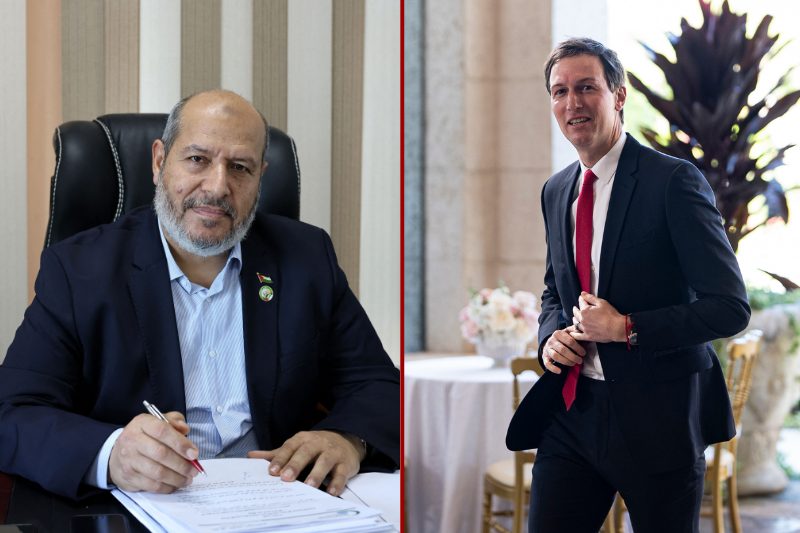
Jared Kushner met face-to-face with Hamas political leader Khalil al-Hayya in Cairo Sunday, pressing the terror group to follow through on its promise to disarm Gaza under President Trump’s historic peace agreement.
The 90-minute meeting was described as “very productive” by a diplomatic source with direct knowledge of the talks.
Kushner sat down with al-Hayya alongside Egyptian, Qatari, and Turkish mediators to hammer out the next phase of Trump’s International Board of Peace plan — the complete demilitarization of Hamas and all militant groups in Gaza.
The inclusion of these three regional powers reflects the diplomatic architecture that has underpinned Middle East peace efforts for years. Egypt has long served as a mediator between Israel and Palestinian factions due to its shared border with Gaza and its 1979 peace treaty with Israel. Qatar has maintained communication channels with Hamas leadership, while Turkey has positioned itself as a key Muslim-majority nation with influence across the region. The presence of all three suggests a coordinated regional approach to implementation.
Hamas leaders reaffirmed their commitment to disarm and thanked the Trump administration for humanitarian efforts in Gaza, according to reporting from Axios. Kushner thanked Hamas for cooperating in the recovery of bodies of deceased Israeli hostages.
“Kushner stressed to Hamas leaders that the bar is high because the Israeli side doesn’t trust them to actually disarm. Kushner told them there is no room for negotiations on the disarmament, but if they show real steps the U.S. will do its best to make sure Israel takes steps of its own.”
This trust deficit represents one of the most significant obstacles to implementation. Decades of conflict between Israel and Hamas, designated as a terrorist organization by the United States, European Union, and Israel, have created deep skepticism on both sides about whether commitments will be honored. The emphasis on “real steps” rather than promises alone signals a verification-based approach to the disarmament process.
The talks focused on actionable steps: maintaining the ceasefire between Israel and Gaza, withdrawing Israeli forces, establishing an international stabilizing force, and transferring governing control to the National Committee for the Administration of Gaza — a Palestinian technocratic body designed to ensure Hamas has no role in Gaza’s future.
The creation of a technocratic governing body represents a significant political restructuring for Gaza, which Hamas has controlled since 2007. The National Committee model aims to separate governance from militant operations, a distinction that has been blurred under Hamas rule. The success of this transition will depend heavily on whether the international community can provide sufficient support and legitimacy to the new governing structure.
Hamas raised concerns about continued Israeli strikes in Gaza. Kushner reportedly pushed back hard, telling them “it took them four months to agree to disarm.”
This marked Kushner’s first sit-down with Hamas leaders since the Gaza disarmament agreement was reached in October.
The four-month gap between the October agreement and this implementation meeting underscores the complexity of moving from diplomatic commitments to concrete action on the ground. Direct face-to-face engagement, particularly between U.S. officials and Hamas representatives, has historically been rare given the group’s designation as a terrorist organization.
Board of Peace high representatives Nickolay Mladenov and former British Prime Minister Tony Blair attended the meeting, along with senior advisers Aryeh Lightstone and Liran Tancman.
Mladenov brings extensive experience as a former United Nations special coordinator for the Middle East peace process, while Blair has worked on Middle East diplomacy since leaving office in 2007. Their involvement adds international diplomatic weight to the negotiations and provides continuity with previous peace efforts in the region.
The meeting follows Trump’s late-July announcement that the Board of Peace had secured an agreement for the complete disarmament of Hamas and all other militant groups in the region.
“This agreement is a critical step towards Gaza finally being governed by a new Palestinian government that will work closely with the Board of Peace to help the Palestinian people. This is a major milestone in the implementation of the Trump 20-Point Plan. The agreement will be carried out in carefully structured phases. As disarmament is completed, Israeli forces will withdraw, and the International Stabilization Force will work with a new Palestinian police force to take responsibility for Gaza being safe for its residents and its neighbors.”
The phased approach outlined in Trump’s statement reflects lessons learned from previous Middle East peace processes, where simultaneous demands often created implementation deadlocks. By sequencing disarmament, Israeli withdrawal, and the deployment of international forces, the plan attempts to build confidence through incremental, verifiable steps rather than requiring all parties to act simultaneously on trust alone.
Kushner and Mladenov are scheduled to meet with Israeli Prime Minister Benjamin Netanyahu in Israel on Monday.
This follow-up meeting will be critical for ensuring Israeli buy-in on the implementation timeline and addressing any security concerns that may have emerged from the Hamas discussions. The sequencing of meetings — Hamas first, then Netanyahu — suggests a deliberative approach to managing the expectations and concerns of both parties.