Iran’s regime is threatening President Donald Trump after he posted a map declaring the Strait of Hormuz “New U.S. Territory” — sparking fury from Tehran and exposing the mullahs’ weakness as Trump tightens the noose.
Trump posted the map to Truth Social without comment Tuesday, doubling down on a claim he first floated last week.
“I mean we control it,” Trump told reporters in the Oval Office. “We control it with the blockade, and I like the idea of declaring it a territory.”
“I mean we control it. We control it with the blockade, and I like the idea of declaring it a territory.”
Iranian Deputy Foreign Minister Kazem Gharibabadi responded directly to Trump’s map, warning that Tehran would correct what he called the president’s “delusion.”
“Just as Trump correctly referred to the Persian Gulf by its proper name, his delusion about the Strait of Hormuz will soon either be dispelled, or we will set this deluded man straight,” Gharibabadi wrote on X.
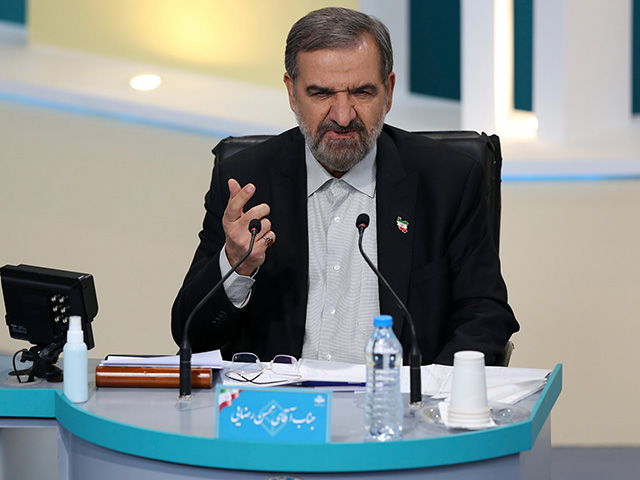
Mohsen Rezaei, the newly appointed secretary of Iran’s Supreme National Security Council and a former Islamic Revolutionary Guard Corps commander, followed with a taunt of his own, posting an image depicting the roughly 7,000-mile distance between Washington and Hormuz beneath the words, “Some Dreams Are Too Far From Reality.”
“Welcome to the post-American order in the Persian Gulf,” Rezaei added.
That’s the kind of bravado dictators use when they’re losing.
Trump separately announced Tuesday that no negotiations are currently underway or scheduled with Tehran, a day after disclosing that his administration had maintained backchannel contacts with IRGC officials.
“There are no talks or conversations going on, or scheduled, with the Islamic Republic of Iran,” Trump wrote. “The Naval Blockade remains in full force and effect. The Hormuz Strait is open and operating. All water mines have been removed or detonated.”
Special Envoy Jared Kushner revealed Monday that contacts between Washington and different elements of the Iranian government had become unusually extensive, while offering a more pessimistic assessment of whether those discussions were producing a deal.
“The conversations between the U.S. government and different areas of the Iranian government … [are] probably more robust than it’s maybe ever been,” Kushner told Fox News.
But Kushner said Iran was “not showing any interest” in reaching an agreement acceptable to Washington.
“They have to be willing to make a real deal,” he said, warning that Tehran could not expect to “play a trick” to extract concessions from the United States.
Iranian Parliament Speaker Mohammad Bagher Ghalibaf, Tehran’s top negotiator, meanwhile reiterated Tuesday that Iran would continue restricting the strategic waterway until Washington meets a series of conditions Tehran says are required under the June memorandum of understanding, which subsequently unraveled amid renewed Iranian attacks and exchanges of strikes.
“I want to state clearly that the Strait of Hormuz will not be opened until the American commitments stipulated in the memorandum of understanding … are implemented,” Ghalibaf said.
Those demands include lifting the U.S. naval blockade, releasing frozen Iranian assets, removing sanctions on Iranian oil and ending U.S. military operations and threats.
“Americans think squeezing Iran harder will win concessions that were never part of the agreement. Bessent and Hegseth are way out of their league.”
Ghalibaf later turned his fire directly on the Trump administration’s efforts to force additional concessions from Tehran through mounting economic pressure, singling out Treasury Secretary Scott Bessent and War Secretary Pete Hegseth.
“Americans think squeezing Iran harder will win concessions that were never part of the agreement,” Ghalibaf wrote on X. “Bessent and Hegseth are way out of their league.”
The Iranian negotiator then mocked the administration more broadly.
“Stop waiting for the clown crew to pull a rabbit out of their hat and clean up the mess you made,” he added.
The regime’s desperation is showing.
The attacks come as the Trump administration continues ratcheting up economic pressure on the Iranian regime, with Bessent warning last week that Washington is preparing measures unlike anything previously imposed on an isolated country.
“We went from Epic Fury to Economic Fury,” Bessent said last week.
“At the president’s orders, we have raised the level even again,” he added, describing a “one-two punch” combining economic isolation with the continuing U.S. naval blockade.
“It will be a combination of economic isolation like the world has never seen before and the continued blockade in the Strait of Hormuz that will keep anything from going in or out of the Iranian ports,” Bessent said.
Mohammad Mokhber, an adviser to Supreme Leader Mojtaba Khamenei, also joined Tehran’s effort to challenge Trump’s assertion of American control Tuesday, insisting that passage through Hormuz remained dependent on Iran.
“Except through the Islamic Republic’s measures and plans, there is no possibility of using the Strait of Hormuz,” Mokhber said. “The situation Trump is creating will cause problems for the whole world.”
The escalating threats from Tehran came alongside renewed Iranian military activity in the Gulf, with the United Arab Emirates announcing Tuesday that two ballistic missiles had been launched from Iran toward the country — the first such attack reported by the UAE in months.
Emirati authorities activated missile warnings across the country before announcing that one missile had fallen outside UAE territorial waters and another within them. No casualties or damage were reported.
The UAE responded hours later by suspending all trade, commercial exchanges, and financial transactions with Iran “until further notice,” sharply escalating the economic fallout from the incident.
The incident followed weeks of attacks on commercial vessels in and around Hormuz, including multiple ships affiliated with the UAE’s state-owned ADNOC, while a vessel transiting the strait Tuesday was struck by an unidentified projectile that damaged its engine room and caused a crew casualty.
The renewed activity comes after a senior Iranian official told Reuters that Tehran was prepared to shift to a “fully offensive” posture if diplomatic efforts failed, as the 60-day negotiating period established under the June memorandum expired Monday without a final agreement.
The confrontation over Hormuz has increasingly become a test of Washington’s campaign to force Iran to relinquish its grip on the strategic waterway.
Trump maintains the United States now controls the strait and has successfully cleared its mines, while Iranian officials continue to threaten shipping and insist Tehran will restrict passage until Washington meets its demands.
Although publicly tracked commercial traffic remains substantially below levels seen before the conflict, Energy Secretary Chris Wright said Monday that ship-tracking data significantly understates actual traffic because vessels have been switching off their transponders while passing through the conflict zone.
Wright said roughly 30 ships crossed Hormuz on Sunday and that “millions” of barrels of oil are moving through the waterway each day, pointing to U.S. military escorts of commercial vessels as evidence of Washington’s control.
The dispute has also placed Oman, which borders the strait opposite Iran and has long served as an intermediary between Washington and Tehran, at the center of the confrontation.
The Wall Street Journal reported Monday that the Trump administration has grown concerned that an emerging Iran-Oman arrangement could leave Tehran with greater control over Hormuz, while some administration officials believe Muscat has tilted too far toward the Iranian regime.
Trump warned Monday that if Oman interfered with U.S. efforts to secure an agreement, “we’ll bomb the shit out of them.”
Iranian state media joined the rhetorical attacks Tuesday, with the Tehran Times previewing its Wednesday front page featuring Trump’s “New U.S. Territory” map beneath the headline, “New U.S. Bone Spur.”
Patriots already know how Trump handles regimes that threaten America — he doesn’t back down.
— The White House (@WhiteHouse) August 18, 2026
Iranian Deputy Foreign Minister Kazem Gharibabadi:
Just as Trump correctly wrote the name of the eternal Persian Gulf, soon his delusion regarding the Strait of Hormuz will either be corrected or we will correct the delusions of this deluded man. pic.twitter.com/Yppogffh2i
— Clash Report (@clashreport) August 18, 2026