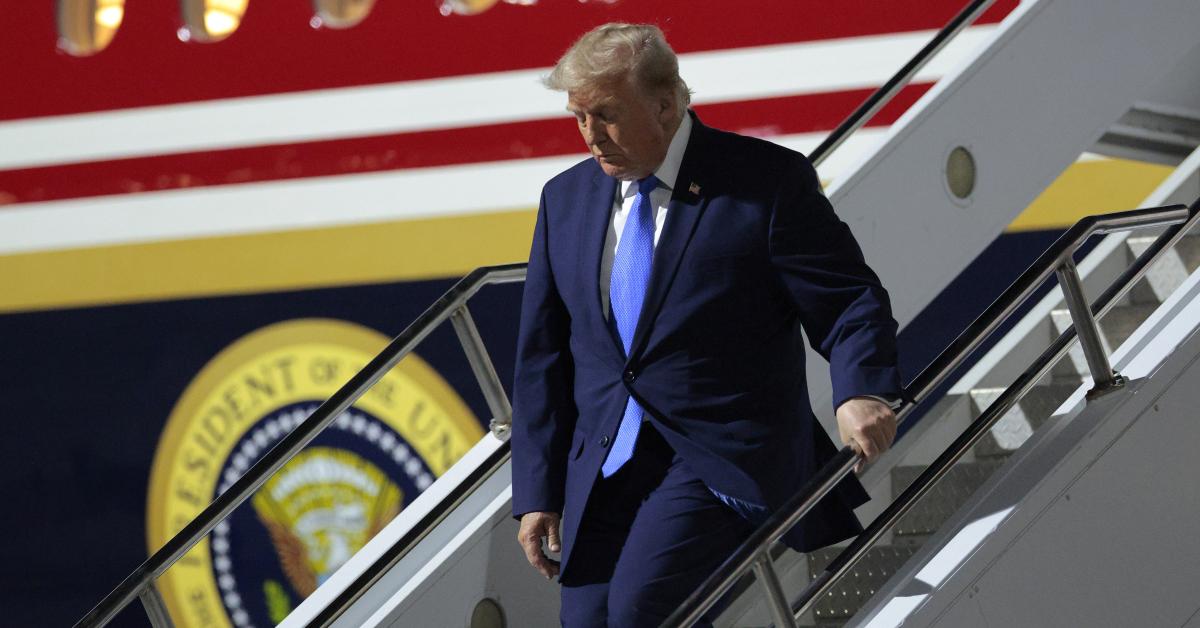
President Donald Trump secretly departed from Turkey last month on a military plane, not Air Force One, that he boarded while hidden inside a catering truck to avoid a purported Iranian death threat.
The maneuver reveals the extraordinary lengths security officials took to protect the president amid his ongoing confrontation with Iran — a war Trump launched in late February that has put him squarely in the crosshairs of the regime. Presidential security measures of this magnitude are exceptionally rare and typically reserved for the most severe threat scenarios. The level of operational complexity involved in the departure suggests intelligence agencies had specific, actionable information about potential threats to the president’s life during the Turkey visit.
Trump flew to Turkey for a NATO summit on a plane given to him by Qatar and meant to be used as Air Force One. While on the trip, officials announced Trump would depart Turkey in an older presidential plane because of security concerns — apparently as part of a larger deception plan to throw off potential Iranian operatives. The public announcement itself was likely a deliberate misdirection, designed to focus attention on one aircraft while preparations were being made for an entirely different departure scenario. Such multi-layered deception tactics reflect the challenge of protecting a president in an era when adversaries have access to sophisticated surveillance technology and global networks of operatives.
After boarding the older aircraft, Trump secretly got off via the catering vehicle and moved to a smaller Air Force C-32A. The use of a catering truck as a covert transfer vehicle is particularly notable, as these service vehicles routinely access aircraft without drawing scrutiny at international airports. This allowed the president to move between planes on the tarmac while remaining completely hidden from view, including from potential surveillance by hostile intelligence services or operatives positioned near the airport.
The Qatari-gifted plane, the older aircraft used as Air Force One, and the C-32A then departed for the United Kingdom, where Trump boarded the Qatari-gifted plane for home. The coordination required to launch three presidential-class aircraft simultaneously from a foreign airport represents a logistical challenge of the highest order, requiring cooperation from Turkish aviation authorities, NATO security personnel, and multiple U.S. military and Secret Service units.
Three presidential aircraft departed Turkey simultaneously — a shell game designed to confuse anyone tracking Trump’s movements.
The Washington Post first reported the plane switch.
The elaborate ruse underscores the seriousness of the Iranian threat against Trump. The regime has vowed revenge for Trump’s military actions against Tehran, and U.S. intelligence officials have warned of credible assassination plots targeting the president. Iran has a documented history of pursuing long-term retaliation against those it perceives as enemies, with intelligence agencies tracking Tehran-linked plots across multiple continents. The regime’s willingness to conduct operations on foreign soil, combined with its stated desire for revenge, created what security officials clearly assessed as an unacceptable risk to presidential safety.
Trump’s use of the Qatari-gifted plane as the new Air Force One has itself been a point of interest. The aircraft was provided by Qatar and is now serving as the primary presidential transport, replacing the aging Boeing VC-25As that have served as Air Force One for decades. The transition to a foreign-provided aircraft for presidential transport represents a significant shift in how the United States approaches executive security and diplomatic relationships with Gulf allies.
Security officials declined to comment on specific protective measures for the president. The catering-truck maneuver and multi-plane departure strategy represent some of the most elaborate presidential security tactics disclosed in recent years. That such details became public at all suggests either a deliberate decision to signal American security capabilities to adversaries or an unusual breach in the typically airtight operational security surrounding presidential movements.
The Iran threat has loomed over Trump’s presidency since he ordered strikes against Iranian military targets in February. The regime’s Supreme Leader has publicly called for retaliation, and U.S. counterintelligence agencies have disrupted multiple plots against Trump and his family. The ongoing nature of the threat means security protocols for the president are likely to remain at heightened levels for the foreseeable future, complicating international travel and potentially affecting diplomatic engagement.
Trump returned safely to the United States after the NATO summit. The full details of the security operation remain classified. The successful execution of such a complex security operation demonstrates the capability of U.S. protective services to adapt to evolving threats, even in challenging overseas environments where American agencies must coordinate with foreign authorities while maintaining operational secrecy.