
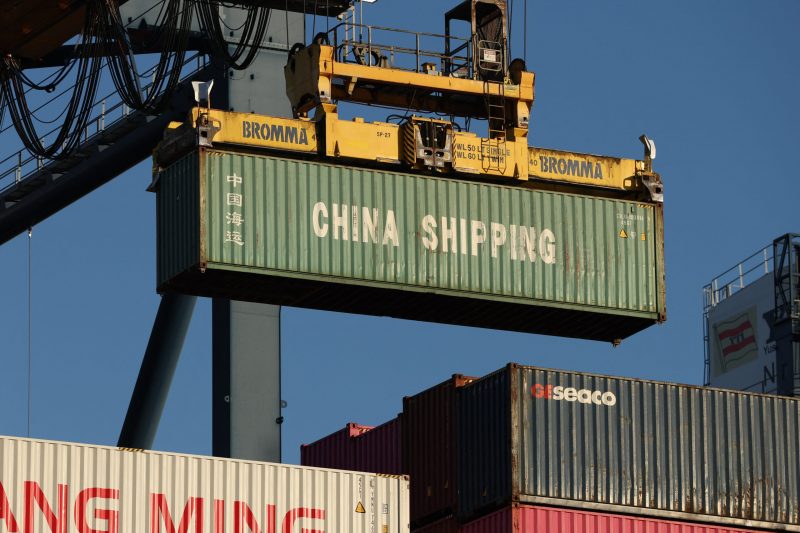
A Chinese state-owned company manufactures 80 percent of the ship-to-shore cranes operating at American ports — from Los Angeles and Long Beach to Houston, Miami, Norfolk, and Baltimore.
That’s not a supply chain. That’s a strategic vulnerability.
Shanghai Zhenhua Heavy Industries, known as ZPMC, doesn’t just sell America port equipment. Congressional investigators found unauthorized cellular modems on ZPMC cranes and reported the company sought remote access to equipment operating at U.S. ports. The Coast Guard hasn’t observed active malicious cyber activity yet — but it warned the cranes’ communications capabilities create potential avenues for unauthorized access and disruption.
The ports aren’t the only chokepoint. DJI, another Chinese company, controls more than 90 percent of the American commercial drone market. Its products are used by police departments and law enforcement agencies across American cities and rural counties. China also accounts for more than 70 percent of global rare-earth extraction and about 87 percent of processing — materials used throughout the modern economy, including in defense applications.
For decades, America opened its doors wide to Chinese companies. American corporations moved manufacturing and distribution to China, attracted by lower costs and a huge new market. The assumption was simple: China would gain access to American consumers, and American companies would gain access to a massive China market. Both nations would prosper through mutual trade and economic cooperation.
That didn’t happen.
Even after a year of the steepest tariffs since the 1930s, America still bought $200 billion more from China than it sold there.
“The United States is no longer willing to treat every commercial relationship with China as ordinary business.”
China made industrial policy a national priority. Made in China 2025 wasn’t a slogan — it identified industries Beijing considered important and directed government resources toward building Chinese strength in them. A 2025 report from the U.S.-China Economic and Security Review Commission found China met or exceeded many of the ambitious goals it set a decade earlier.
Chinese companies received extraordinary access to the U.S. marketplace while American companies often encountered a much different system in China. The Office of the U.S. Trade Representative has repeatedly documented Chinese market barriers and state-directed practices that favor domestic companies.
The Department of Defense now identifies Chinese companies with reported links to China’s military-civil fusion strategy. The FCC has acted as well — its Covered List includes equipment involving Huawei and ZTE, along with specified equipment involving Hytera, Hikvision, and Dahua. Congress and the Commission have tied those restrictions to national security concerns.
The Trump Administration seems to understand the difference between enablement and enforcement when it comes to regulation of Chinese companies. These long-overdue actions were not vigorously advanced by previous administrations — Democratic and Republican alike — and are now being embraced by many U.S. companies.
The debate today isn’t just about products — it’s also about data and national security. Artificial intelligence may prove to be the most consequential issue of all because it reaches far beyond the sale of another Chinese product in America. A drone can take photographs and map terrain. A connected car can collect location data and communicate outside the vehicle. Telecommunications equipment sits inside networks through which enormous amounts of information move.
At some point, reciprocity has to mean something. If Chinese companies want full access to American consumers, American companies should be able to compete in China on reasonable terms.
Chinese companies that play by American rules and present no legitimate security problem should be able to compete. But access to America cannot remain an entitlement while American businesses face unequal treatment abroad.
The policy shift is clear: Not closed access. Earned access.
Who owns the company? What obligations does it have under Chinese law? Does it receive state support? Where does information collected in America go? Can technology developed for ordinary commercial purposes be used in other ways?
Answering these questions should be the price of doing business in strategically important American markets. Chinese companies remain welcome in America, but access to the American market is not an entitlement. It carries obligations: transparency, reciprocity, compliance with American law, and respect for American security interests.
For too long, Washington confused openness with passivity and commerce with innocence. That era is ending. America doesn’t need to close its doors to China.
It does need to guard them.