
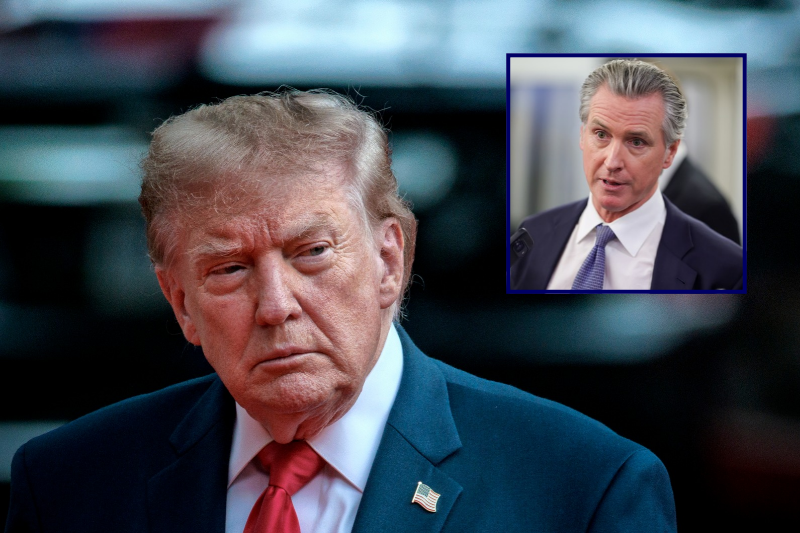
President Donald Trump will meet Monday with families of crime victims who oppose California Governor Gavin Newsom’s commutation of all 548 inmates on the state’s death row — a decision Trump labeled a “disaster for justice in America.” The meeting marks a significant escalation in the ongoing debate between state and federal perspectives on capital punishment, and positions the White House directly against one of the nation’s most prominent Democratic governors on an issue that has divided Americans for decades.
The family of 12-year-old Polly Klaas, kidnapped and taken from her family in 1993, is expected to attend. Her accused attacker, Richard Allen Davis, was sentenced to death in 1996 but was among the 548 inmates granted life sentences earlier this month in Newsom’s final weeks as governor. The Klaas case remains one of the most emotionally resonant examples in discussions about capital punishment, particularly in California, where the crime shocked the state and galvanized a generation of victims’ rights activists.
“The president has the world’s largest bully pulpit. I hope he uses it to condemn Newsom’s mass commutations. I hope that he explains the dangers of bringing these dangerous people one step closer to being released from prison. I hope that he impresses upon the public the importance of public safety.”
Marc Klaas, Polly’s father, called Newsom “a pig” for pausing state executions in 2019. He described this month’s order as “a shiv in my back” and said, “The criminal justice system can turn on a whim.” The visceral language reflects the deep sense of betrayal felt by many victims’ families who have waited decades for sentences to be carried out, only to see executive action fundamentally alter the outcomes of their cases.
Newsom claimed he made the decision based on his “long and deeply held” personal convictions that capital punishment is amoral. The governor’s move comes as California has not executed an inmate since 2006, amid ongoing legal challenges and a de facto moratorium that predates his administration. California’s death penalty has been in a state of limbo for years, caught between voter support for capital punishment and practical obstacles to its implementation.
“I firmly believe that state-sanctioned killing is incompatible with California’s values,” Newsom said when issuing the order. “I know we cannot execute people in our imperfect legal system and remain true to our core values.” His statement reflects arguments long made by death penalty opponents, who point to cases of wrongful conviction and racial disparities in sentencing as fundamental flaws in the system.
The governor argued the order was “a righteous action” that makes California “stronger as a society.” Newsom’s decision effectively transforms sentences that juries and judges imposed over decades, raising questions about the balance of power between the judicial system and executive clemency authority.
White House spokeswoman Lauren Bis offered a sharp rebuke.
“Governor Newsom is failing these innocent victims and their families by refusing to carry out justice against these heinous offenders. He is playing politics with public safety. President Trump will always stand with innocent victims and will continue to restore law and order and deliver safer communities.”
Trump’s Monday event, according to a California Post report published Friday, will formally condemn Newsom’s mass commutation of death row sentences. The gathering is expected to amplify voices that have felt marginalized in recent criminal justice debates, which have increasingly focused on reform and rehabilitation rather than retribution.
Davis was convicted of the abduction and death of Polly Klaas, who was taken from her Petaluma home during a slumber party. The case drew national attention in 1993 and became a rallying point for victims’ rights advocates and death penalty supporters. The crime occurred during an era when concerns about violent crime dominated American politics and helped shape California’s approach to criminal sentencing for a generation.
The 548 commutations represent one of the largest single acts of clemency in U.S. history. All death row inmates in California now face life sentences without the possibility of parole. The scope of the action is unprecedented in modern American governance and effectively ends California’s use of capital punishment for the foreseeable future, regardless of what future governors or voters may decide about the death penalty in the abstract.
Trump declared Newsom’s decision over the weekend a “disaster for justice in America.” The statement signals the administration’s intent to make the California clemency decision a focal point in broader discussions about criminal justice policy and the role of progressive governance in matters of public safety.
Monday’s meeting will give families like the Klaas family a platform to share their opposition to the governor’s clemency order with the president — and the nation. For these families, the event represents a rare opportunity to have their perspectives heard at the highest levels of government, after feeling that their voices have been overshadowed by criminal justice reform movements and executive decisions made without their input.