
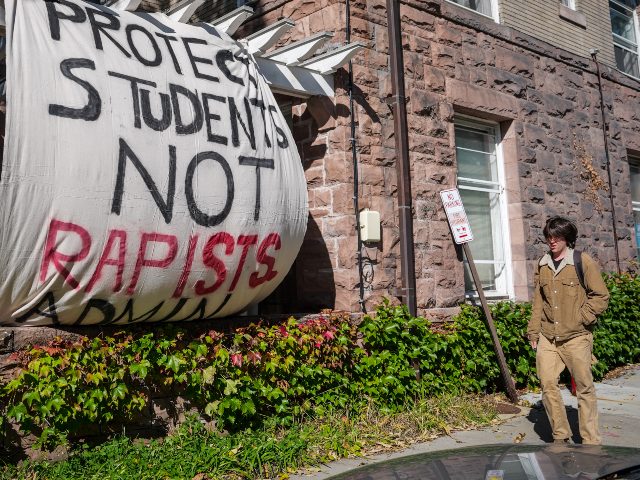
A text message appears to undermine the explosive gang-rape allegations against seven Cornell University fraternity brothers — raising questions about whether the accuser was actually incapacitated during the hours she now claims she was drugged and assaulted.
The case has drawn national attention not only for the severity of the allegations, but also for the unusual timeline and the high-profile political figures who have become involved. What began as a campus investigation that concluded with a finding of consensual activity has transformed into a criminal matter overseen by one of New York’s most politically prominent prosecutors.
According to Jane Doe’s civil lawsuit, the men gave her drugs and alcohol on the night of October 20, 2024, until she was too incapacitated to know they were assaulting her. But a newly released text message — timestamped at 3:05 a.m. on October 20, 2024 — shows the woman responding to her sorority sister during the very hours she now claims she was being raped.
“You coming home tn”?
“idk.”
Translation: Are you coming home tonight? I don’t know.
The brevity of the exchange belies its potential significance. In cases involving allegations of incapacitation, prosecutors and civil litigants typically must demonstrate that the alleged victim was unable to consent due to their mental or physical state. Evidence of lucid communication during the time period in question can complicate that narrative considerably, as it suggests a level of awareness and agency that may be inconsistent with claims of drug- or alcohol-induced helplessness.
The text raises a critical question: what kind of alleged rapist allows their victim to keep her phone and send text messages during an assault? Jane Doe has not alleged in her lawsuit that the men took away her phone or that someone else used it to text on her behalf.
Legal experts have noted that in authentic sexual assault cases where victims are severely incapacitated, perpetrators often do take steps to isolate victims from potential help or witnesses. The absence of any such allegations in this case adds another layer of complexity to the claims being made.
The message is the latest in a series of contemporaneous communications that appear to contradict Jane Doe’s allegations. According to previous reports, text messages from the days and weeks after the alleged incident show the woman describing the encounter approvingly as a “gang bang” and telling one of the men involved, “I really do love u.”
These post-incident communications have become a central point of contention. Defense attorneys in similar cases have long argued that messages sent in the immediate aftermath of an alleged assault provide the most reliable window into a complainant’s state of mind and understanding of events, before outside influences or social pressures can reshape memory or interpretation.
About two weeks after the event, Jane Doe gave a statement to Cornell campus police in which she agreed that everything that happened — including the drinking and drug use — was consensual. It wasn’t until two years later, just weeks before a midterm election, that she filed a high-profile civil suit accusing seven Chi Phi fraternity brothers of gang rape.
The extended delay between the initial police statement and the civil filing has become a focal point for skeptics of the allegations. While trauma experts acknowledge that delayed reporting is common in sexual assault cases, the specific fact pattern here — an initial statement affirming consent followed by allegations only after a significant time gap — presents an unusual set of circumstances that diverges from typical delayed disclosure scenarios.
Various reports claim additional text messages written by Jane Doe in the aftermath show a woman who showed up at a frat house after having a few drinks, agreed to a threesome, and then participated in hours of group sex. Witnesses told Cornell investigators Jane Doe consented to the encounter.
Then, according to the narrative supported by the texts, news of the event spread around campus and Jane Doe felt slut-shamed.
This dynamic — consensual activity followed by social stigma and reputational harm — has been documented in other campus cases, though it remains deeply controversial to discuss. The question of whether social consequences can influence subsequent characterizations of consensual encounters is one that challenges both advocates for accusers and those concerned with due process.
Gov. Kathy Hochul appointed New York Attorney General Letitia James as a special prosecutor on the case. James has a record of pursuing high-profile political targets — she brought civil fraud charges against Donald Trump despite him paying back his loans with interest. Whether she can manufacture a criminal indictment against the Cornell 7 with the evidence currently known remains to be seen.
The involvement of such a prominent political figure has intensified scrutiny of the case’s timing and motivation. James’s office has not publicly addressed the evidentiary challenges posed by the contemporaneous text messages or explained how prosecutors plan to reconcile Jane Doe’s initial statement to campus police with her later allegations.
From what the public knows now, though, the rape allegation appears increasingly difficult to sustain — and critics argue it may have been launched to interfere with the midterm elections.