
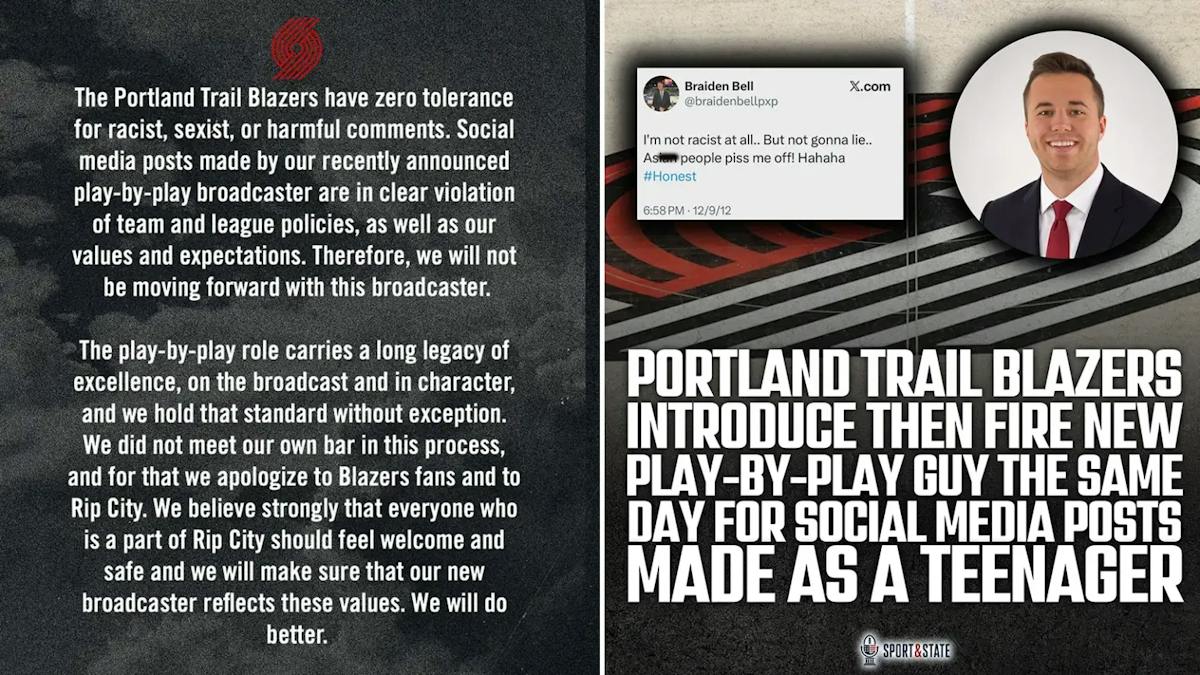
The Portland Trail Blazers hired 29-year-old Braiden Bell as their new television play-by-play announcer Thursday morning. By late afternoon, they’d fired him.
The reason? Tweets Bell posted when he was 15 years old.
Bell was set to replace longtime Blazers broadcaster Kevin Calabro and become the youngest play-by-play announcer in the NBA. But when old social media posts containing racist and misogynistic comments surfaced—posts from 2012 and 2013, when Bell was a high school sophomore—Portland immediately reversed course.
The reversal represents one of the most dramatic examples yet of how organizations handle resurfaced social media content from job candidates’ teenage years. It also raises questions about accountability, redemption, and whether professional consequences for adolescent behavior have gone too far in the age of permanent digital records.
“Bell wrote the offensive posts in 2012 and 2013, when he was a teenager.”
“The Portland Trail Blazers have zero tolerance for racist, sexist, or harmful comments,” the organization said in a statement. “Social media posts made by our recently announced play-by-play broadcaster are in clear violation of team and league policies, as well as our values and expectations. Therefore, we will not be moving forward with this broadcaster.”
— Portland Trail Blazers (@trailblazers) October 2, 2026
The timeline is particularly striking. The organization conducted what presumably was an extensive search process, including vetting candidates, reviewing their work, and conducting interviews. Bell emerged as their top choice from what was likely a competitive field. Yet within hours of the public announcement, that entire evaluation was rendered meaningless by content created when Bell was barely old enough to drive.
According to CBS Sports, KGW—the outlet that uncovered the posts—found no offensive content from Bell since he became an adult. From 2015 onward, his account reportedly became almost entirely sports-focused.
This detail is significant. It suggests a 14-year pattern of professional conduct and maturity—essentially Bell’s entire adult life—was insufficient to overcome statements made during his sophomore year of high school. The contrast between his teenage social media presence and his adult behavior appears stark, yet the organization gave no weight to that evolution.
The offending tweets included one from December 9, 2012: “I’m not racist at all.. But not gonna lie.. Asian people piss me off! Hahaha #Honest.”
Another from November 30, 2012 read: “Gotta give a shoutout to all the big girls out there and those closet w–res.”
Rude? Absolutely. Typical of a teenager with an undeveloped prefrontal cortex? Also yes.
Neuroscience has long established that adolescent brains are not fully developed, particularly the prefrontal cortex responsible for judgment, impulse control, and understanding long-term consequences. This biological reality is why the legal system treats minors differently than adults in nearly every context—from criminal prosecution to contract law. Yet that same principle apparently doesn’t apply when organizations face public pressure over digital footprints.
Sports commentator Clay Travis called out the absurdity.
We have to stop firing people for tweets sent when they were minors. If this guy had robbed a store as a minor, his juvenile record would be sealed forever. If we don’t hold people accountable for crimes as minors, holding people accountable for Tweets is beyond absurd. https://t.co/xb3xtWzkAP
— Clay Travis (@ClayTravis) October 2, 2026
The irony is hard to miss. A minor who commits an actual crime gets a sealed juvenile record. A minor who posts something stupid on Twitter gets his adult career torpedoed—14 years later.
The comparison to juvenile criminal records underscores a fundamental inconsistency in how society treats youthful mistakes. The entire premise of juvenile justice reform rests on the understanding that young people deserve opportunities to grow beyond their worst moments. Courts seal records specifically to prevent teenage errors from permanently derailing adult opportunities. Yet in the court of public opinion and corporate risk management, no such protection exists.
Bell spent his adult years building the résumé Portland believed qualified him for the job. He previously called games for the Phoenix Mercury and the G League’s Valley Suns. The Blazers interviewed him, evaluated his work, and decided he was good enough to become the television voice of an NBA franchise.
His professional trajectory shows the kind of steady career progression that typically signals reliability and competence. Working his way up through women’s professional basketball and the NBA’s developmental league, Bell apparently demonstrated the skills, professionalism, and character the Blazers wanted representing their franchise—until a few hours after they said so publicly.
Then they fired him over tweets from when he was in high school.
We’re entering an era where every young professional has grown up with social media. If organizations are going to waste time combing through decades of internet history just to prove they align with the right politics, no one is safe.
The precedent this sets is chilling for anyone under 40. An entire generation now faces permanent professional vulnerability for anything they posted during their formative years, regardless of the growth, maturity, or amends demonstrated since. The question isn’t whether Bell’s teenage posts were offensive—they clearly were. The question is whether we’ve created a system where redemption is impossible and teenage stupidity becomes a permanent scarlet letter.
Bell’s biggest mistake was thinking all that work meant more than a few dumb posts so deep on his timeline that he’d probably forgotten they existed.