
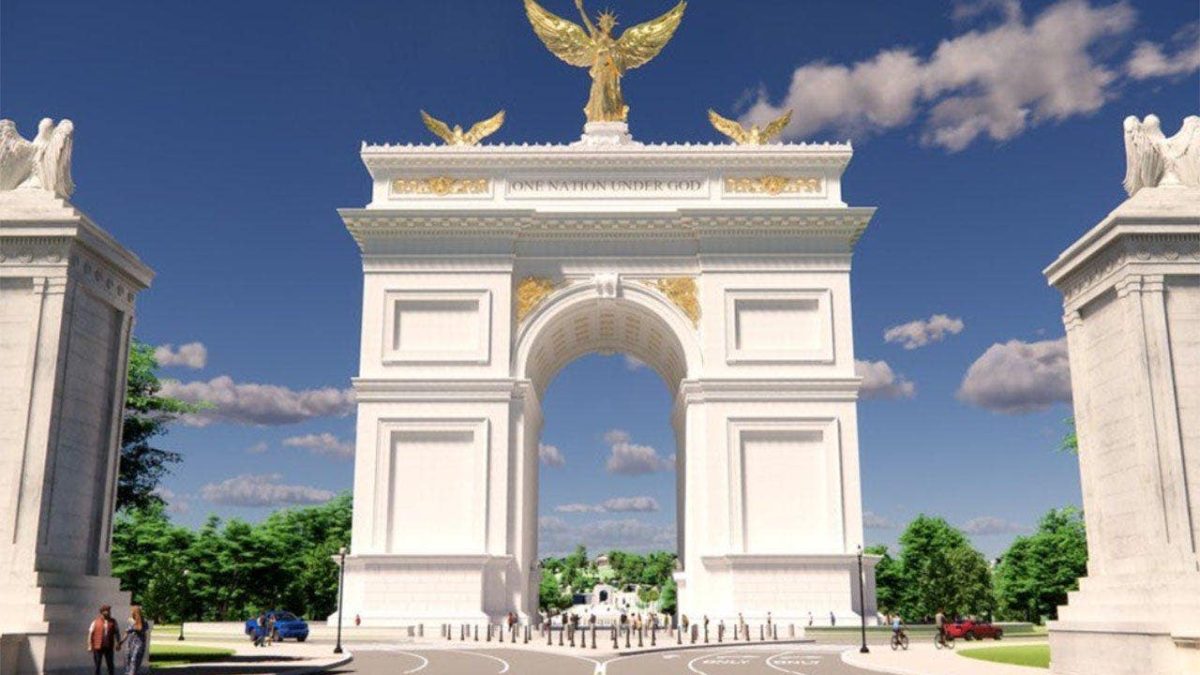
President Donald Trump announced Sunday that his planned 250-foot triumphal arch near Arlington Memorial Bridge will double as a military complex capable of deploying drones, housing snipers, and storing large quantities of ammunition.
The announcement represents a significant shift in the nature and purpose of what was originally conceived as a ceremonial monument. The decision to integrate military capabilities into the monumental structure marks an unprecedented approach to commemorative architecture in the nation’s capital, where such landmarks have traditionally served purely symbolic and memorial functions.
“At the strong request of the United States Military, and for National Security purposes, I have agreed to convert the magnificent Triumphal Arch … into a top grade Military Complex/Triumphal Arch,” Trump wrote on Truth Social.
The structure will have the “rapid ability” to deploy large numbers of drones, with snipers positioned on the roof and plaza areas. Trump said it will store “large quantities of sniper ammunition.”
The dual-purpose designation raises questions about how the structure will balance its ceremonial and operational roles. Military facilities in the Washington area have historically been situated away from the symbolic heart of the capital, with the Pentagon located across the Potomac River in Virginia. The integration of active military infrastructure into a monument positioned at one of the city’s most historically significant entry points represents a departure from established practices in the design and use of the National Mall and its surrounding areas.
“There will be no facility like this anywhere in the World.”
The monument — inspired by Paris’ Arc de Triomphe — is intended to welcome visitors crossing Memorial Bridge from Arlington National Cemetery into the nation’s capital. The proposed structure will be clad in granite and topped with three golden statues.
The design draws from European traditions of victory monuments, though the Arc de Triomphe in Paris functions solely as a memorial and tourist destination without any military operational component. The choice of location is particularly sensitive given its position along the direct visual axis connecting Arlington National Cemetery, where more than 400,000 service members and their families are buried, to the Lincoln Memorial.
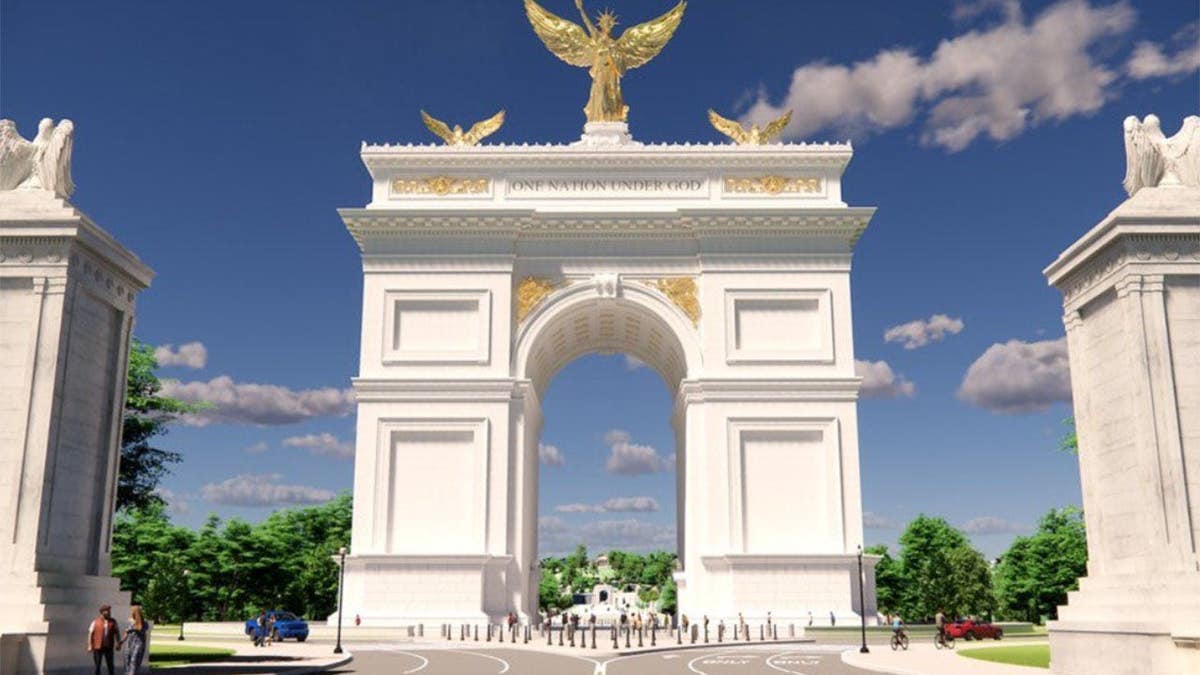
The project has drawn criticism from preservationists, lawmakers, and veterans, who argue it could disrupt views of the Lincoln Memorial and Arlington National Cemetery. Opponents have also questioned whether the project requires congressional approval under federal law.
The addition of military functions to the structure is likely to intensify these concerns. Critics have pointed to the Commemorative Works Act, which governs the placement of memorials and monuments on federal land in Washington, though it remains unclear whether a structure with active military capabilities falls under the same regulatory framework. The National Mall and Memorial Parks area is managed by the National Park Service, which typically restricts operational facilities within its boundaries.
The National Capital Planning Commission has approved the site and preliminary plans, but the project still requires additional review. Construction was previously expected to begin this month.
It is not yet clear whether the commission’s approval accounted for the military functions now planned for the structure, or whether the change in purpose will require a new round of reviews. Federal projects in the capital typically undergo extensive environmental and historical impact assessments, particularly when they involve construction near nationally significant sites.
The arch is one of several major construction projects Trump has pursued in Washington.
The administration has also begun work on a 90,000-square-foot White House ballroom. The sprawling addition, announced last July, will accommodate approximately 650 seated guests and follow the White House’s classical design.
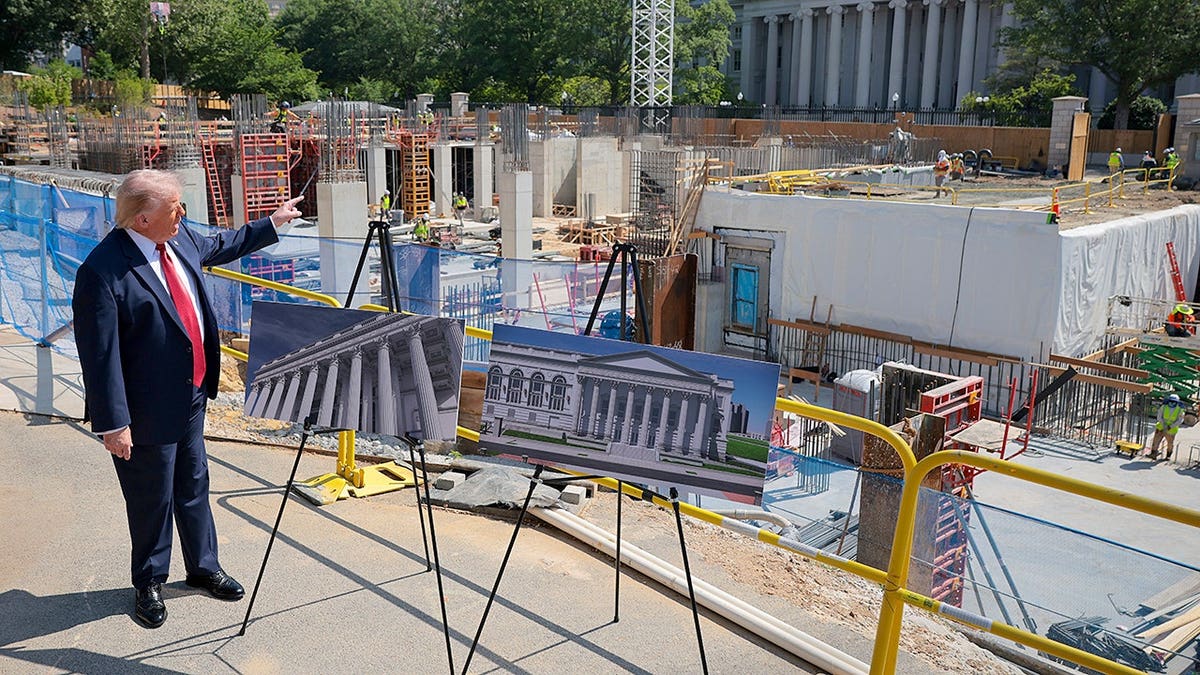
The White House currently lacks a formal ballroom, and the new structure is expected to replace the existing East Wing. Then-White House press secretary Karoline Leavitt said the ballroom is estimated to cost $200 million and will be financed by Trump and private donors.
The scale of these construction initiatives reflects an ambitious agenda to reshape the physical landscape of the presidency and the capital city. Unlike previous administrations that have made more modest modifications to White House interiors or grounds, Trump’s projects involve substantial new construction that will permanently alter the architectural footprint of these historic sites.
Trump has also introduced gold accents in the Oval Office and Cabinet Room, lined the “walk of fame” with portraits of former presidents, added stone pavers to the Rose Garden lawn, and installed two 88-foot flagpoles.
All of these renovations reflect Trump’s broader vision for redesigning the White House and Washington’s monumental core — with the triumphal arch serving as both a national landmark and a functioning military asset.