
President Donald Trump just made the boldest economic promise of the 2026 midterms—and it has nothing to do with tax credits or budget abstractions.
If Republicans hold the House and Senate in November, every adult American gets $5,000.
The proposal, which Trump is branding as the “Trump Dividend,” represents an unprecedented approach to midterm campaigning. Unlike traditional campaign promises that focus on legislative proposals or policy reforms that could take months or years to implement, this pledge offers voters an immediate, tangible return. It’s a strategy that transforms the upcoming congressional elections into something closer to a national referendum with a direct payout attached to the outcome.
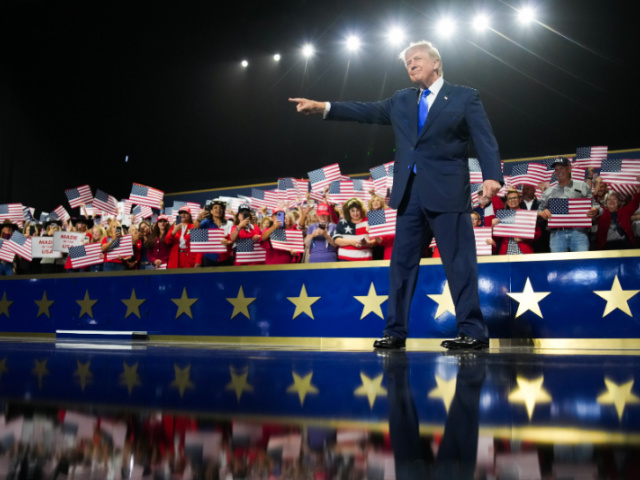
Trump announced the pledge Wednesday night at the Republican National Convention in Dallas, calling it “maybe the best part” of his keynote address before a packed crowd at the American Airlines Center.
“If the Republicans win the House of Representatives and the United States Senate, both of them, because of our tremendous economic success—like in history we’ve never had anything like what’s happening—but because of our tremendous strength and success economically, I will issue a dividend to every adult citizen in the United States of America for $5,000.”
The framing of the payment as a “dividend” rather than a stimulus check or relief payment is deliberate. It positions American citizens not as recipients of government assistance, but as stakeholders in the nation’s economic performance—shareholders, in effect, of American prosperity. This rhetorical choice reinforces Trump’s longtime approach of running the country with business principles and rewarding success.
Trump compared the payment to how successful companies distribute cash to shareholders—or like the $1,776 bonus he gave military members last year.
There’s one condition: spend it in America.
“The only caveat I have is that the dividend that we’re making must be spent in the United States of America,” Trump said. “We don’t want you going to Canada to spend the money. We don’t want you going to China, to Germany. You got to spend the money in the United States of America.”
This spending restriction serves a dual purpose. On one level, it’s designed to ensure the payment functions as an economic stimulus that circulates through American businesses, retailers, and service providers. But it also reinforces the “America First” economic nationalism that has defined Trump’s trade and economic policy since his first campaign. By explicitly naming Canada, China, and Germany—all major trading partners—Trump is drawing a line between domestic economic activity and foreign consumption.
The enforcement mechanism for such a restriction remains unclear, though similar conditions have been attached to other federal programs in the past. Previous economic stimulus payments have generally come with few strings attached, making this proposal notably different in structure and intent.
He hammered Democrats for being unable to make a similar promise, tying it directly to their refusal to use tariffs as an economic weapon.
“The reason the Democrats can’t do that is because they don’t do tariffs, they don’t take in money. All they know is poverty and how to ruin our country. But we’re making a fortune,” Trump said. “So if the Republicans win, you win with us, and you get $5,000.”
Trump’s argument hinges on the assertion that tariff revenue—taxes on imported goods—has generated sufficient surplus to fund this massive payout. With roughly 260 million adults in the United States, a $5,000 payment to each would require approximately $1.3 trillion. Whether tariff collections and general economic growth have produced that level of surplus, and whether such funds could be distributed without congressional appropriation, are questions likely to dominate economic and political debate in the weeks ahead.
The announcement positions the midterms as a direct referendum on economic policy—with a cash incentive patriots can count in their bank accounts.
Republicans hold narrow majorities in both chambers heading into November. Trump’s promise raises the stakes higher than any GOP midterm in modern history.
Historically, midterm elections have functioned as referendums on the sitting president’s performance, with the president’s party typically losing seats. By making control of Congress a prerequisite for the dividend, Trump is attempting to reverse that historical pattern and give voters a concrete financial reason to buck the traditional midterm trend. The strategy transforms what might have been a defensive election cycle into an offensive campaign with a clearly defined reward structure.
.@POTUS announces the TRUMP DIVIDEND: If Republicans win both the House and the Senate, because of our tremendous economic success, I will issue a dividend to every adult citizen in the United States for $5,000 pic.twitter.com/s4orJJGx9d
— Rapid Response 47 (@RapidResponse47) September 10, 2026
THE TRUMP DIVIDEND! 🇺🇸 https://t.co/N8ofqrM1nX pic.twitter.com/fS308Ze9LP
— Rapid Response 47 (@RapidResponse47) September 10, 2026