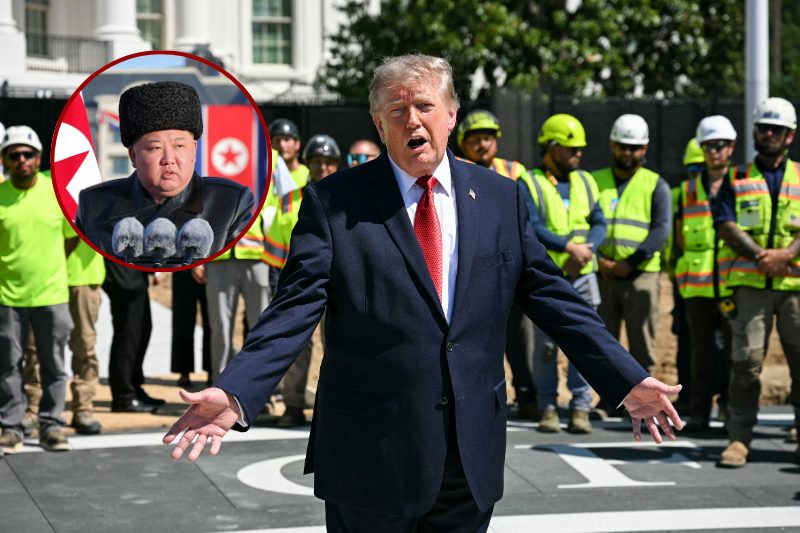
President Donald Trump confirmed Wednesday he will meet with North Korean leader Kim Jong Un later this year, telling reporters outside the White House that maintaining dialogue with Pyongyang is crucial given the regime’s nuclear arsenal. The announcement comes amid renewed international concerns about North Korea’s expanding weapons program and signals Trump’s continued commitment to personal diplomacy as a cornerstone of his approach to one of America’s most complex foreign policy challenges.
“I get along with him great,” Trump said of Kim.
“You know what, the fact that I get along with him, it’s a good thing, not a bad thing … He has 57 very powerful nuclear weapons. If I were president [when North Korea acquired them], I wouldn’t have allowed it.”
The 57-warhead figure appears drawn from U.S. intelligence estimates, according to insiders. Intelligence assessments indicate North Korea has between 50 and 60 active nuclear warheads — Trump’s comment marks the first time a U.S. official has publicly cited a specific number. The public disclosure of such a precise figure represents a significant departure from the typically guarded language used by American officials when discussing classified intelligence assessments. Experts have long debated the exact size of North Korea’s nuclear stockpile, with estimates varying widely over the years as the isolated regime has accelerated its weapons development despite international sanctions and diplomatic pressure.
When asked directly if he’d meet Kim this year, Trump answered: “Yeah, I will be.”
“Are you expecting to meet with [Kim Jong Un] later this year?”@POTUS: “Yeah, I will be.” pic.twitter.com/63KgHgme2D
— Rapid Response 47 (@RapidResponse47) August 19, 2026
The summit would be Trump’s fourth with the North Korean dictator — and his first since returning to office in 2025. The prospect of another meeting underscores Trump’s belief that high-level engagement with Kim can yield results where traditional diplomatic channels have failed, a strategy that has drawn both praise from supporters who see it as pragmatic and criticism from detractors who argue it legitimizes an authoritarian regime with a documented history of human rights abuses.
Trump remains the only sitting U.S. president to ever meet with a North Korean leader. Former Presidents Jimmy Carter and Bill Clinton both traveled to Pyongyang to meet with Kim’s grandfather and father, but those visits occurred after they left office. This distinction highlights the unprecedented nature of Trump’s approach to North Korea, breaking decades of American policy that avoided direct presidential contact with the Kim dynasty. The decision to engage at the highest level marked a fundamental shift in U.S. strategy toward the hermit kingdom, one that upended longstanding diplomatic protocols and sparked intense debate among foreign policy experts about the risks and potential rewards of such direct engagement.
“I know Kim very well and he’s going to be fine. As long as we have a smart president, he’s going to be fine. If we have a dumb president, then he’s probably not going to be so fine.”
The rapport wasn’t always this warm. In 2017, Trump labeled Kim “Rocket Man” at the United Nations. Kim responded by calling Trump a “mentally deranged U.S. dotard” while referencing his “nuclear button.” Trump fired back, calling Kim a “madman.” That period of escalating rhetoric alarmed global observers and raised fears of potential military conflict on the Korean Peninsula, with both leaders trading increasingly bellicose threats as North Korea conducted a series of provocative missile tests.
The two later shifted to direct diplomacy during Trump’s first term: Singapore in June 2018, Hanoi in February 2019, and the Demilitarized Zone in June 2019. During the DMZ meeting, Trump briefly stepped into North Korean territory — the first sitting American president to cross that border. Each summit generated worldwide media attention and offered moments of historic symbolism, though concrete progress toward denuclearization remained elusive. The Hanoi summit notably ended abruptly without an agreement, illustrating the substantial gaps that remain between the two nations on core issues of sanctions relief and nuclear disarmament verification.
The United States and North Korea maintain no formal diplomatic relations. The two countries remain technically at war, as the 1950-1953 Korean War ended with an armistice rather than a peace treaty, leaving the peninsula in a state of frozen conflict for more than seven decades.