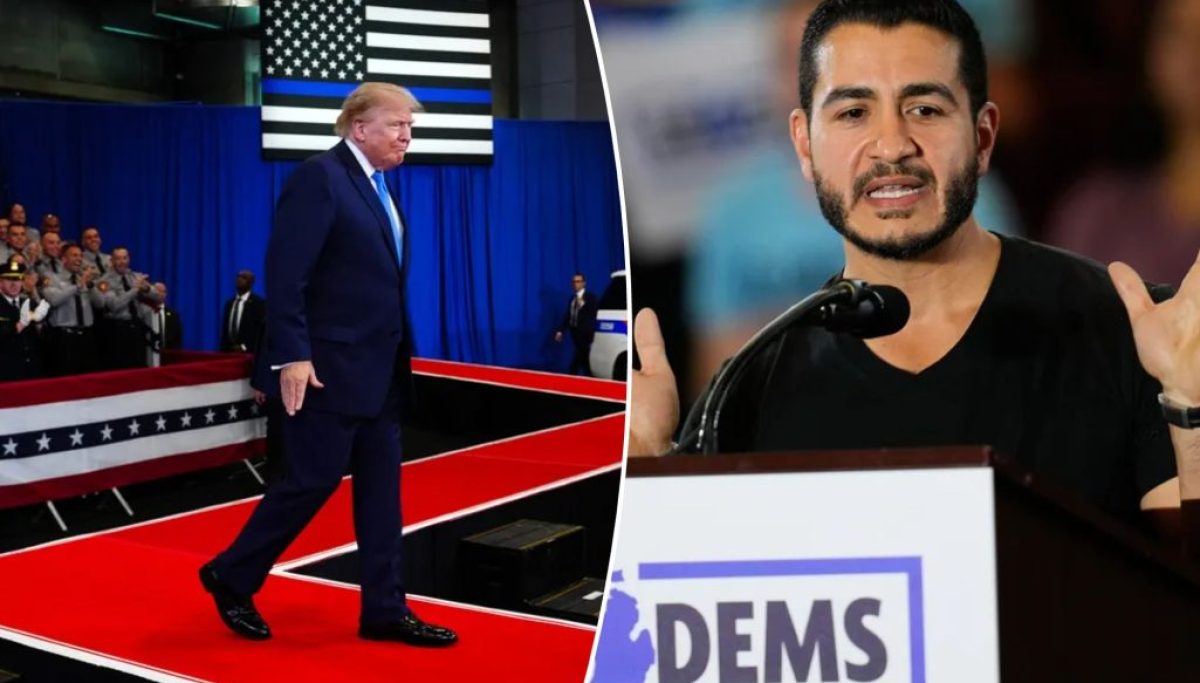
A Fox News poll released last week sent shockwaves through the Democratic establishment — and the numbers reveal exactly why.
The poll shows Republican Mike Rogers leading Democrat Abdul el Sayed by 4 points (51% to 47%) in Michigan’s Senate race. But the real danger for Democrats isn’t the tight margin — it’s what’s happening inside their own coalition.
In any competitive statewide race, party unity becomes the foundation upon which campaigns are built. When one party can consolidate near-unanimous support from its base while the opponent struggles to hold their coalition together, even a close topline number can mask a structural disadvantage that becomes insurmountable as Election Day approaches.
Among Republicans, 96% plan to vote for Rogers.
Among Democrats? Just 91% intend to vote for el Sayed — the DSA-adjacent progressive who won the party’s nomination.
That 5-point enthusiasm gap is massive in a battleground state race. And it gets worse.
Among black voters — a critical Democratic base — only 75% said they’ll vote for el Sayed. 22% plan to vote for Rogers.
To understand why these numbers are so alarming for Democrats, consider the mathematics of Michigan elections. Black voters have consistently delivered between 88% and 92% support for Democratic Senate and gubernatorial candidates in recent cycles. They represent roughly 14% of the Michigan electorate, meaning every point of slippage translates directly into thousands of lost votes in a state where recent statewide races have been decided by narrow margins. A 16-point deficit from typical Democratic performance among this core constituency doesn’t just represent lost votes — it represents a collapse in the coalition arithmetic that makes Democratic victories possible in purple states.
The fracture isn’t hard to explain. El Sayed, who identifies closely with the Democratic Socialists of America wing, won a brutal primary that split moderate Democrats from the party’s far-left flank. Now those moderates — the voters who despise Trump but can’t stomach a socialist — are staying home or quietly defecting.
It’s the nightmare scenario Democrats feared after 2024: AOC-style candidates winning primaries in swing states, then bleeding support from the center in November.
The dynamic playing out in Michigan reflects a tension that has simmered within the Democratic Party for years. Primary electorates — typically more ideological, younger, and whiter than general election voters — have increasingly rewarded candidates who embrace bold progressive positions. But general elections in competitive states still require building coalitions that extend well beyond the party’s activist base. When those two realities collide, the result is often a nominee who energizes one portion of the party while alienating another — exactly the schism these poll numbers reveal.
Michigan isn’t an isolated case. Across the country, the party’s progressive vs. moderate civil war has left some Democrats asking whether hating Trump is enough reason to vote for candidates they fundamentally oppose on policy.
For decades, negative partisanship — voting against the other party rather than enthusiastically for your own — has been sufficient to hold coalitions together. But el Sayed’s numbers suggest that strategy has limits. When Trump’s approval sits at 41% with 58% of Michigan voters disapproving, a Democratic candidate polling at just 47% indicates a significant bloc of Trump-disapproving voters who aren’t yet willing to back the Democratic nominee. These are voters who should be accessible to Democrats but remain out of reach, creating a gap between anti-Trump sentiment and pro-Democratic voting behavior.
For Rogers, the path is simple: hold Republicans at 96%, peel off disaffected Democrats and independents, and let el Sayed’s socialism do the rest of the work.
The Republican strategy requires no elaborate maneuvering — merely maintaining discipline within their own ranks while el Sayed’s ideological profile does the work of fracturing the Democratic coalition. In an environment where Republicans are unified and Democrats are divided, the burden falls entirely on the trailing candidate to expand their appeal, a challenge made exponentially harder when the very positions that won the primary are the same positions driving away general election voters.
Democrats, meanwhile, are left praying that anti-Trump fury can paper over a base that’s fractured — and unenthusiastic.
TL;DR is that if Abdul El-Sayed is only at 47% in a state where 58% disapprove of Trump, that's…a problem. To get there AES has to overcome doubts among a whole lot of voters who disapprove of Trump but aren't yet willing to support AES: https://t.co/xT7hmW8MTE
— . (@GregTSargent) August 14, 2026
Fox poll has Abdul El-Sayed behind by 47-51. He's only at 75% w/blacks and badly losing noncollege whites (38-61) and noncollege overall (44-54)
Trump approval in MI: 41-58
Bears out what @RonBrownstein and I said on AES need to win Trump disapprovers:https://t.co/CEysQKWNcO pic.twitter.com/OaAyF4rhb2
— . (@GregTSargent) August 14, 2026