
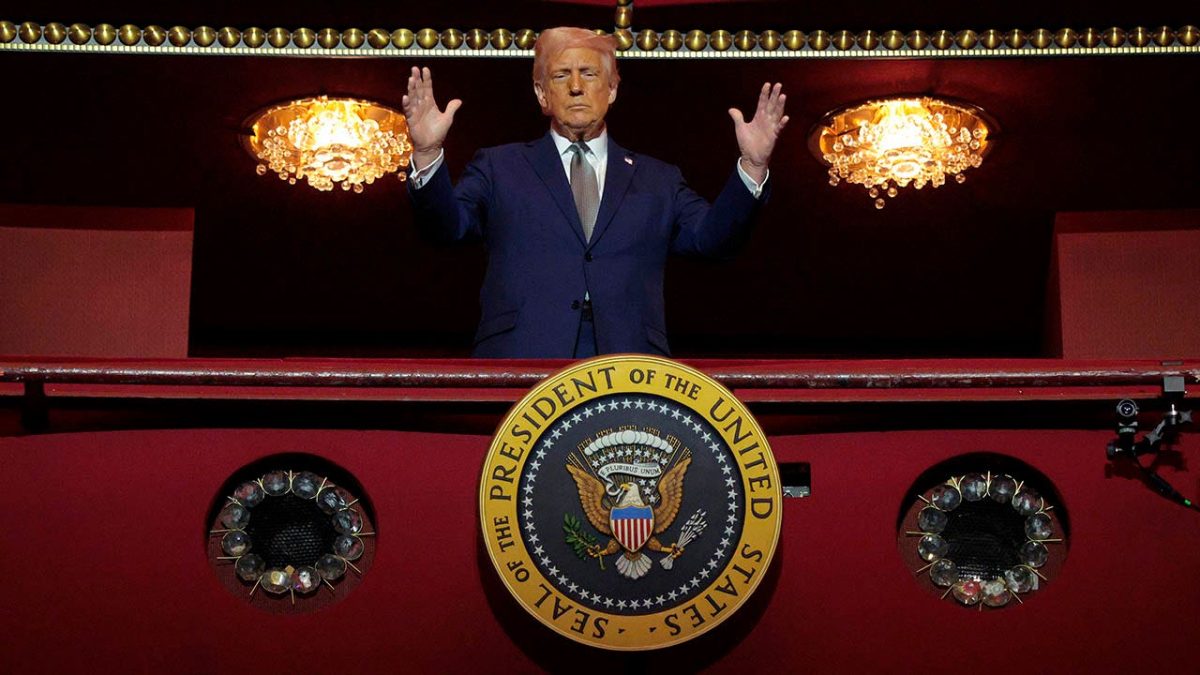
The Kennedy Center Board of Trustees voted to name the iconic arts institution’s grounds the “President Donald J. Trump Plaza” — part of a sweeping effort to honor the president as the center embarks on a historic $257 million renovation.
The decision marks a significant shift in how the center, which opened in 1971 as a living memorial to President John F. Kennedy, will recognize contemporary political figures. The grounds naming represents one of the most visible changes to the cultural landmark since its founding, placing Trump’s name prominently at an institution that has long served as a nonpartisan gathering place for the arts.
The board also approved an inscription reading “Endowed by the Trump Kennedy Center Fund” once the fund reaches a $100 million endowment, according to Fox News reporting.
The previously unreported moves came Thursday alongside a 20-3 supermajority vote to add an inscription crediting Trump with restoring and renovating America’s cultural center.
The proposed inscription would place Trump’s role in the renovation alongside Kennedy’s founding legacy, creating a permanent record of the current administration’s investment in the facility. Such inscriptions typically remain in place for generations, making the board’s decision one with lasting implications for how the center presents its history to millions of future visitors.
“THE JOHN F. KENNEDY MEMORIAL CENTER FOR THE PERFORMING ARTS RESTORED AND RENOVATED BY PRESIDENT DONALD J. TRUMP.”
Three Democrats — Sen. Sheldon Whitehouse of Rhode Island and Reps. Joyce Beatty of Ohio and Rick Larsen of Washington — voted no on both the inscription resolution and the partial-closure resolution.
The split vote reflects broader political tensions surrounding the Kennedy Center, which operates as a public-private partnership and receives both federal funding and private donations. The minority opposition underscores concerns among some board members about the appropriateness of renaming elements of a memorial dedicated to a president from a different political era and party.
The board is moving forward after Trump secured $257 million from Congress to address decades of deferred maintenance at the Kennedy Center. The massive renovation will tackle water infiltration, damaged electrical rooms, hundreds of structural failure points in the parking garage, and 2,000-plus-pound soffit panels that have reached “end-of-life” status and pose a public safety risk.
The infrastructure problems have accumulated over more than five decades of continuous operation, with many systems now operating well beyond their intended lifespan. The Kennedy Center has struggled with funding gaps for routine maintenance and capital improvements, making this federal investment unprecedented in scale and scope for the institution. Without these repairs, engineers have warned that critical building failures could force emergency closures or create dangerous conditions for the millions of patrons who visit annually.
The board approved a partial closure following an independent analysis. The Kennedy Center said the plan would leave a $3.4 million surplus, compared with a projected $78 million deficit under an alternative involving four years of revolving closures.
The financial modeling suggests the partial closure approach would significantly minimize operational losses while allowing contractors to work more efficiently without the complications of maintaining performances in adjacent spaces. The alternative revolving closure model would have required the center to maintain full staffing and operations while limiting revenue-generating performances, creating an untenable financial situation.
Free Millennium Stage programs, film events, educational programming, and the JFK memorial exhibit will remain available at the REACH during the partial closure. The National Symphony Orchestra will perform its 2026-2027 Classical Season at venues around the Washington, D.C., area and across the country.
The continuity plan aims to preserve the Kennedy Center’s mission of providing accessible arts programming even during the renovation period. The REACH, which opened in 2019 as an expansion facility, will serve as a temporary home for many of the center’s public-facing activities, ensuring that the institution maintains its community presence throughout the construction phase.
“The Kennedy Center Board of Trustees has reaffirmed its unwavering commitment to the responsible stewardship of America’s Cultural Center,” a Kennedy Center spokesperson said.
“WITH THE CONFIDENCE OF THE BOARD AND CHAIRMAN PRESIDENT TRUMP’S UNPRECEDENTED SUPPORT, THIS HISTORIC REVITALIZATION PROJECT CAN COMMENCE.”
The latest moves come after a federal judge blocked an earlier effort to rename the center after Trump, along with an earlier closure plan.
The court intervention had created uncertainty about how the center could proceed with both honoring Trump’s funding contribution and moving forward with necessary renovations. The board’s new approach appears designed to navigate the legal constraints established by that ruling while still recognizing the current administration’s role. By naming the grounds rather than the center itself, and by making inscriptions contingent on specific funding thresholds, the board may have crafted a strategy that addresses previous legal objections.
White House spokeswoman Liz Huston celebrated the board’s action in a statement to Fox News Digital.
“Under President Trump’s bold leadership, the Kennedy Center is on its way to becoming the finest cultural institution anywhere in the world,” Huston said.
The JFK Library and Jack Schlossberg — Kennedy’s grandson, who has been outspoken about the center — did not immediately respond to requests for comment.
The absence of immediate response from Kennedy family representatives leaves open questions about how the family views these changes to the memorial established in President Kennedy’s honor. The Kennedy Center has historically maintained close ties with the Kennedy family, making their perspective on the naming decisions potentially significant for the institution’s relationship with its founding legacy.