
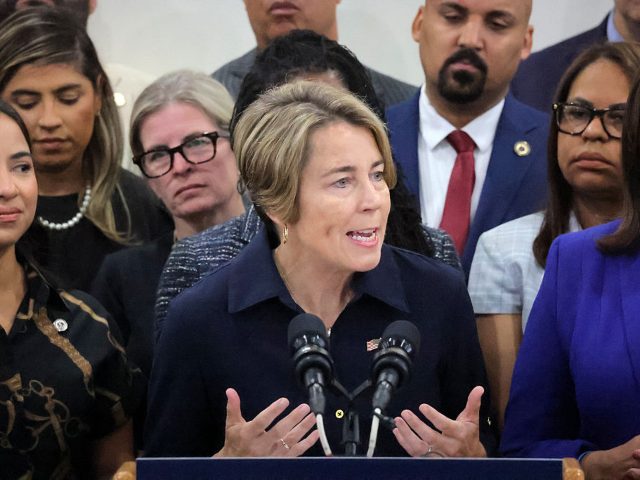
Nine Democratic lawmakers couldn’t stomach what their own party just signed into law in Massachusetts — a bill that removes all gestational limits on abortion and allows the procedure moments before birth.
The Prioritizing Patient Access to Care Act passed 119-33 in the state House on July 22. Democratic Governor Maura Healey signed it this week, making Massachusetts one of the most permissive states in the nation when it comes to abortion access. The legislation marks a significant shift in state policy, even in a commonwealth long considered a progressive stronghold on reproductive rights.
The new law eliminates all time restrictions on abortion in Massachusetts. Physicians can now perform the procedure at any stage of pregnancy based on their professional medical judgment — with greater legal protection from penalties. This represents a departure from the previous framework that had been in place for decades, and positions Massachusetts alongside a small number of states with similarly expansive abortion laws. The law also includes provisions strengthening protections for abortion providers against potential legal challenges from other states.
“THIS NEW LAW REPRESENTS AN EXTREMIST AND DANGEROUS POSITION. TO BE CLEAR, IT ALLOWS ABORTION ANY TIME, UNRESTRICTED, AND IN MANY CASES, PUBLICLY FUNDED UNTIL THE MOMENT OF BIRTH.”
That’s Democratic State Rep. Jeffrey Turco of Winthrop, who voted against the bill alongside eight other Democrats and a solid block of Republicans. His concerns reflect growing unease among some members of his own party about how far abortion protections should extend, particularly in the later stages of pregnancy when questions of fetal viability become more medically and ethically complex.
Turco told Fox News Digital the bill was “rushed through the legislative process in two weeks without an opportunity for the public to weigh in.” The accelerated timeline left many constituents unaware of the full scope of the changes until after the vote had already taken place, he argued.
“The new law is barbaric,” he said.
Other Democrats were just as vocal in their opposition, raising concerns that transcend typical partisan divides on reproductive rights.
State Rep. Chris Markey of Dartmouth said the bill creates a troubling precedent — putting doctors in a “very difficult ethical dilemma” that conflicts with long-standing criminal case law. His concerns centered on how the new statute might interact with existing legal frameworks governing medical practice and the treatment of viable fetuses.
“I BELIEVE THIS LAW IS NOT CONSISTENT WITH THE BELIEFS OF THE VAST MAJORITY OF MY CONSTITUENTS. WHILE MANY ARE PRO-CHOICE, YOU CAN STILL BE PRO-CHOICE AND SEE THIS LAW AS GOING BEYOND THE NORMS OF ACCEPTABILITY.”
Markey’s statement highlights a tension that exists even in liberal-leaning districts: voters who support abortion rights in principle may still have reservations about removing all restrictions, particularly in the third trimester. Public polling has consistently shown that Americans hold more nuanced views on abortion than simple pro-choice or pro-life labels suggest, with support for abortion access generally declining as pregnancy progresses.
State Rep. Dennis Gallagher, representing the 8th Plymouth District, said changes to the existing law weren’t necessary. Prior Massachusetts law already permitted abortions after 24 weeks to preserve the mother’s health or in cases of severe fetal anomalies. That framework, Gallagher suggested, had provided sufficient protection for women facing serious medical complications while maintaining some ethical boundaries around late-term procedures.
“At that point in a pregnancy, if the health of the mother is fine and the baby’s health is fine, I just think alternatives should be encouraged for that baby,” Gallagher said. “So that’s what I struggled with.” His comments point to adoption and other options that become more viable as pregnancy advances, particularly in cases where no medical emergency exists.
State Rep. Alan Silvia, a pro-life Democrat from Bristol, vehemently opposed expanding abortion in the state. His presence in the Democratic caucus represents a diminishing faction within the party, as abortion rights have become an increasingly central litmus test for Democratic candidates nationwide.
“My position has been consistent: I believe in protecting human life, including the life of the unborn,” Silvia said. “We go to extraordinary lengths as a society to protect vulnerable life, saving whales and saving strays, yet when it comes to an unborn child, that same sense of protection too often seems to disappear.”
Governor Healey defended signing the legislation, citing “unprecedented attacks across the country” on abortion following the Supreme Court’s 2022 decision overturning Roe v. Wade. The Dobbs decision eliminated the federal constitutional right to abortion and returned the issue to individual states, prompting a patchwork of laws nationwide. Many Democratic-led states have moved to expand abortion access in response, while Republican-controlled states have implemented new restrictions.
In a statement early this week, she claimed the law guarantees families won’t have to “travel hundreds of miles” out of state and that “patients can continue to receive compassionate, medically appropriate care in Massachusetts during some of the most difficult moments of their lives.” Her framing emphasized rare but heartbreaking cases of wanted pregnancies that develop severe complications late in gestation.
The vote breakdown: 119-33 in favor. Nine Democrats joined Republicans in opposition — a rare break on abortion policy within the Democratic caucus. The bipartisan opposition, though ultimately unsuccessful in blocking the bill, signals that even in deep-blue Massachusetts, consensus on abortion policy remains elusive when the debate moves beyond general principles to specific gestational limits.