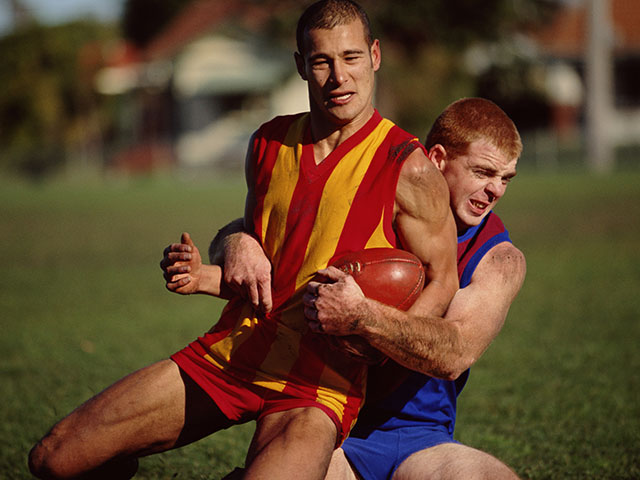
The Australian Football League is allowing a 6-foot-3, 200-pound biological male to compete in women’s competitions — despite three formal complaints from clubs warning the league has a “duty of care” to protect female athletes. The decision has reignited a fierce debate about fairness and safety in women’s sports, particularly in contact sports like Australian rules football where physical collisions are fundamental to gameplay.
Anthony “Freya” Golding previously played in the senior men’s division. Now he plays for the Westminster Old Scholars in the Adelaide Footy League for women. The transition from competing against male athletes to female athletes has raised questions about the physical disparities that exist between the sexes, especially in a sport known for its aggressive body contact, tackling, and aerial contests.
His placement on the women’s team sparked immediate backlash. The concerns were not merely theoretical but grounded in observable differences in size, strength, and the potential for injury when athletes with male physiology compete against female players.
“CONCERNS WERE IN PART MOTIVATED BY VIRAL FOOTAGE CIRCULATED EARLIER THIS YEAR SHOWING GOLDING CASUALLY KNOCKING A WOMAN TO THE GROUND DURING A GAME.”
Three different clubs submitted formal complaints, accusing Golding of placing female players at risk. The clubs said the AFL had a “duty of care” to block him from playing on women’s teams, according to Reduxx reporting. The complaints represented multiple organizations within the league expressing similar safety concerns, suggesting the issue was not isolated to a single club’s perspective.
The AFL’s “Gender Diversity Policy Committee” investigated. The committee was tasked with balancing inclusivity objectives against player safety considerations, a tension that has become increasingly common in sports governing bodies worldwide.
Their conclusion? Golding can keep playing.
In a confidential email seen by Nine News, the committee said it was “not satisfied that the Player’s participation in the Competition gives rise to unacceptable safety risks.” The carefully worded statement acknowledges some level of risk but deems it not to reach the threshold of “unacceptable,” a distinction that critics have found troubling.
Adelaide Footy League chief executive John Kernaham slammed the decision — and pointed out the committee’s own admission that Golding still poses some level of risk to female athletes. His criticism highlights what many see as an inconsistency in the ruling: acknowledging risk while simultaneously permitting the activity that creates it.
“We to this day maintain that it is a safety risk,” Kernahan told Nine News. “This particular player is 6’2″ or 6’3″, 92kg. I appreciate the notion that there might be other naturally born women that are 6’3″ and 92kg. But they are few and far between.” His point underscores the statistical reality that while outliers exist among female athletes, they represent rare exceptions rather than the norm, whereas Golding’s physical profile is more typical of male athletes.
The AFL reportedly made its decision under its “Gender Diversity Policy” framework, which allows players to participate on teams that match their self-proclaimed “gender identity.” This policy framework reflects broader institutional shifts in Australian sports governance toward prioritizing gender identity over biological sex in determining eligibility for sex-segregated competitions.
The policy also states that players cannot be banned from women’s teams “solely” because they may have a physical advantage over women. This provision effectively removes the traditional rationale for sex-segregated sports categories, which were historically created precisely because of the physical advantages male puberty confers.
Golding celebrated the decision in an interview with Nine News — and denied having a physical advantage over his female opponents.
“I’m not the biggest and tallest player getting around and by no means am I a dominant player,” Golding said. “I’ve had some good moments, but it’s rare I get in the best players. I just want to play the sport I love with a great group of people and I’ve been so lucky to do that this year.” The statement emphasizes personal fulfillment and team camaraderie while downplaying the physical disparities that concerned the complaining clubs.
The AFL’s decision comes after a number of setbacks in Australia as advocates work to protect women’s sports and spaces. The ruling represents another chapter in an ongoing cultural and legal battle playing out across Australian institutions regarding the definition of “woman” in contexts specifically created for female people.
The Australian Football League has ruled that a 6'3" male will be allowed to continue to play on women's teams.
Multiple clubs had submitted complaints about Anthony "Freya" Golding, citing the physical risk he posed to female players.https://t.co/jp4AHo00l0
— REDUXX (@reduxx) August 10, 2026
AFL policies are under fire after multiple clubs raise complaints over a man playing in the women's league.
Male athlete Anthony "Freya" Golding can be seen knocking a woman to the ground during a game. He barely seems to notice her while she bounces off his body.
Golding… https://t.co/YA57KklKU1 pic.twitter.com/v9s5nfF1eu
— HeCheated.org (@hecheateddotorg) July 15, 2026