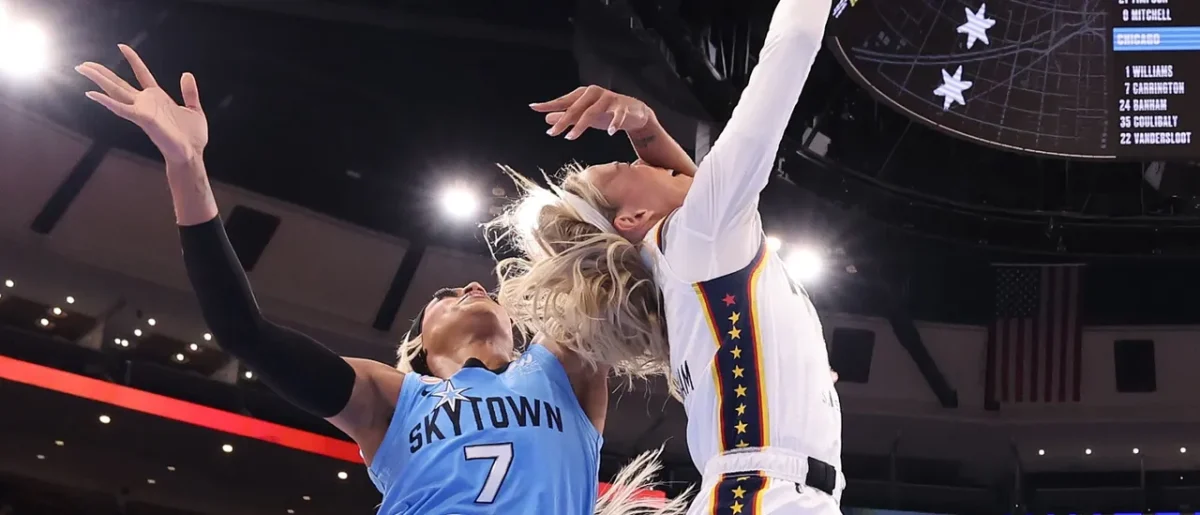
Chicago Sky guard DiJonai Carrington blamed race after referees ejected her for a violent foul on Indiana Fever guard Sophie Cunningham.
Carrington drew a flagrant 2 and an ejection Saturday for a hard foul on Cunningham, then posted the words “WHITE PRIVILEGE” on her Threads account and tagged the Fever.
The incident immediately sparked widespread debate across social media and sports commentary circles about race, officiating standards in women’s basketball, and the appropriateness of invoking racial dynamics in response to on-court penalties. The ejection marked one of the most controversial moments of the WNBA season and drew attention from figures well beyond the basketball world.
The foul landed late in the first quarter of a game Indiana won 90-86.
Cunningham was out ahead of the pack on a fast-break layup when Carrington chased her down and struck her across the face and neck, dropping her to the floor as the shot fell. Officials initially assessed a flagrant 1, then upgraded it after review, citing windup, impact and follow-through on the play.
The upgrade from flagrant 1 to flagrant 2 is significant in WNBA officiating, as it requires officials to determine that excessive and unnecessary contact occurred. A flagrant 2 results in automatic ejection and potential additional league discipline, while a flagrant 1 allows the player to remain in the game. The decision to upgrade after review suggested officials saw clear evidence of excessive force in the replay footage.
DiJonai Carrington was assessed a Flagrant 2 and was ejected from the game after this play. pic.twitter.com/WRapu4lqHX
— ESPN (@espn) August 8, 2026
Cunningham rejected the race claim outright.
“This has nothing to do with race. Last year, I did the same thing and I got kicked out. And I deserved to be kicked out. There’s no reason even to play that card.”
Cunningham’s reference to her own prior ejection provided context for her perspective on officiating consistency. Her acknowledgment that she had previously received similar punishment for similar conduct appeared designed to undercut Carrington’s assertion that race played a role in the officiating decision. By citing her own experience with ejection, Cunningham suggested the officials apply standards uniformly regardless of the players involved.
She also called the foul deliberate.
“Clearly, I think it was like unnecessary. I’ve never really spoken to her and have no beef with her, but I guess she has some pent up stuff,” Cunningham said.
Cunningham sprang up and got in Carrington’s face, shoving her before teammate Makayla Timpson and Fever staff pulled her back.
The immediate confrontation illustrated the intensity of the moment and the physical nature of the contact Cunningham had just absorbed. Her reaction, while quickly contained by teammates and staff, demonstrated her belief that the foul crossed a line beyond normal competitive play. No additional technical fouls were assessed for the post-whistle confrontation.
Fever coach Stephanie White defended the call while stopping short of assigning intent. “It was a hard foul,” White said. “I don’t think that DiJonai intentionally came out to get her across the neck like she did, but it did happen, and I thought it was the right call.”
White’s measured response reflected the delicate position coaches often occupy when discussing opponent conduct. While supporting the officiating decision and acknowledging the severity of contact to her player’s neck area, White opted not to accuse Carrington of deliberate intent to injure, leaving open the possibility that the excessive contact resulted from an overly aggressive defensive play rather than malicious intent.
Sophie Cunningham’s own coach Stephanie White DEFENDS DiJonai Carrington after Flagrant 2 ejection for foul on Cunningham: “I also don’t think that she intentionally went for the neck.” https://t.co/SrToPTPrwkpic.twitter.com/hocbpAH3Gs
— Daily Caller (@DailyCaller) August 9, 2026
Carrington had opened strong before the ejection, scoring eight points on 3-of-3 shooting roughly four minutes into her outing.
The timing of the ejection proved costly for Chicago, as Carrington’s hot start suggested she was poised for a significant offensive performance. Her removal from the game in the first quarter deprived the Sky of one of their key contributors for the remaining three quarters, potentially affecting the game’s final outcome given Indiana’s narrow four-point margin of victory.
The matchup carried added tension, with Cunningham already under scrutiny over comments she made about transgender athletes in a recent ESPN profile.
This broader context surrounding Cunningham added another layer to the post-game discourse, as some observers questioned whether off-court controversies might have contributed to on-court tensions between the players. The intersection of multiple contentious cultural topics created a combustible atmosphere that extended well beyond typical game analysis.
Florida Attorney General James Uthmeier weighed in on the foul with a warning to the WNBA.
“The WNBA knows better than to play games down here in Florida, because I’ll be charging people with assault,” Uthmeier said.
Uthmeier’s intervention represented an unusual escalation, with a state law enforcement official threatening criminal charges over professional sports conduct typically handled through league discipline. His statement suggested the incident had transcended sports boundaries to become part of larger political and cultural conversations.
The WNBA knows better than to play games down here in Florida, because I’ll be charging people with assault. https://t.co/wryaIdyFz3
— James Uthmeier (@JamesUthmeierFL) August 8, 2026