Dr. Anthony Fauci’s newly-released personal diary documents the spectacular collapse of his relationship with President Donald Trump during the COVID-19 pandemic — from Trump calling him “really a famous guy” in early 2020 to their final profanity-laced phone call two days before the 2020 election.
Sen. Rand Paul (R-KY) released over 1,000 pages of Fauci’s diary this week as part of his investigation into whether Fauci lied to Congress about the origins of COVID-19. The entries chronicle how mutual public praise devolved into bitter political warfare as the pandemic response became a flashpoint in Trump’s reelection fight against then-former Vice President Joe Biden.
The first meeting set the tone.
Trump and Fauci met in the White House Situation Room on Jan. 29, 2020. Trump stayed about 20 minutes, asking questions about the emerging coronavirus threat.
“The President came in, and the first thing he said as he looked at me was: ‘Anthony, you are really a famous guy.'”
Fauci wrote that he was “surprised and very pleased” and that other officials were “clearly stunned and impressed.”
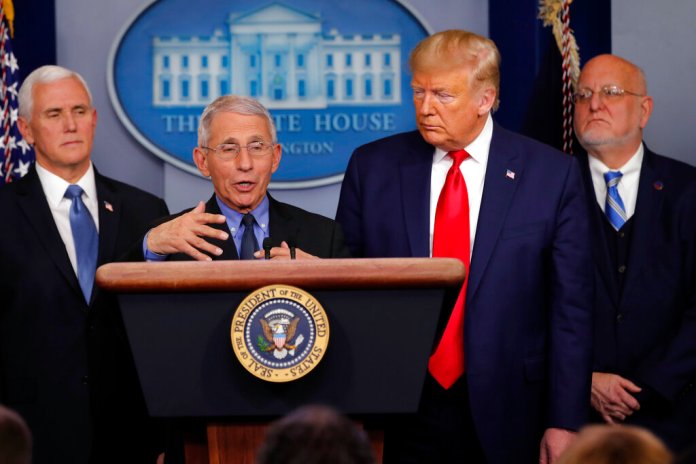
At the outset, Trump publicly praised Fauci as “a terrific guy” and “a wonderful man.” Fauci became a fixture at White House Coronavirus Task Force briefings, standing beside the president as the administration projected unity.
The admiration appeared mutual. Trump recalled the late Fox News host Lou Dobbs told him Fauci was “the smartest person” around. After their January 2020 meeting, Fauci wrote in his diary: “Amazing day today!”
But the honeymoon didn’t last.
By late spring 2020, the relationship began to fray. Fauci advocated social distancing, masking, and a guarded approach to reopening. Trump, focused on restarting businesses and projecting optimism ahead of the election, grew frustrated with what he viewed as overly pessimistic messaging.
Fauci’s private diary reflected mounting frustration. He described Trump’s coronavirus briefings as “painfully rambling” and “stream of consciousness.” As the 2020 campaign entered its final stretch, Fauci wrote that Trump was “spewing nonsense” on the trail and called him “a true embarrassment.”
Over the course of their relationship, Fauci privately described Trump as “incompetent,” “an idiot,” “totally nuts,” and “an obnoxious adolescent.” Trump, in turn, called Fauci a “disaster,” dubbed him the “king of flip-flops,” and accused him of seeking the spotlight.
By March 2020, Fauci was increasingly frustrated by Trump’s tendency to lose focus during pandemic discussions. During one March meeting, Fauci described Trump’s discussion as “a disturbingly rambling discussion” in which the president talked about television ratings, hydroxychloroquine, influenza, and other subjects.
“President Trump’s tendency to announce that he loved me and then scream at me on the phone — well, let’s just say that I found this to be out of the ordinary.”
Yet flashes of warmth persisted. On June 2, 2020, Fauci recorded a positive Oval Office meeting focused on vaccine development.
“As usual, POTUS was very warm and friendly with me,” Fauci wrote. “When he walked into the Oval with us waiting, I was standing next to the door, and he said, ‘I love you, Tony. I feel like giving you a big hug.'”
Those moments increasingly became the exception.
The final phone call came at 9:30 a.m. on Nov. 1, 2020 — two days before Election Day.
Trump was aboard Air Force One when he called Fauci following an interview with the Washington Post.
“Tony, I really like you, and you know that, but what the f*** are you doing?” Trump said, according to Fauci’s diary.
Trump complained that Fauci was “constantly” dropping “bombs” on him and said people inside and outside the White House wanted him fired.
“I like you, but so many people, not only in the White House, but throughout the country, hate you because of what you are doing,” Trump told him.
Trump then turned to Biden, whom he disparaged as “so f***ing stupid,” and predicted he would defeat him in a landslide.
“You are 10 times smarter than he is,” Trump told Fauci. “I am going to kick his f***ng a** in this election. I will win by a landslide. Just wait and see.”
For the next 15 minutes, Trump continued discussing why Americans allegedly hated Fauci, mocked Biden’s campaign, and insisted he would win reelection in a landslide.
“Tony, you have to be positive,” the president said. “I do not want to keep you off TV, but when you are out there, you have to be positive.”
It was a striking end to a relationship that, just months earlier, had been held up as a symbol of the administration’s united response to an unprecedented public health crisis.
Dr. Anahita Dua, founder and chair of Healthcare for Action, a PAC that recruits and trains frontline healthcare workers running for public office, said public health emergencies require scientific consistency and political leadership to work together.
“The broader lesson is not about assigning blame to any one individual,” she told the Washington Examiner. “It is about recognizing that future public health emergencies require scientific experts and political leaders to work together while communicating openly, acknowledging uncertainty, and balancing disease control with the social, economic, and emotional consequences of their decisions.”