Social Security is projected to be insolvent within a decade. President Donald Trump’s answer? Give every American child a stake in the nation’s economy from day one.
Trump Accounts — launched for children born between 2025 and 2028 — provide a $1,000 federal seed investment placed into diversified U.S. stock index funds. Families and employers can add more. The funds grow tax-deferred until retirement.
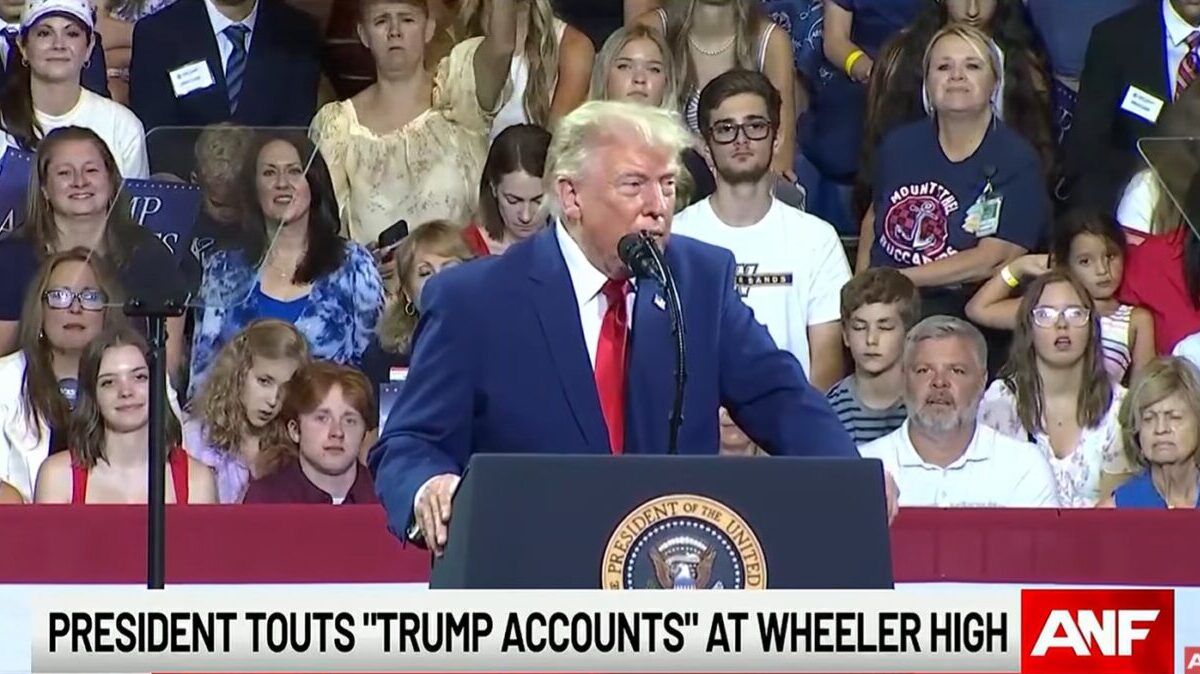
At a July 22 appearance in Marietta, Georgia, Trump told a high school crowd that “for decades, Washington gave our children nothing but debt, but Trump Accounts now create a positive financial future.”
He introduced two American families who opened accounts. Dean Fondulin, a Trump Account dad, said the program will “strengthen the fabric of America.”
“For decades, Washington gave our children nothing but debt, but Trump Accounts now create a positive financial future.”
The accounts may be more than just a nest egg for newborns. They could be the long-term cure to a government retirement system running on borrowed time.
The math doesn’t lie. In 1940, there were 42 workers funding every retiree. Now there are fewer than three. When Social Security was created, the average life span was 61 and the retirement age was set at 65. Today, the average life expectancy is 79 and retirees can collect at 62.
Today’s payouts were never part of the initial calculation.
Trump Accounts create a future where Americans build retirement wealth they actually own — not government IOUs that disappear when you die.
Ownership You Can Pass Down
One moral failure of Social Security is that it does not create an estate retirees can leave to family or charities — no matter how much they pay into the system during their working lives. Accumulated payroll taxes are not inheritable personal assets.
Money in a private investment account remains the property of the account holder and their estate, allowing families to transfer wealth across generations.
The power of compounding illustrates why this model works. The administration estimates that the initial $1,000 government contribution alone could grow to $5,800 by age 18 based on assumed market returns. If maximum contributions are made, the account could surpass $1 million by age 28.
If grandparents contribute just $250 a year for 27 years, the account is estimated to reach $51,000. If that amount is contributed until the account holder is 55, it can hit $742,000. If the annual maximum of $5,000 is invested for that same period, the retiree could have as much as $13 million.
If the annual maximum of $5,000 is invested until age 55, the retiree could have as much as $13 million.
Trump Accounts are not an immediate replacement for Social Security. But they may represent the first serious step toward a retirement system built on ownership instead of dependency.
The intellectual roots stretch back to economist Milton Friedman, who argued for decades that individuals should have ownership over their financial futures rather than relying on government-managed systems. Friedman believed expanding personal ownership and investment would produce greater prosperity, stronger incentives to save, and more economic freedom.
Trump Accounts embrace that philosophy by giving a generation of young people — many taught nothing by public schools about financial literacy, capitalism, or compounding — a real stake in the American economy.
In 2001, President George W. Bush created a commission to explore personal retirement accounts. The proposals were derailed by 9/11 and politics. But the underlying idea still makes sense.
Trump Accounts could finally realize that vision. Rather than asking young Americans to rely on a broken government transfer system, these accounts introduce them to something every economic conservative understands: participation in the American economy is for everyone.
Every dollar invested allows children to participate in the growth of the businesses, entrepreneurs, and workers who make our country prosperous.
It may be easier than learning how to use a fork.