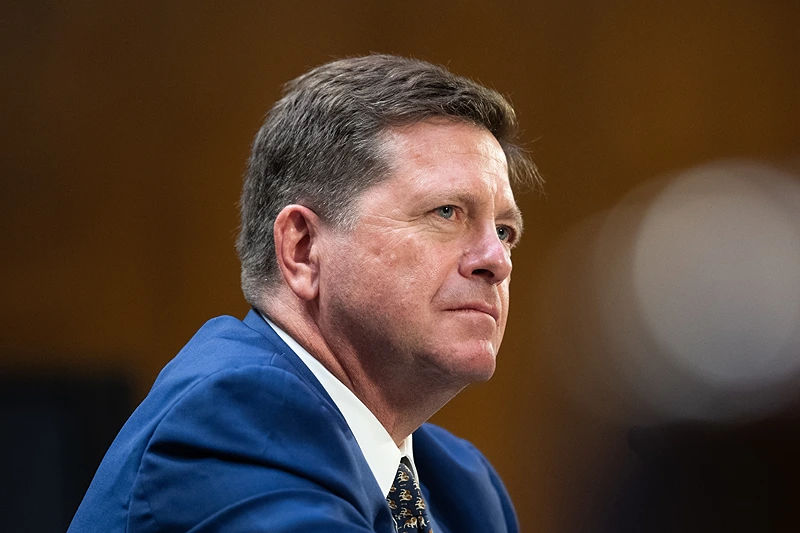
The Senate voted 51-47 along party lines Tuesday to confirm Jay Clayton as the nation’s next Director of National Intelligence, filling a critical national security role left vacant since May.
The position of Director of National Intelligence was created in the aftermath of the September 11, 2001 terrorist attacks as part of the most sweeping reorganization of the U.S. intelligence community in decades. The role serves as the principal intelligence advisor to the President and coordinates the work of the nation’s sprawling intelligence apparatus, making the extended vacancy particularly concerning to national security experts who have warned about potential gaps in coordination and oversight during the prolonged leadership transition.
Clayton, a veteran corporate attorney who served as Chairman of the Securities and Exchange Commission during President Trump’s first term and most recently as U.S. Attorney for the Southern District of New York, now assumes command of the federal agency tasked with coordinating the country’s 18 intelligence bodies.
His professional background marks a significant departure from the typical career trajectory of previous intelligence directors, many of whom rose through the ranks of military intelligence, the CIA, or other national security agencies. This unconventional resume became a central point of contention throughout the confirmation process, with critics questioning whether experience in financial regulation and federal prosecution adequately prepares someone to oversee global intelligence gathering and counterintelligence operations.
The confirmation caps a turbulent nomination process marked by delays and sharp partisan debate.
Trump’s pick hit an initial snag when the president abruptly postponed Clayton’s first scheduled confirmation hearing, prolonging a leadership vacuum created by the May resignation of former DNI Tulsi Gabbard.
The extended period without permanent leadership raised concerns among intelligence professionals and congressional oversight committees about continuity in critical operations, including ongoing counterterrorism efforts, monitoring of foreign adversaries, and coordination with international intelligence partners who rely on stable American leadership for information sharing and joint operations.
Democrat lawmakers vigorously challenged Clayton over his “lack of traditional background” in national security and intelligence operations.
Senate Democrats also heavily criticized Clayton’s refusal during questioning to state that former President Joe Biden won the 2020 presidential election.
This line of questioning reflected broader Democratic concerns about the politicization of intelligence agencies and whether Clayton would maintain the independence necessary to provide objective assessments to policymakers, even when those assessments might conflict with political preferences or narratives. The intelligence community’s credibility depends heavily on its reputation for providing fact-based analysis free from partisan influence.
The new intelligence chief inherits an office deeply altered by interim leadership.
Before Tuesday’s final vote, temporary acting director Bill Pulte announced a 30% reduction in personnel at the Office of the Director of National Intelligence. Coming on top of earlier workforce cuts initiated under Gabbard, the structural downsizing leaves ODNI with fewer than 1,000 active staff members.
The scale of these cuts represents one of the most dramatic reshapings of the office since its establishment two decades ago. Supporters and critics have offered starkly different interpretations of what this reduction means for America’s intelligence capabilities and whether the remaining workforce can effectively fulfill the coordination mandate that justified ODNI’s creation.
Republican lawmakers championed the restructuring as a long-overdue correction, arguing the reforms strip away bloated bureaucracy and restore ODNI to the sharp, agile coordination hub Congress originally intended following the 9/11 terrorist attacks.
However, critics have expressed alarm that the personnel reductions may have eliminated essential expertise and institutional knowledge, potentially compromising the office’s ability to integrate intelligence from diverse sources and provide comprehensive threat assessments to decision-makers across the executive branch and Congress.
Congressional leaders reportedly hope Clayton’s arrival will break a monthslong impasse surrounding national security legislation.
Lawmakers are facing urgent pressure to negotiate the reauthorization of Section 702 of the Foreign Intelligence Surveillance Act, a warrantless surveillance authority that expired in June after bipartisan negotiations broke down during Pulte’s temporary tenure.
Section 702 has been a cornerstone of foreign intelligence collection for years, allowing agencies to monitor non-U.S. persons located outside the United States without obtaining individual warrants. Its lapse has created what some lawmakers describe as a dangerous gap in the nation’s ability to detect and prevent foreign threats, though civil liberties advocates have long argued the program requires significant reforms to prevent abuse and protect Americans’ privacy rights.
Supporters of Clayton describe him as a pragmatist whose deep legal credentials — including overseeing notable prosecutions like the federal indictment of former Venezuelan dictator Nicolás Maduro — can help rebuild legislative trust, secure FISA reauthorization and restore steady leadership to the nation’s intelligence agency.
Clayton takes the helm at a pivotal moment for the intelligence community, with both personnel restructuring and major legislative deadlines looming.
His success will likely be measured not only by his ability to manage the day-to-day operations of a significantly reduced ODNI workforce, but also by whether he can navigate the complex political landscape on Capitol Hill to advance critical national security legislation while maintaining the intelligence community’s nonpartisan credibility in an increasingly polarized environment.