
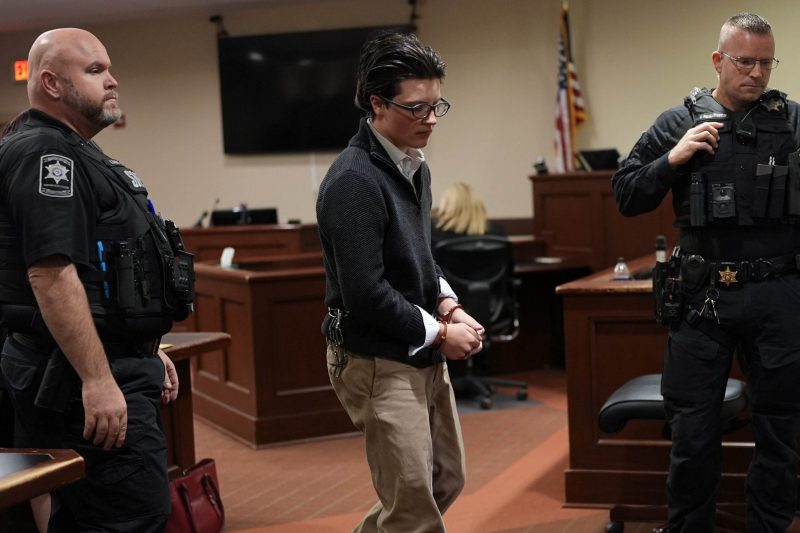
Colt Gray, now 16, was sentenced to life in prison without the possibility of parole Tuesday after pleading guilty to all 55 felony counts stemming from the 2024 attack at Apalachee High School in Georgia that left four people dead.
The sentencing marks the conclusion of a case that has gripped the state of Georgia and reignited national conversations about youth violence, parental accountability, and the persistent threat of school attacks. The 55 counts to which Gray pleaded guilty encompassed murder, aggravated assault, and related charges tied to the September attack that shattered the community of Winder, Georgia, a town of approximately 18,000 residents located roughly 50 miles northeast of Atlanta.
Piedmont Superior Court Judge Nicholas Primm delivered the sentence with words as sharp as the evidence.
“You do not seem to be tormented by what you did, you seem to relish following in the footsteps of those you idolize. You aren’t racked with guilt. You’re proud of yourself.”
The judge made clear this wasn’t a case of youthful impulse.
“You understood the horror of what you were going to do,” Judge Primm said. “This wasn’t transient immaturity. It was deliberate, contemplated evil.”
Those words reflected what prosecutors had argued throughout the proceedings: that Gray’s actions were the result of extensive planning and ideological commitment to violence, not the impulsive act of a troubled teenager. The distinction proved critical in justifying the severity of the sentence for someone who committed the crime as a minor.
Gray was 14 years old when he attacked Apalachee High School on September 4, 2024. Teachers Richard “Ricky” Aspinwall, 39, and Cristina Irimie, 53, were both targeted and lost their lives. Students Mason Schermerhorn and Christian Angulo, both 14, were also targeted.
The attack unfolded during morning classes, sending the school into lockdown and prompting a massive law enforcement response. Beyond the four deaths, several other students and staff members sustained injuries, some requiring hospitalization. The trauma extended throughout the student body of more than 1,900 students and reverberated across a community where many families have deep generational roots.
Gray declined to address the court. As he was escorted out in handcuffs, he reportedly glanced toward the gallery at his grandmother, Debbie Polhamus.
His silence in court stood in stark contrast to the detailed digital trail he left behind, which investigators meticulously documented in the months following his arrest. That evidence painted a portrait of radicalization and obsession that had developed over an extended period, raising questions about what warning signs may have been missed by family members, school officials, or others in his orbit.
Investigators described Gray’s obsession with infamous attackers. He was fixated on the 1999 Columbine High School case, the 2012 Sandy Hook Elementary case in Connecticut, and the 2018 Parkland, Florida case.
When authorities searched Gray’s bedroom, they found what they called a shrine to Nikolas Cruz — the Parkland attacker who received the same life-without-parole sentence. Gray had saved more than 2,000 photos of Cruz on his phone and taped additional images to his bedroom walls.
This pattern of veneration is not uncommon among perpetrators of mass violence, according to threat assessment experts. The phenomenon, sometimes referred to as “contagion,” involves individuals who study previous attacks and seek to emulate or surpass them. The discovery of such extensive documentation underscored the premeditated nature of Gray’s actions and bolstered the prosecution’s case that this was not a spontaneous act of adolescent rage.
The case took another turn in March when Gray’s father, Colin Gray, was convicted by a jury on second-degree charges and involuntary manslaughter for giving his son the weapon used in the attack.
The elder Gray’s conviction represented a relatively rare instance of a parent being held criminally responsible for a child’s actions in a school attack. Legal experts have noted that the case could set precedent for how courts approach parental liability when minors gain access to weapons that are then used in acts of violence. Colin Gray faces his own substantial prison sentence, though it has not yet been formally imposed.
Judge Primm acknowledged the permanence of Tuesday’s outcome.
“It’s only a measure of closure. The slain will not return to life. The injured will not forget their wounds, and a 16-year-old boy will live and die in prison.”
Gray will serve his sentence in a Georgia state facility. The case remains one of the deadliest events in Georgia school history.
The life-without-parole sentence means Gray will spend the remainder of his natural life in the custody of the Georgia Department of Corrections, with no possibility of release regardless of rehabilitation, age, or changing circumstances. For the families of the victims, Tuesday’s sentencing brings legal resolution to a tragedy that has forever altered their lives, though as Judge Primm noted, no judicial outcome can restore what was lost on that September morning.