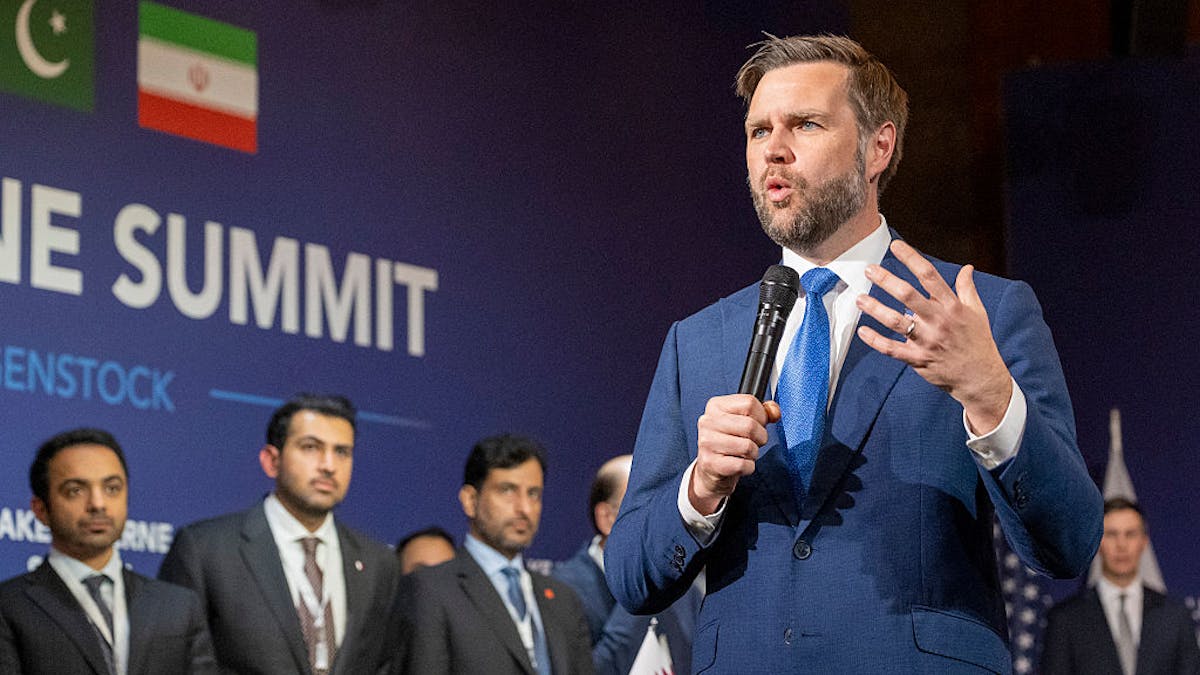
Vice President JD Vance made clear in an exclusive interview that negotiations with Iran will continue for exactly as long as President Trump wants them to — and not one moment longer.
“We’re going to keep on talking so long as the president tells us to do so,” Vance told The Daily Wire. “When the president says stop talking to the Iranians, then we’ll stop talking to the Iranians.”
The ceasefire between the United States and Iran collapsed last week after Iranian forces attacked commercial shipping in the Strait of Hormuz.
Trump declared the memorandum of understanding dead and called Iran’s leaders “scum” and “sick people” — but allowed negotiations to continue.
“When the president makes a decision, we follow that decision. And right now, the decision is talk to the Iranians.”
Vance emphasized the administration operates in lockstep on Iran strategy, with robust internal debate but unified action once Trump decides.
“What so many people from the outside of the administration don’t appreciate is that we all have obviously very robust conversations about how to solve this or that problem, but when the president makes a decision, we follow that decision,” he said.
The vice president defended the original memorandum of understanding as a strategic win for America — pointing to Iran’s failure to honor even its most basic term.
“I always found it a little curious,” Vance said. “There was so much criticism of the original MOU, oftentimes before people had even read the language, and I think what we’re finding is that the MOU was in fact a very good deal for the United States of America because the Iranians are struggling to keep even its first and most important term, which is that the Strait of Hormuz has to be open during negotiation.”
Keeping the Strait of Hormuz open was an “extraction” the U.S. demanded before even sitting down at the table — and Iran conceded it, Vance explained.
“And having conceded it, you see some people within their country saying, ‘Well, maybe we shouldn’t have conceded it.’ Well, that’s between them and their leadership,” he said. “But fundamentally, when you make a deal with the United States, you have to honor it. And if they’re going to shoot at ships, we’re going to shoot back.”
Vance laid out the next step: Iran must stop behaving like a terrorist state.
“The most important next step is that the Iranians need to make it very clear that they are done acting like a terrorist nation that shoots at commercial shipping,” he said. “And if they don’t do that, we’re not going to make any additional progress, and none of the benefits that are contemplated in the final negotiation are ever going to flow to the Iranians.”
“Donald Trump doesn’t do endless wars.”
Pressed on concerns about an endless conflict with no off-ramp, Vance pointed to Trump’s record and clear objectives.
“Every strike that we’ve done is attached to a very discreet objective that he’s trying to accomplish for the American people,” Vance said. “What he’s doing fundamentally right now is he’s focused on ensuring that commercial shipping, the free flow of oil and gas happens in that region of the world because the benefits ultimately flow to the American people.”
Vance confirmed the United States has already destroyed Iran’s nuclear program, adding “we can take further action there, but you know we’re in a situation where we have a lot of optionality.”
“I’m not worried, and I don’t think the American people should be worried, that this will become a war without objective,” he said. “That’s what an endless war is — something that just goes on forever and ever without a clear objective. The president has identified clear objectives.”
Vance reminded critics that the U.S. actually stopped shooting first — until Iran violated the deal by attacking commercial vessels.
“It’s important for the United States to enforce its red lines,” Vance said. “That doesn’t mean that we have endless war and this conflict or any other.”