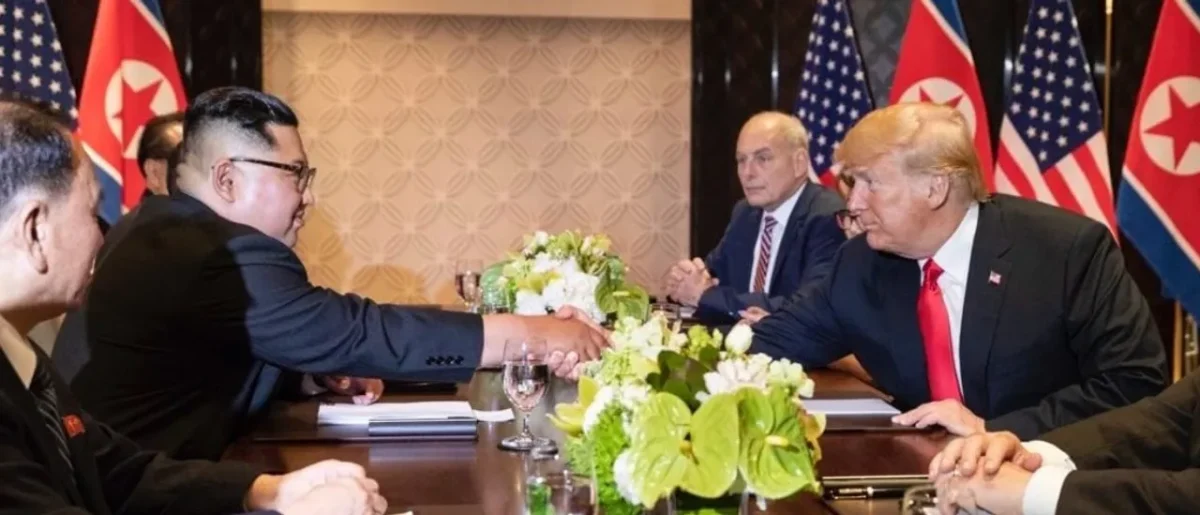
President Trump is done listening to the foreign policy establishment tell him that denuclearization is impossible.
Two Washington veterans — Jung H. Pak and Victor Cha — just published articles in Foreign Affairs essentially waving the white flag on North Korea. Pak’s piece credits Kim Jong Un with a “strange triumph,” pointing to his nuclear buildup, sanctions evasion, and alliances with Russia and China. Cha calls for a “cold peace,” arguing denuclearization is a “distant objective” and the U.S. should settle for arms control talks and coexistence with a nuclear-armed Kim.
Trump rejected this tired defeatism in his first term. He rejects it now.
The idea that Kim has “won” isn’t analysis — it’s an excuse for weakness.
Appeasement Has Failed For Decades
The bipartisan foreign policy establishment watched North Korea’s arsenal grow from zero to an estimated 50 warheads with enough fissile material for dozens more. Hundreds of missile tests. ICBMs capable of striking the U.S. homeland.
“MAXIMUM PRESSURE BROUGHT KIM TO THE NEGOTIATING TABLE. FOR THE FIRST TIME, A NORTH KOREAN LEADER NEGOTIATED DIRECTLY WITH AN AMERICAN PRESIDENT.”
The establishment’s answer? Learn to live with the threat. Lower our expectations. Sign more arms control agreements. Appease Pyongyang some more.
Not Trump.
Maximum Pressure Works
Trump’s first-term maximum-pressure campaign — tough sanctions, diplomatic isolation, threats of military force — brought Kim to the table. Nuclear testing halted in 2018. North Korea observed a moratorium on long-range and nuclear missile tests from April 2018 until late 2019. Kim stopped launching missiles over Japan.
Even Trump’s critics credited him with lowering tensions and opening a door to peace.
Biden’s Weakness Invited Chaos
The contrast with the Biden era is stark. North Korea ramped up missile testing to unprecedented levels — Kim lobbed over 70 missiles in 2022 alone, the most in North Korean history. Pyongyang forged a dangerous military alliance with Russia, supplying troops and weapons for Ukraine and reportedly receiving advanced satellite, missile, and submarine technology in return.
This North Korea-Russia axis emerged under Biden’s weakness. It’s made denuclearization harder — but not impossible.
The Ukraine Factor
Pak and Cha seem to think Kim’s ties to Moscow and Beijing make reversing this situation impossible. They’re wrong.
Trump’s America First approach never assumed North Korea could be solved in isolation. He pressured China economically. He confronted Russia when needed.
Crucially, ending the war in Ukraine — something only Trump can achieve — may be the most important step to pressure North Korea. Cutting off Russia’s advanced technology and support to Pyongyang would weaken Kim’s position and restore U.S. leverage.
“COLD PEACE” IS JUST CODE FOR MANAGED DECLINE.
Accepting a nuclear North Korea doesn’t stabilize Asia — it destabilizes it. It tells Iran, China, and every would-be proliferator that the United States lacks the will to enforce its red lines. It threatens South Korea and Japan, who rely on U.S. extended deterrence.
Trump Wants A Real Deal
President Trump has been clear: He wants a deal with Kim Jong Un, but only one that fully ends the nuclear threat. He has no interest in empty photo-ops or signing a bad deal while leaving American cities vulnerable to North Korean missiles.
Kim Jong Un has not “won.” He has survived by drawing on support from other rogue states and the weakness of the foreign policy establishment.
Trump can end this threat. Maximum pressure, personal diplomacy, and an unwavering commitment to denuclearization remain the only path to real peace.
Anything less is surrender dressed as sophistication.