The Declaration of Independence is fundamentally a unity document — not just a proclamation of liberty or equality, historian Michael Auslin argues in a new book.
Auslin, a scholar at the Hoover Institution, makes the case in National Treasure: How the Declaration of Independence Made America that the parchment’s opening words — “one people” — set the overarching framework for everything that follows.
“These were 13 very different sovereign states — New Hampshire and Georgia had almost nothing in common — and yet they were declaring themselves one people.”
Jefferson originally wrote “a people,” Auslin told the Washington Examiner. Benjamin Franklin likely changed it to “one people” as a deliberate statement.
The document then continues with “We hold these truths to be self-evident” — not I, not Congress alone — we. The founders closed by pledging their lives, fortunes, and sacred honor not to the new nation or their states, but to each other.
Auslin’s book traces both the physical parchment and its symbolic power through American history. He corrects widespread myths: independence was voted July 2nd, not the 4th. There was no parchment on July Fourth at all. Signing didn’t begin until August and continued piecemeal over weeks, possibly months.
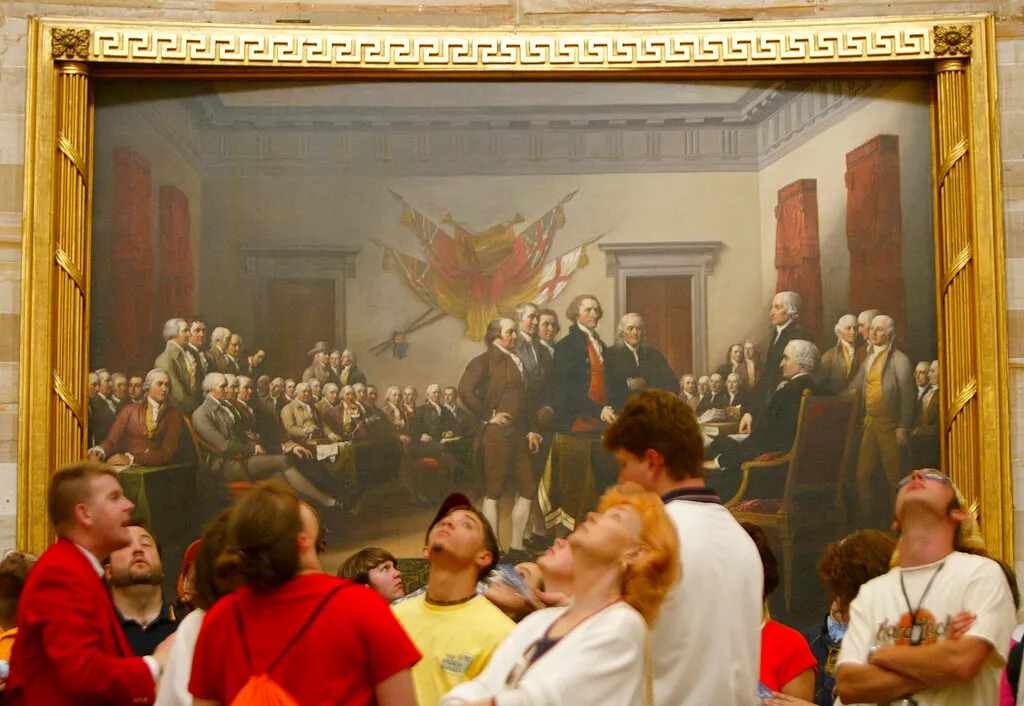
The famous John Trumbull painting in the Capitol Rotunda doesn’t depict the signing — it shows Jefferson and the Committee of Five presenting the draft to Congress.
The original parchment nearly vanished multiple times. State Department clerk Stephen Pleasonton spirited the document out of Washington just ahead of the British in 1814.
“Without him, for the past 212 years, we would have been celebrating July Fourth in front of an empty shrine.”
Auslin pushes back on both progressive revisionism and MAGA nationalism. Every group that has appealed to the Declaration since — abolitionists, suffragettes, immigrants, civil rights marchers — appealed to it not for special status, but to be fully American.
The creed is the heritage, Auslin says. Civic assimilation means everyone has an equal right to the public square, regardless of religion, ethnicity, or background.
What worries him: both Left and Right now reject that civic standard. The Left demands differential treatment and carve-outs. The Right claims a prior heritage that supersedes the creed — that some Americans are more authentically American by lineage or culture.
Both are corrosive. Both are rejections of the Declaration.
Reagan said freedom is always just one generation away from extinction. The danger today isn’t a foreign power extinguishing it — it’s Americans extinguishing it themselves.