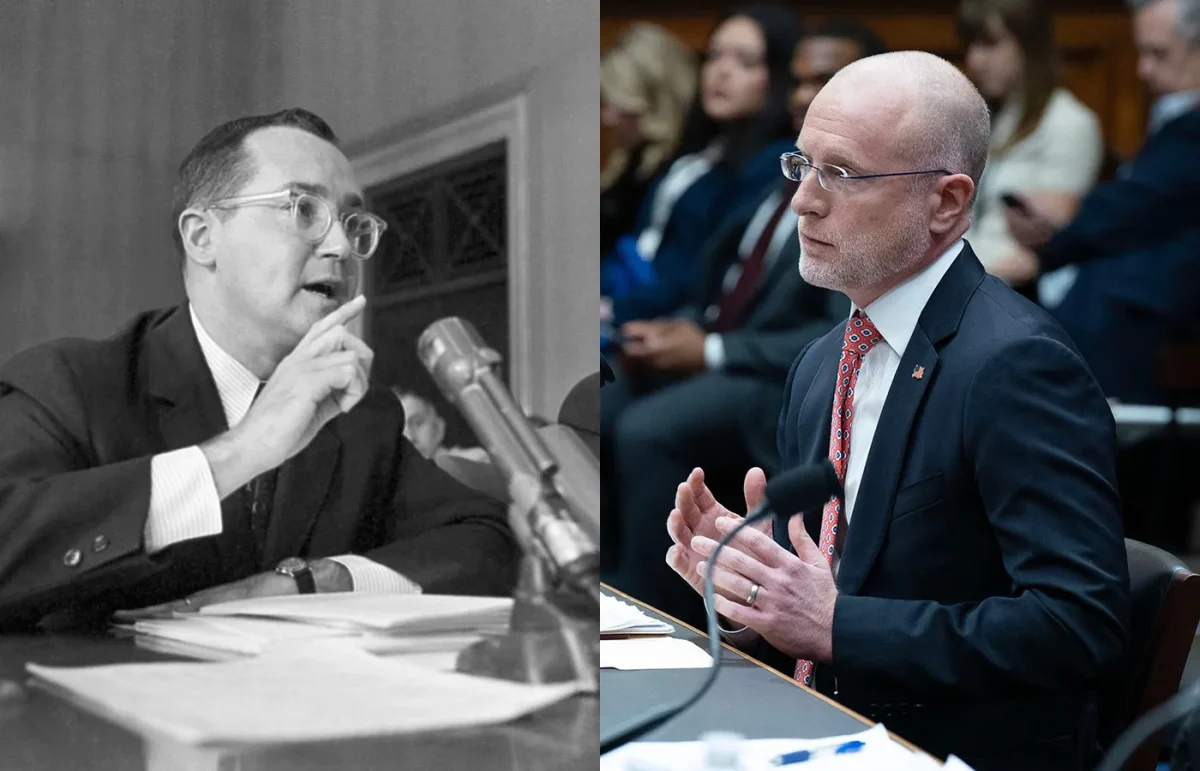
FCC Chairman Brendan Carr launched a controversial review of eight local ABC television licenses in April, targeting major-market affiliates in Chicago, New York, Los Angeles, and Philadelphia — a move that echoes a similar 1961 crackdown by another activist FCC chief under very different political circumstances.
The Federal Communications Commission ordered ABC to file license renewals by May 28, more than two years ahead of schedule, citing “possible violations of the Communications Act of 1934 and the FCC’s rules, including the agency’s prohibition on unlawful discrimination.”
ABC, owned by Disney, filed the renewal requests under protest. In its response on behalf of WABC-TV in New York, the network called the renewal order “unlawful, arbitrary and unconstitutional.”
“The Order is inconsistent with a legitimate exercise of investigative authority and is plainly incompatible with the First Amendment. Worse, the Order opens the door to an assault on the Station’s license, while the Commission searches for a legal pretext to achieve its desired goal.”
Carr’s inquiry focuses on diversity, equity, and inclusion practices at ABC stations — a priority target for President Donald Trump and conservative allies.
“No company is above the law – not even Disney. If Disney engaged in illegal DEI discrimination, if it failed to operate broadcast stations in the public interest, it will be held accountable,” Carr said in a May 28 X post.
The timing of the review — one day after Trump and first lady Melania Trump said ABC should fire late-night host Jimmy Kimmel over his joke that she looked like an “expectant widow” — prompted backlash from a dozen Democratic senators.
“The FCC order, sent under your leadership, appears to be a blatant effort to punish Disney for its editorial decision-making, notably its refusal to fire Kimmel over a recent joke,” wrote the senators, including Senate Minority Leader Chuck Schumer and Sen. Ed Markey.
“Although the FCC has the authority to ensure broadcasters operate in the public interest, it cannot serve as President Trump’s roving censor, threatening to revoke licenses against broadcasters whose editorial content – including a comedian’s jokes – displeases the President.”
But it’s not just Democrats raising concerns. Several Republicans and conservatives criticized Carr’s review when it was announced in April, according to Semafor.
“I do not believe the FCC should operate as the speech police,” Sen. Ted Cruz, the Senate Commerce Committee chairman, told Punchbowl.
Rep. James Comer, chairman of the House Oversight Committee, offered this advice in an interview with NewsNation: “I would hope that if my friend Brendan Carr is looking at something on ABC, it has more to do than with a few tasteless jokes.”
The move has a surprising historical parallel. Sixty-five years ago, Newton N. Minow — an appointee of President John F. Kennedy — also threatened to yank TV stations’ licenses in a famous May 1961 speech to the National Association of Broadcasters.
Minow, then a 35-year-old lawyer, famously derided the quality of TV programming as a “vast wasteland” and warned 2,000 broadcast executives that “there is nothing permanent or sacred about a broadcast license.”
Both chairmen flagged TV networks on “diversity,” but meant the word in far different ways. While Carr targets DEI practices, Minow demanded programming variety: “You must provide a wider range of choices, more diversity, more alternatives.”
In response to both Minow and Carr, critics claimed the FCC was violating the First Amendment. Some network executives compared Minow’s actions to censorship out of the Soviet Union playbook.