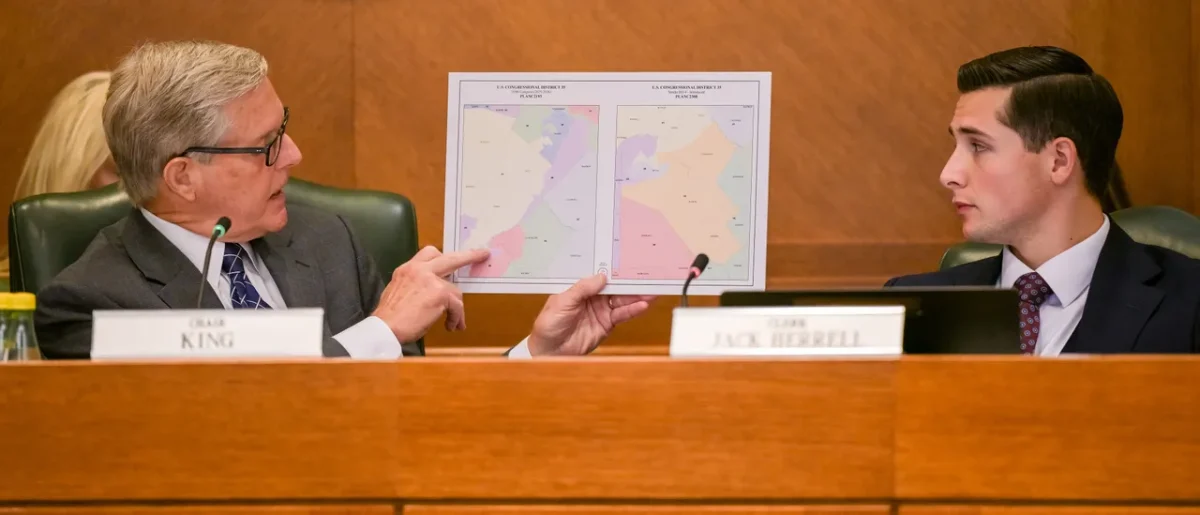
Republicans are emerging as clear winners in the 2026 midterm redistricting battle, securing favorable maps in eight of ten states that redrew congressional districts this cycle — but mounting polling headwinds and an unpopular Iran war could wipe out those gains.
Republican consultant Jim Ellis said Thursday that the GOP stands to gain between five and 12 seats from the redrawn maps across ten states — the most to redistrict mid-decade since the 1800s, according to the National Conference of State Legislatures.
Republicans’ performance during the midterms will still hinge on the Trump administration’s Iran war and skyrocketing gas and grocery prices, according to Ellis.
Texas led the charge in July 2025, passing a new GOP-friendly map after Democratic lawmakers fled the state to block the vote. The map will likely flip three to five Democratic-held seats red. The Supreme Court gave Texas the green light to use the map in December 2025.
Florida Gov. Ron DeSantis signed a May 4 map seeking to flip four Democratic House seats into Republican control. The aggressive map leaves none of the redrawn seats rated “Solid R” by Cook Political Report — despite all voting for Trump by at least nine points in 2024.

Days after Florida’s map dropped, the Supreme Court struck down a portion of the Voting Rights Act of 1965 mandating race-based gerrymandering in the South. Alabama, Louisiana, and Tennessee each redrew their maps, creating a new Republican-favoring seat in each state.
North Carolina changed a Democratic-held seat Trump won by three percentage points in 2024 to one he won by 12. Ohio changed Rep. Marcy Kaptur’s seat from one Trump carried by under seven points to one he won by nearly 11.
Democrats struck back in November 2025 when California voters passed Proposition 50 — a lopsided gerrymander backed by Gov. Gavin Newsom seeking to flip up to five Republican-held seats. Deep-red Utah also created a safely blue Salt Lake City seat after a Republican-appointed judge’s ruling, replacing the deep-red seat held by retiring Rep. Burgess Owens.
Democrats prematurely celebrated after Virginia voters narrowly passed a gerrymander that could have given them four additional House seats. The state supreme court struck it down 17 days later.
The Problem: Gas Prices and an Unpopular War
The Real Clear Politics polling average between May 7 and June 2 shows Democrats ahead by six points in the 2026 House generic ballot. Recent Democratic upset victories in special elections for Texas and Florida state legislative districts suggest a blue wave similar to 2018.

Polling has showed the Iran war to be among the least-popular conflicts in American history.
Even with the GOP gaining a dozen seats due to redistricting, the party can still lose control of the House.
Ellis noted that in Texas and California, multiple seats drawn as flips may remain with their current parties. He specifically referenced two GOP-targeted seats in the heavily-Hispanic Rio Grande Valley — the 28th and 34th Districts. In California, he named the 22nd District held by Rep. David Valadao and the open 48th District.
Ellis is confident the DeSantis-signed Florida map will hold despite a Democratic wave year, pointing to massive Republican Party registration gains in the state.
“In 2018 there were 257,000 more registered Democrats than Republicans” in Florida, Ellis told the Daily Caller News Foundation. “Today, there’s 1.5 million more Republicans than Democrats. That’s the difference. And that’s what the pollsters miss. And that’s why the polling has been wrong in Florida in almost every election since 2018.”
How the Redistricting War Really Started
Ellis said the redistricting battle’s origins are “way different than what the media likes to portray.”
Contrary to Democratic talking points that Texas launched a “Republican power grab,” the efforts trace their roots to a federal court case a year earlier. The Biden-era Justice Department brought the case Petteway v. Galveston County after a heavily Republican Texas county eliminated a racially gerrymandered majority-minority seat. The Fifth Circuit ruled in 2024 that the district was not protected under the Voting Rights Act.

“At that point, the Justice Department informed the state of Texas that their congressional map, based upon that ruling, was illegal and had to be redrawn,” Ellis said. “That’s why redistricting started.”
Ohio was also forced to redraw its map by state law. The Buckeye State has a unique procedure involving both the legislature and a bipartisan commission. Since the legislature failed to pass Ohio’s post-2020 Census map by a three-fifths vote in 2021, the map was only allowed to stand for two election cycles — 2022 and 2024.
“So, Gov. Newsom in California then sees, ‘Well, if Texas and Ohio are redrawing and getting all these new Republican seats, we’re going to redraw California, and we’ll get five seats to negate that,” Ellis added. “Then it started off a chain reaction.”
More Redistricting Ahead
Ellis predicted another redistricting wave prior to the 2028 House elections, citing the Louisiana v. Callais case and possible retaliation from blue states.
“In coming elections now we can anticipate another round of redistricting based on the Louisiana case in 2028,” he said. “Some of the Democratic states that do the same — New York — I guarantee you they’ll redistrict.”

Looking into the 2030s, Ellis said overwhelming population gains projected for Florida and Texas compared to losses in California and New York are poised to give the GOP more seats when all states redistrict prior to the 2032 elections.
If apportionment after the 2030 census is carried out using 2025 population estimates, California would lose four congressional seats while Texas would gain four and Florida would gain two, according to the American Redistricting Project. Idaho and Utah would gain one each, while New York, Rhode Island, Oregon, Illinois, and Minnesota would each lose one.
The event in which Ellis spoke marked the launch of the America’s Economy First speaker series at Navigators Global’s Washington, D.C. office.