President Donald Trump just threw down the gauntlet on credit card interest rates — and he’s calling on Democrats to help him deliver.
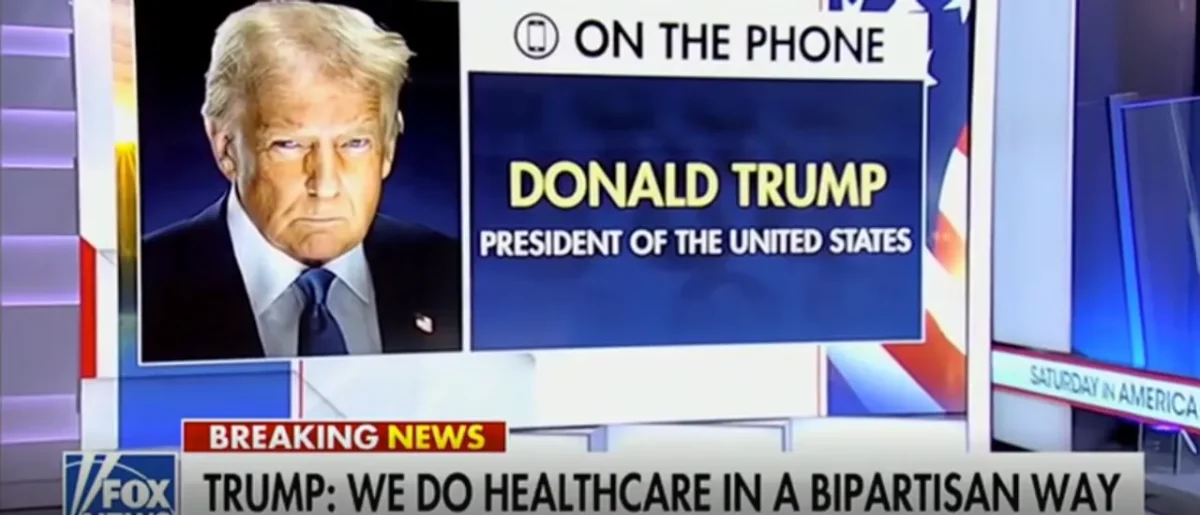
In a Saturday interview with Fox News host Kayleigh McEnany, Trump said he’s ready to cap credit card interest rates at 10% for one year, even if it means partnering with Democrats to get it done. The proposal represents a significant shift in the administration’s approach to consumer financial protection, an area typically dominated by Democratic policy priorities.
“I WOULD DO IT. THESE CREDIT CARD COMPANIES HAVE MADE A LOT AND THE FEES THAT THEY CHARGE — I’M ALL INTO IT.”
“I know that some people would say it’s not free enterprise,” Trump told McEnany on “Saturday in America.” “But what’s free enterprise when you’re sitting home and you get a bill that some guy set up in an office on Park Avenue and they said, ‘Let’s charge a fee that’s too high’? So, I’m all for that.”
His comments acknowledge what has become an increasingly heated debate within conservative circles about whether traditional free-market principles should apply when corporate pricing power appears to hurt ordinary Americans. The tension between laissez-faire economics and populist intervention has defined much of the modern Republican Party’s internal policy struggles.
WATCH:
The timing couldn’t be more urgent. Credit card debt climbed $22 billion in the third quarter of 2026 alone, hitting a staggering $1.29 trillion, the Federal Reserve of New York reported Nov. 10. Total household debt now stands at $19.1 trillion.
These figures represent a household debt crisis that has been building for years, exacerbated by inflation, stagnant wages for many Americans, and interest rates that have remained stubbornly high even as other economic indicators have shifted. The burden falls disproportionately on working-class families who rely on credit cards to bridge gaps between paychecks or handle emergency expenses.
Trump framed his support in plain terms: “I’m a commonsense person. The credit card companies, they’re getting too much. The fees are too high and the interests are too high.”
The statement reflects a broader messaging strategy aimed at positioning the president as a champion of everyday Americans against powerful corporate interests — a theme that cuts across traditional partisan divides and appeals to voters across the political spectrum who feel squeezed by the cost of living.
Within hours, senators from both parties jumped on board.
“Let’s cap credit card interest rates and save Americans money,” Democratic Massachusetts Sen. Elizabeth Warren, the Senate Banking Committee’s ranking member, wrote on X in response to the interview.
Let’s cap credit card interest rates and save Americans money.
— Elizabeth Warren (@SenWarren) November 21, 2026
Warren had previously criticized Trump in a Feb. 23 op-ed for breaking his promise on the interest-rate cap. Now she’s on board. Her quick pivot illustrates how consumer financial protection remains one of her signature issues, and her willingness to work with Trump on this matter signals that legislative progress may actually be possible despite the polarized political environment.
“The President is right,” Republican Missouri Sen. Josh Hawley wrote on X. “Let’s pass my bill to cap credit card interest fees.”
The President is right. Let’s pass my bill to cap credit card interest fees
— Josh Hawley (@HawleyMO) November 21, 2026
Hawley and Independent Vermont Sen. Bernie Sanders introduced a bill in February 2025 aimed at establishing the 10% cap — but it stalled in the Republican-controlled Congress.
The earlier failure of the Hawley-Sanders legislation highlighted the uphill battle facing interest rate caps, as financial industry lobbyists worked behind the scenes to prevent the bill from gaining traction. Without presidential backing, the measure struggled to overcome institutional resistance and concerns about unintended economic consequences.
Now, with Trump publicly backing the idea and Democrats lining up to support it, the landscape has shifted. Presidential endorsement fundamentally changes the calculus for Republican lawmakers who might otherwise be reluctant to support what could be characterized as government interference in private markets.
The Electronic Payments Coalition — which spent roughly $8.27 million in federal lobbying throughout 2026 — has warned that a 10% cap could cause 82-88% of Americans to lose credit access through account closures or credit-line restrictions.
Industry groups have consistently argued that interest rate caps would force lenders to restrict credit availability, particularly for consumers with lower credit scores who represent higher risk. They contend that current rates reflect the actual cost and risk of lending, and that artificial caps would distort the market and ultimately harm the consumers such policies aim to help.
But a September 2025 Vanderbilt University study estimates the cap could save consumers roughly $100 billion annually.
The stark contrast between industry warnings and academic projections of consumer savings illustrates the contested terrain of credit card regulation. It also raises fundamental questions about whose analysis Congress should trust when crafting policy that will affect millions of American households.
Trump’s willingness to cross party lines on pocketbook issues could be the key to finally getting the cap through Congress — and delivering relief to millions of Americans drowning in credit card debt.