
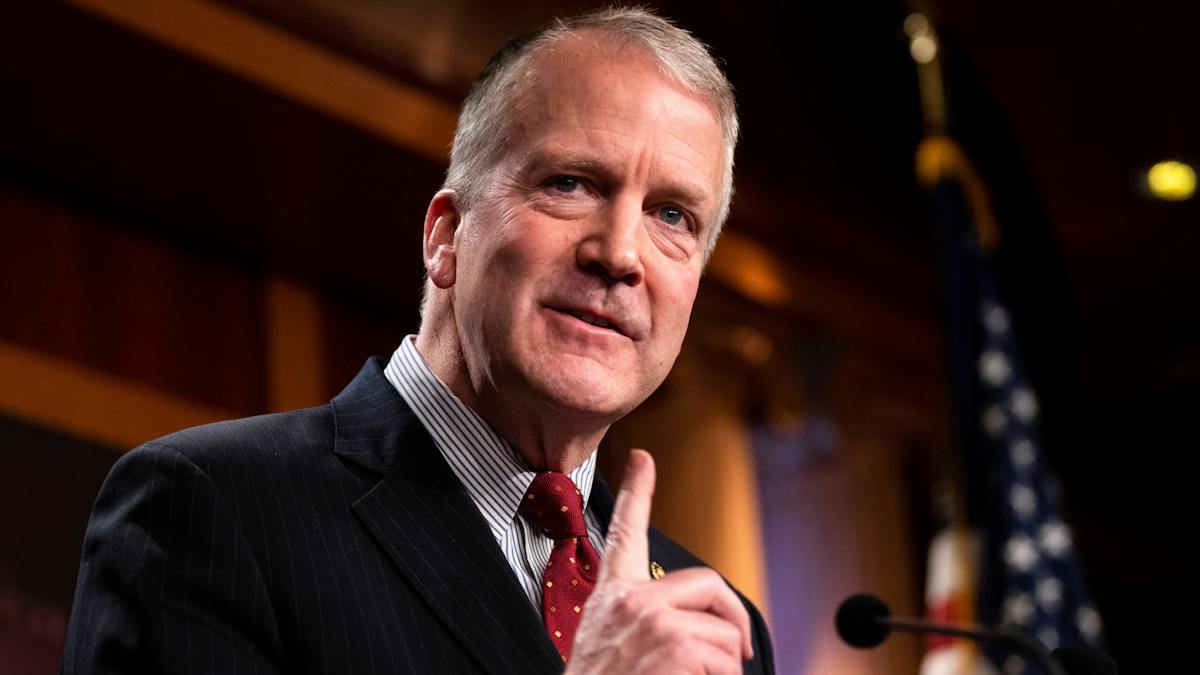
The Trump administration is fighting to stop what Republicans call a ballot rigging scheme in Alaska — where a retired teacher with an almost-identical name to Republican Sen. Dan Sullivan is running for the same Senate seat.
The Justice Department filed a federal lawsuit Thursday demanding the power to delay election certification if voter confusion over the nearly matching names costs Sullivan his seat.
The lawsuit targets Daniel J. Sullivan Jr., a challenger Republicans believe was recruited specifically to siphon votes away from the incumbent senator and hand the race to Democrat Mary Peltola, a former congresswoman.
“The United States accordingly brings this lawsuit to protect the integrity of the 2026 Senate election in Alaska.”
Alaska election officials originally rejected the challenger’s candidacy, concluding it wasn’t filed in good faith. A state judge overturned that decision, and the Alaska Supreme Court let him stay on the ballot.
The legal journey to this point has been winding. Election officials’ initial rejection signaled serious concerns about the challenger’s motivations, but state courts have consistently sided with his right to appear on the ballot. The Alaska Supreme Court’s decision to allow Daniel J. Sullivan Jr. to remain in the race effectively exhausted state-level remedies, setting the stage for federal intervention.
The Trump DOJ is now asking a federal court to block certification if Sullivan loses — but would have won if votes cast for the similarly-named challenger had gone to the incumbent senator instead under Alaska’s ranked-choice voting system.
This legal strategy represents an unprecedented approach to election oversight. Rather than challenging results after the fact, the Justice Department is seeking what amounts to conditional authority — a mechanism that would only trigger if specific vote-splitting scenarios materialize. Legal experts note this preemptive framework raises novel questions about federal versus state authority over election administration.
Trump himself has repeatedly slammed the challenger and Alaska’s ranked-choice system. At an October 13 rally in the state, he called the system vulnerable to “damn bad cheating.”
The president’s criticism reflects broader Republican frustration with ranked-choice voting systems, which have gained traction in several states as reforms intended to moderate partisan polarization. Alaska adopted the system through a 2020 ballot initiative, making it one of only two states to use ranked-choice voting for federal elections. Republicans have blamed the system for unexpected losses in previous cycles, arguing it creates opportunities for strategic manipulation.
The numbers tell the story. In the August primary, Sen. Sullivan received approximately 41.4% of the vote. Peltola got 49.5%. Daniel J. Sullivan Jr. pulled 2.5% — a margin Republicans fear could decide the general election.
That 2.5% represents roughly several thousand voters in a state where margins can be razor-thin. Alaska’s small population means even modest vote splits can prove decisive. The mathematical reality is stark: if even a fraction of those who voted for Daniel J. Sullivan Jr. in the primary were confused about which Sullivan was the incumbent senator, it could alter the final outcome after ranked-choice tabulation.
Alaska’s ranked-choice system allows voters to rank candidates by preference. If no one wins a majority of first-choice votes, the lowest-performing candidate is eliminated and ballots are redistributed to voters’ next choices. The process repeats until someone reaches a majority.
That’s exactly the scenario where a spoiler candidate with a confusingly similar name could flip the outcome.
The mechanics of ranked-choice voting amplify concerns about voter confusion in ways that traditional plurality systems might not. Under a conventional first-past-the-post system, the name confusion would still matter, but the ranked-choice redistribution process creates an additional layer where those confused votes could prove pivotal during elimination rounds. This dynamic is at the heart of Republican concerns about the system’s vulnerability to strategic candidacies.
The challenger has denied being part of any scheme. “I have every right to run for whatever office I’m qualified for, and I’m qualified for this office,” he told the Associated Press in June.
Peltola’s campaign has denied any involvement in recruiting the challenger.
The DOJ complaint was filed less than two weeks before Election Day on November 3. Attorney General Todd Blanche addressed the timing Thursday, telling reporters the department has no intention to “improperly interfere with elections or the state certification process,” according to the Washington Post.
The compressed timeline creates significant practical challenges for all parties involved. Election administrators must prepare for the possibility of delayed certification while simultaneously conducting normal election operations. The close proximity to Election Day also raises questions about voter awareness and whether the lawsuit itself might influence turnout or voting behavior.
The case was assigned to U.S. District Judge Sharon Gleason, an Obama appointee.
Sullivan campaign spokesman Nate Adams said the campaign would “let the DOJ complaint run its course,” adding that Alaskans can distinguish the senator from his challenger, Politico reported.
The lawsuit marks a rare preemptive move — asking a federal court to intervene in election certification before votes are even cast.
Federal courts have historically been reluctant to intervene in state election processes absent clear constitutional violations, preferring to let state systems resolve disputes through their own mechanisms. This case tests those boundaries by seeking prospective relief rather than retrospective remedy. The outcome could establish new precedents for how federal authorities can engage with state election administration when allegations of bad-faith candidacies arise.