Denmark keeps the flag. America gets the keys. Beijing gets a polite note saying the position has been filled.
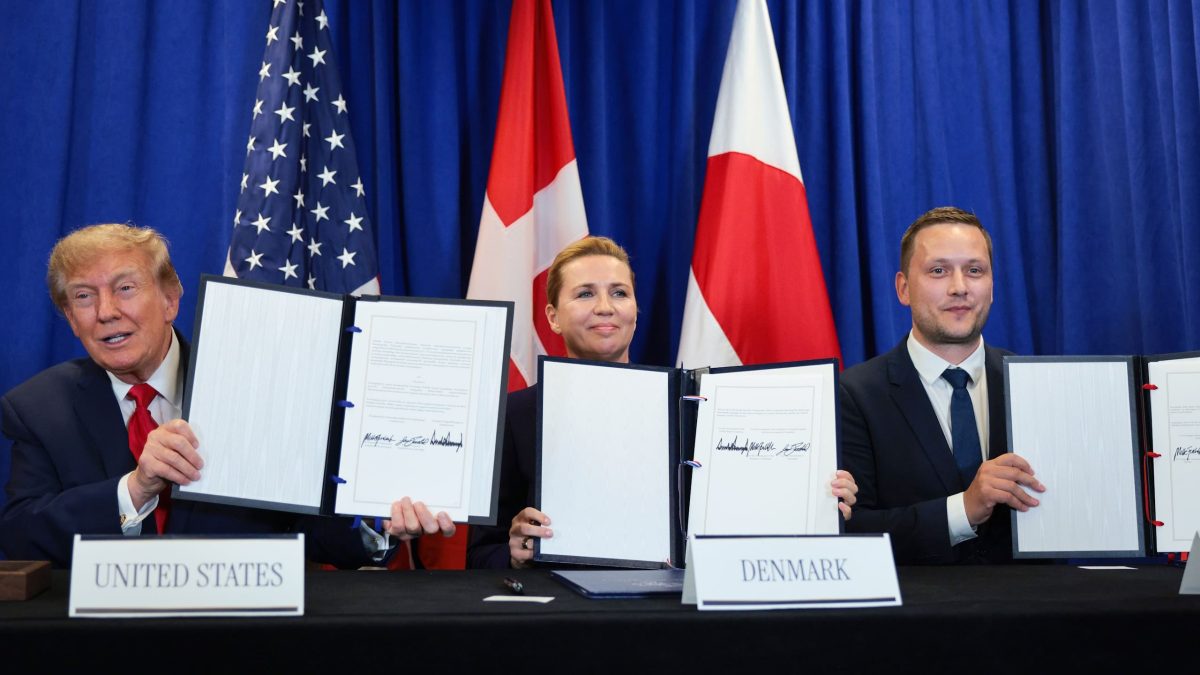
On September 19, the United States, Denmark, and Greenland signed a deal giving America permanent military access, basing rights, and overflight authority on the world’s largest island — while barring China, Russia, and every other non-NATO power from establishing a base there. For seven years, the intellectual set treated Donald Trump’s interest in Greenland as a late-night punch line. The punch line became a signed agreement.
This is the Trump Corollary to the Monroe Doctrine in action.
“Denmark keeps the flag. America gets the keys. Beijing gets a polite note saying the position has been filled.”
Washington skipped the fee-simple purchase nobody would sell and negotiated a perpetual easement with an exclusivity clause instead. Presidents tried the purchase route before — Harry Truman offered Denmark $100 million in gold for Greenland in 1946. Copenhagen passed then too.
The doctrine has deep roots. In December 1823, Monroe told Congress the Americas were “henceforth not to be considered as subjects for future colonization” by European powers. Then in 2013, Secretary of State John Kerry announced “the era of the Monroe Doctrine is over.”
Beijing noticed.
Last year’s National Security Strategy reversed Kerry. It pledges to “reassert and enforce the Monroe Doctrine” and deny outside competitors the ability to “own or control strategically vital assets” in this hemisphere. January’s National Defense Strategy named Greenland, the Gulf of America, and the Panama Canal as key terrain requiring guaranteed military and commercial access.
The operative phrase: “own or control.” Monroe worried about redcoats and Spanish men-of-war. The modern threat wears a hard hat and carries a loan agreement.
Spin a globe instead of staring at a flat map — the logic jumps out. The shortest route for a Russian missile to Chicago or New York runs over the top of the world. Pituffik Space Base in northwest Greenland sits under that route. Its 12th Space Warning Squadron runs a phased-array radar with three missions: missile warning, missile defense, and space domain awareness.
Every minute of warning it buys is a minute a president doesn’t have to guess.
That matters more now that Trump has committed to a Golden Dome missile shield the administration priced at $175 billion out of the gate, though the Congressional Budget Office puts a comparable architecture at up to $1.2 trillion over 20 years. Either way, interceptors are expensive paperweights without sensors, and the Arctic is where they need to be.
You don’t build a shield that costly on a lot you might lose when Copenhagen’s coalition math changes. This agreement, officials say, has no expiration date and survives even if Greenland someday chooses independence.
“You take the high ground before the fight starts, not during it. Pituffik is the high ground, and we now hold it.”
Beijing has been working the Greenland angle for years. In 2018, China declared itself a “near-Arctic state” — a neat trick for a country whose capital sits farther from the North Pole than Berlin — and rolled out a “Polar Silk Road.” A Chinese state-owned builder chased Greenland’s airport contracts until Denmark outbid it. China’s Shenghe Resources is the largest shareholder in the company holding Kvanefjeld, among the three biggest rare earth deposits outside China.
Russia has reopened about 50 Soviet-era Arctic military posts, including 13 air bases.
None of that required a single soldier. Their method is one every distressed-debt investor recognizes: lend first, own the collateral later. A commercial port becomes a naval logistics hub. The new agreement reportedly requires America’s express written approval for sensitive investments, which closes any side door Monroe never had to think about.
That same playbook has been running at the other end of the hemisphere. After Secretary of State Marco Rubio’s February 2025 visit, Panama quit China’s Belt and Road Initiative. This past January, Panama’s Supreme Court voided the concession that let Hong Kong-based CK Hutchison run the Balboa and Cristóbal ports since 1997, and a Maersk subsidiary stepped in.
No Marines landed. Roosevelt sent gunboats and customs collectors. Trump sent term sheets.
The terms answer critics who call this a sphere-of-influence policy in a security costume. The deal explicitly recognizes Danish territorial integrity, and the Greenlandic people retain the right to choose independence on their own schedule. For the first time, Nuuk sat at the table as a direct negotiating partner, not as a territory managed from Copenhagen.
Danish Prime Minister Frederiksen called it a “great agreement,” and Greenland’s Jens-Frederik Nielsen said it was “to the benefit of us all.”
When the party with the leverage leaves the other’s sovereignty intact and self-determination rights on the table, that’s a negotiation, not an occupation.
Vacuums don’t stay empty. If America doesn’t hold the Arctic high ground, Beijing and Moscow will fill it. Better the strong party be a democracy that negotiated for the keys.
The deal isn’t finished. It still needs signatures and approval from the Danish and Greenlandic parliaments, and the full text hasn’t been released. Three things should happen next:
Congress should demand the text and hold hearings. The president says the deal comes at “no cost” to taxpayers. Show us the funding plan.
Fund the follow-through. The Coast Guard’s only heavy polar icebreaker, Polar Star, is roughly 50 years old; contracts for 11 new Arctic Security Cutters are a start. Keep that money flowing and add Arctic sensors to the Golden Dome budget.
Bring private capital to the table. An investment screen only works with a better offer attached. American and allied money should compete for Greenland’s minerals, so Nuuk never again has to choose between a Chinese loan and no alternative.
Seven years of mockery stood in the way. The better move turned out to be a lease. On September 19, America prepared. Now Congress should read the fine print, pay for what we’ve promised, and let Beijing find another “near-Arctic” hobby.