
President Donald Trump’s tariff fight with Canada is about to land squarely on Michigan car buyers — and the timing couldn’t be worse for Republicans defending a Senate seat this November.
The battleground state ships $21.2 billion in exports to Canada annually, about 36% of Michigan’s total, mostly vehicles and auto parts. Now Trump’s escalating trade war threatens to spike prices at dealerships across the state just as voters head to the polls.
Michigan’s economic relationship with Canada represents one of the most integrated cross-border trade partnerships in North America. Decades of automotive manufacturing agreements have created a seamless production ecosystem spanning the Great Lakes region, with Canadian provinces like Ontario serving as essential links in the supply chain that keeps Detroit’s Big Three automakers running. This interdependence has historically benefited both nations, allowing manufacturers to optimize costs and efficiency through specialized production facilities on each side of the border.
The state’s manufacturing sector employs hundreds of thousands of workers whose livelihoods depend on the smooth flow of goods across the border. Any disruption to this carefully calibrated system ripples through communities from Detroit to Grand Rapids, affecting not just autoworkers but also the suppliers, logistics companies, and service industries that support vehicle production.
David Clement, policy director of the Consumer Choice Center, told Fox News Digital the costs are inevitable.
“How you see this as a Michigan consumer is higher prices on the dealership lot.”
Clement called tariffs stacked on top of already-elevated inflation a “double whammy” for Michigan families.
Consumer prices have remained a persistent concern for American households following the inflationary spike of recent years. While inflation has cooled from its peak, many families are still adjusting to higher baseline costs for groceries, housing, and transportation. The prospect of additional price increases on major purchases like vehicles — often the second-largest expense after housing for most families — threatens to compound existing financial pressures.
The president imposed an additional 50% tariff on certain Canadian products earlier this year. The administration has since barred other Canadian goods from entering the U.S. beginning Sept. 29.
Michigan ranks seventh nationally in export vulnerability to the trade dispute, according to Clement, with equipment, machinery, and the auto industry taking the biggest hits.
The state’s integrated supply chain with Canada compounds the pain. A single auto component can cross the U.S.-Canada border up to eight times before a vehicle is completed, Clement said.
This multi-crossing phenomenon reflects the sophistication of modern automotive manufacturing, where raw materials might be processed in one location, stamped into parts in another, assembled into sub-components elsewhere, and finally integrated into vehicles at a different plant entirely. Each border crossing under the new tariff regime represents another opportunity for costs to accumulate, transforming what were once negligible transportation expenses into significant price adders.
“When you are tariffing automotive parts going across the border each way, that is where the exposure numbers start to tick up,” he explained.
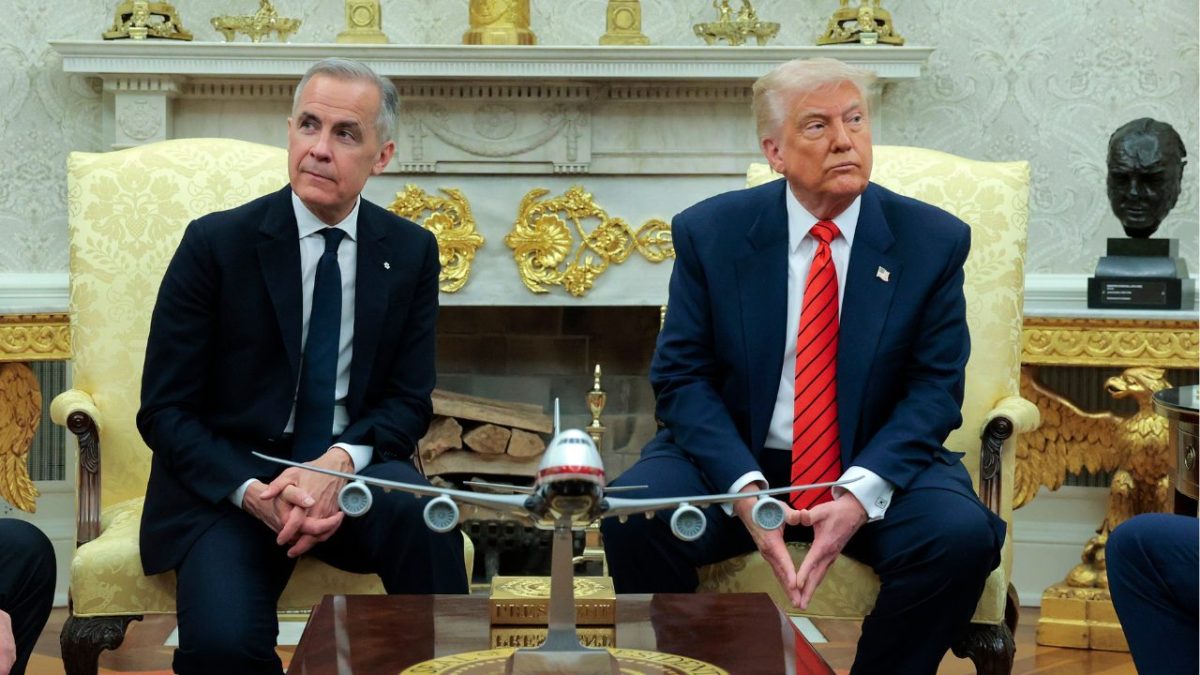
The trade fight with Canadian Prime Minister Mark Carney has broken down into tit-for-tat tariff escalations, with both countries imposing new measures targeting each other’s goods.
Trade disputes between allied nations often follow this retaliatory pattern, with each side responding to the other’s protective measures with their own countermeasures. What begins as a targeted action can quickly spiral into broad economic friction affecting industries far removed from the original point of contention. The current escalation represents a significant departure from the cooperative trade relationship that has characterized U.S.-Canada relations for generations.
Politically, the timing is brutal. Democrat Abdul El-Sayed and Republican Mike Rogers are locked in a tight race for the Senate seat being vacated by retiring Democratic Sen. Gary Peters.
Senate races in swing states like Michigan often hinge on narrow margins, with economic conditions playing an outsized role in voter decision-making. The state’s status as a perennial battleground means both parties pour enormous resources into races here, and any shift in the economic landscape can tip close contests. Voters in automotive-dependent communities will be weighing their personal financial situations against broader political considerations as they make their choices.
The Trump administration has defended its tariffs as necessary to protect American businesses and level the playing field with Canada.
But Clement warned the economic reality could undercut that message.
“It would appear that Donald Trump’s original escalation against Canada has somewhat backfired in terms of the midterms.”
American manufacturers relying on Canadian inputs are going to feel the squeeze right as voters cast ballots, Clement said. Cost of living, cost of goods, and cost of doing business remain top factors for Americans heading into November.
Economic issues consistently rank among the highest priorities for voters across the political spectrum, often overshadowing other policy debates when household budgets feel squeezed. The concentration of these effects in a key swing state with a competitive Senate race creates a political vulnerability that could reverberate beyond Michigan, potentially affecting the balance of power in Washington.
Michigan’s deeply intertwined auto supply chain with Ontario means tariffs and retaliation “really gum up” production, Clement added — and that mess lands on dealership lots just in time for the midterms.