
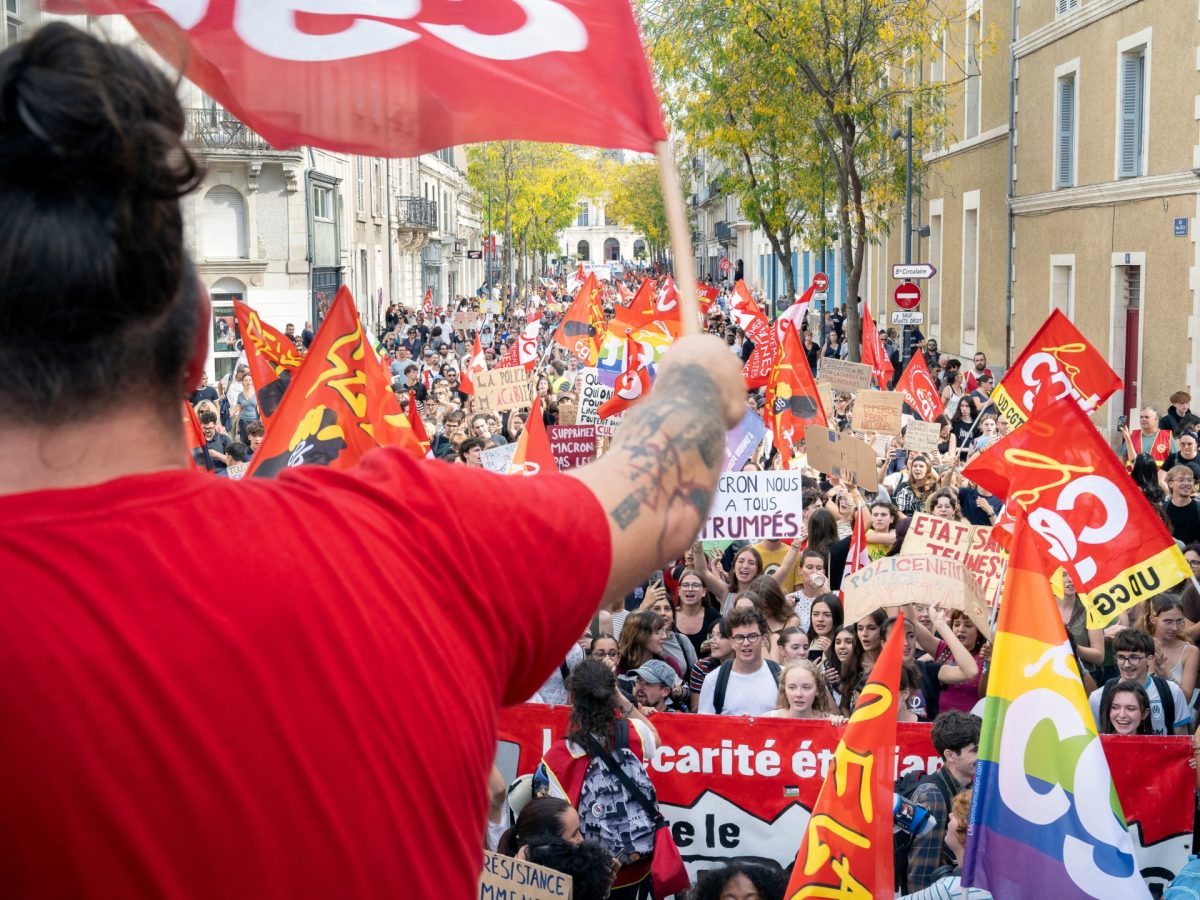
Over 400 individuals were detained in France on Tuesday as violent student protests swept across the country — two-thirds of them minors, according to the French Interior Ministry.
What started as high school student demonstrations demanding better school conditions exploded into full-scale riots across France’s major cities. Protesters set fire to rubbish bins, hurled projectiles at police, and clashed with law enforcement responding with batons and tear gas. The scale and intensity of the violence has raised questions about the underlying tensions within France’s public education system and the broader frustrations affecting French youth.
The violent protests come just hours before President Emmanuel Macron’s government is set to unveil its 2027 budget — a spending plan that reportedly contains significant cuts to public services. The timing has amplified concerns among educators and students that the education sector may face further resource constraints, adding urgency to the demonstrations. France’s education system has been under mounting pressure for years, with teachers and administrators warning that chronic underfunding has created a crisis that affects millions of students nationwide.
“WHAT IS LEGITIMATE ARE THE DEMANDS, WHEN THEY RELATE TO SCHOOL LIFE. A CRIME OR AN OFFENSE IS NEVER LEGITIMATE BY DEFINITION IN A DEMOCRACY.”
The unrest began in the Ile-de-France region surrounding Paris but quickly spread to other cities in the following days. Students initially demanded solutions to teacher shortages and overcrowded classrooms — core grievances about France’s faltering education system. These long-standing issues have been documented repeatedly by education unions and parent organizations, who argue that years of neglect have left schools struggling to provide adequate instruction and safe learning environments.
But Tuesday’s protests escalated far beyond peaceful demonstrations. Between 200,000 and 300,000 protesters — students, teachers, and public-sector workers — took to the streets demanding more resources and solutions to loss of purchasing power, according to Le Monde. Protesters blockaded school entrances before the violence began. The broad coalition of demonstrators reflects growing discontent not only within the education sector but across France’s public service workforce, where employees have increasingly voiced concerns about wages that fail to keep pace with inflation.
At least 31 protesters were injured during the clashes. The injuries underscore the severity of confrontations between demonstrators and security forces deployed to restore order in affected areas.
Interior Minister Laurent Nuñez told BFMTV on Tuesday night that at least 440 detentions took place across France — and emphasized his office doesn’t yet have the full count. The unprecedented number of arrests, particularly involving minors, has sparked debate about how French authorities balance maintaining public order with protecting the rights of young demonstrators.
“I’m told that two-thirds of these [detentions] led to individuals being taken into police custody,” Nuñez said. “These arrests were primarily for property damage and attacks on internal security forces, in other words, violence against public officials.”
Nuñez defended French law enforcement, stating officers responded to the riots in an “extremely proportionate manner.” His assertion comes amid scrutiny of police tactics during large-scale demonstrations, an issue that has repeatedly surfaced during previous waves of unrest in France.
Education Minister Édouard Geffray condemned the violence Wednesday morning and called on protesters to stop and express demands through democratic channels instead. His appeal reflects the government’s effort to de-escalate tensions while maintaining that France’s institutional framework provides legitimate avenues for addressing grievances.
“The right to demonstrate is a fundamental freedom. Democratic institutions must be respected. Violence is unacceptable,” Geffray said, stressing, “Honestly, this has to stop.”
Geffray accused the far-left political movement La France Insoumise of “co-opting” and manipulating the student protests. The allegation highlights concerns within the government that political organizations are exploiting genuine student grievances for broader political purposes, potentially transforming educational issues into wider challenges to government authority.
The Minister acknowledged some student demands are legitimate — particularly the need for substitute teachers to replace absent ones. Other issues like facilities and cafeteria services must be addressed “within an organized local framework,” he said. Geffray’s acknowledgment represents a partial concession that the education system faces real problems requiring attention, even as he draws firm boundaries around acceptable methods of protest.
“A crime or an offense is never legitimate by definition in a democracy. We live in a state governed by the rule of law,” Geffray said. “What is legitimate are the demands, when they relate in this case to school life.”
French high school student unions are calling for another round of protests on Thursday, October 1. The planned demonstrations suggest that Tuesday’s unrest may be the beginning of a sustained campaign rather than an isolated incident, raising the prospect of prolonged confrontation between student movements and government authorities over the future of France’s public education system.
Majority of French Think Country Experiencing ‘Great Replacement’ by Non-European Migrantshttps://t.co/G255Jm1W3o
— Breitbart London (@BreitbartLondon) April 21, 2026
Foreign Born Population of France Soars, Highest-Ever Growth https://t.co/fd99zs5mRG
— Breitbart London (@BreitbartLondon) October 16, 2025