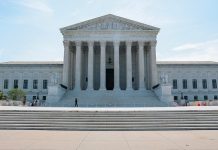
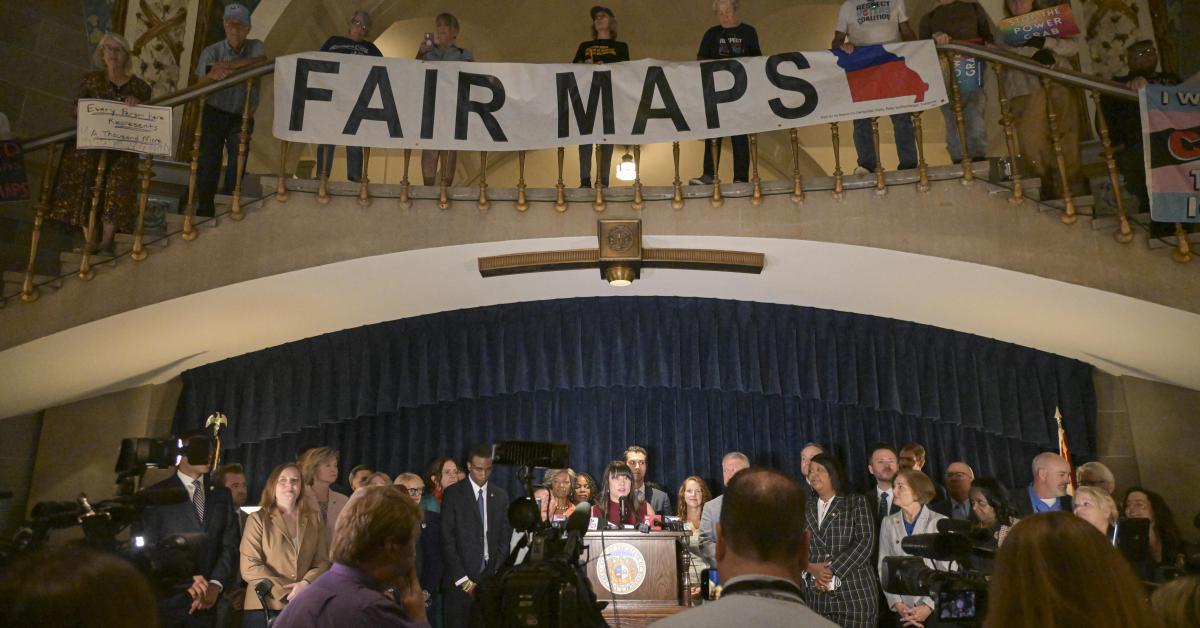
The Supreme Court blocked a Republican-backed redistricting map in Missouri for the third time Friday, forcing the state to use the 2022 electoral map for the November midterm elections.
The decision represents a significant setback for Missouri Republicans who have spent years attempting to redraw congressional boundaries in a state that has increasingly trended conservative in presidential and statewide races. Redistricting battles like Missouri’s have become central to determining control of the House of Representatives, where even a single seat can prove decisive in a closely divided chamber.
The ruling comes after a federal appeals court attempted to revive a 2025 GOP-friendly map that would have shifted the state’s congressional delegation from six Republicans and two Democrats to seven Republicans and one Democrat — effectively eliminating a seat held by Democratic Rep. Emanuel Cleaver.
Cleaver, who has represented Missouri’s Fifth Congressional District since 2005, holds a seat anchoring the Kansas City metropolitan area. The proposed Republican map would have dismantled this urban-centered district by dividing Kansas City voters among multiple rural-dominated districts, a redistricting technique critics describe as “cracking” — one of the classic hallmarks of partisan gerrymandering.
The high court’s order overturned the appeals court’s decision, which had ruled the 2025 map must be used because the primary election had already taken place under it.
The appeals court’s reasoning had centered on concerns about voter confusion and administrative disruption, arguing that candidates had already filed, campaigned, and competed in primaries under the boundaries established by the 2025 map. Election administrators had similarly warned that reverting to different district lines mid-cycle could create logistical challenges and potentially disenfranchise voters unfamiliar with changing boundaries.
Two prior Supreme Court rulings had already rejected the Republican map, along with a decision by the Missouri state Supreme Court.
The repeated judicial rejections underscore the legal vulnerability of the Republican redistricting effort, which has now failed to survive scrutiny at both the federal and state levels. Courts evaluating redistricting plans typically examine whether maps comply with the Voting Rights Act, respect communities of interest, maintain reasonable compactness, and avoid unconstitutional partisan manipulation.
The appeals court argued the primary timing justified using the new map. The Supreme Court disagreed.
Missouri will now proceed with the same six Republican, two Democratic district lines used in 2022 — at least for this cycle.
The phrase “at least for this cycle” signals that the redistricting battle may not be over. State legislatures typically redraw congressional maps following each decennial census, but mid-decade redistricting has become increasingly common as parties seek electoral advantages. Missouri’s next scheduled redistricting would follow the 2030 census, though lawmakers could attempt another map revision sooner.
The redistricting fight reflects broader national tensions over congressional maps heading into what Republicans hope will be a strong midterm showing. Missouri’s GOP-led legislature had pushed the 2025 map as a reflection of the state’s conservative shift, but federal and state courts have now blocked it three separate times.
Nationwide, redistricting disputes have shaped the congressional landscape in numerous states, with both parties accused of gerrymandering where they control state legislatures. The outcomes of these legal battles collectively influence which party can most easily capture a House majority and by what margin.
With early voting underway in some states and November 3 approaching, the decision locks in the battleground for Missouri’s eight House seats.
“The court blocked in its latest order an appeals court ruling that sought to revive the 2025 map despite two previous Supreme Court decisions and a ruling by the state Supreme Court that ruled against Republicans on the same issue.”
Republicans had framed the new map as a correction to outdated district lines. Democrats called it an unconstitutional gerrymander designed to eliminate Cleaver’s Kansas City-area district.
The competing narratives reflect fundamentally different philosophies about what redistricting should accomplish. Republicans argue that district boundaries should reflect current political geography and population distribution, naturally consolidating conservative voting strength across Missouri’s predominantly rural landscape. Democrats contend that redistricting must protect minority representation and ensure urban communities maintain meaningful electoral voice rather than being subdivided to dilute their influence.
The Supreme Court did not issue a detailed opinion explaining its reasoning — the order simply vacated the appeals court ruling and restored the prior map.
The brevity of the Court’s action is typical for emergency matters on what’s known as the “shadow docket,” where justices issue orders without full briefing or oral argument. These expedited decisions often provide limited guidance for future cases, leaving the underlying legal questions unresolved even as they determine immediate practical outcomes.
Missouri Republicans now face the reality of defending six seats instead of a potential seven, while Democrats will work to hold their two districts in what remains a heavily red state.