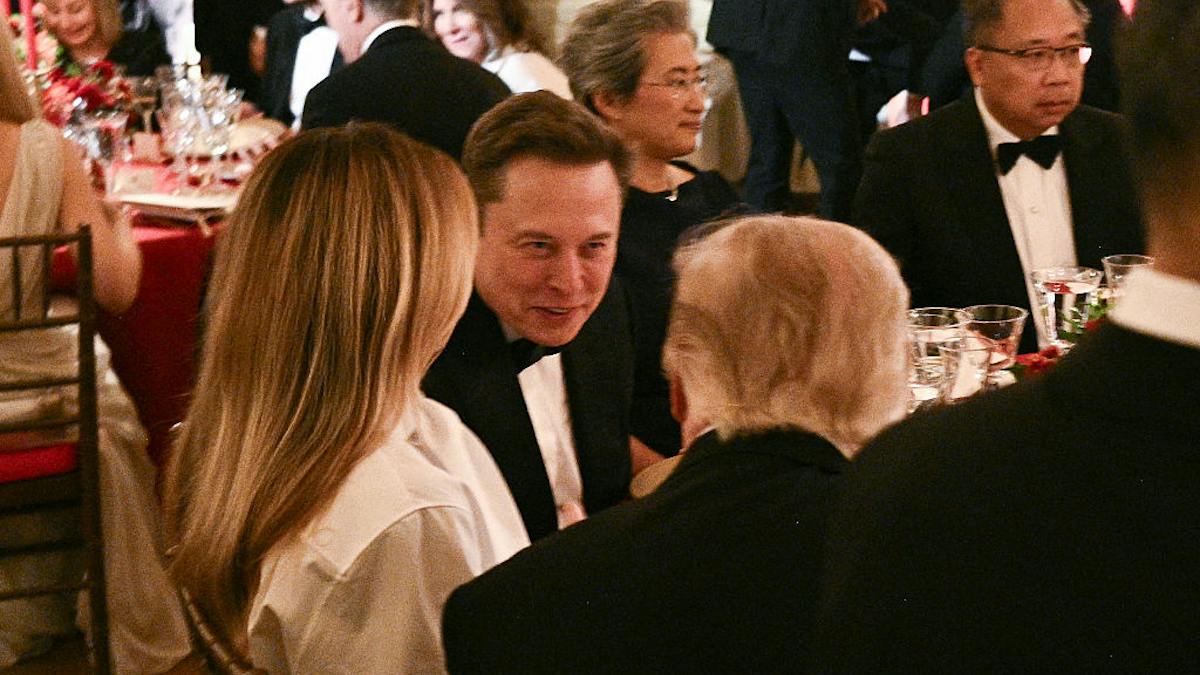
When President Trump sat down for Thursday night’s state dinner with Chinese President Xi Jinping, he didn’t pack the East Room with bureaucrats and diplomats. He brought America’s business titans — Elon Musk, Jeff Bezos, Michael Dell, Sundar Pichai, Sam Altman, and JPMorgan Chase CEO Jamie Dimon.
The guest list was a power move.
While Xi arrived with Communist Party apparatchiks, Trump surrounded himself with the innovators and financiers who will decide the future of AI — the real battleground in the new Cold War with China.
“There is nothing more important for our country — and in fact, I don’t think it’s exaggeration to say for the whole free and democratic world — that America maintains the preeminent military, supported directly by the preeminent economy of the world.” — Jamie Dimon
The symbolism wasn’t lost on anyone in the room. Elon Musk — who battled Trump publicly and ruthlessly for months during his tenure as DOGE head — was seated with Trump and Xi, all smiles. The hatchet was buried.
That’s a flex Xi can’t match. It’s hard to imagine a Chinese tech executive who criticized Xi keeping his life, let alone his seat at the table.
The same applies to Sam Altman. Trump slammed Altman’s calls for an industry-wide AI pause as part of a “globalist scheme” — the day before the dinner. Yet there was Altman, seated alongside the president, Elon, and Mark Zuckerberg.
The message to Beijing: America can win the AI race without nationalizing companies or imprisoning critics.
AI dominated the evening’s subtext. When Trump talks about competing with China now, he’s not focused on manufacturing or Belt and Road infrastructure. He’s laser-focused on AI — who controls the chips, the data centers, the future.
The Daily Wire’s Brecca Stoll reported this week that authors of a paper frequently cited by data center critics have deep CCP ties. Trump called it earlier: “a sick conspiracy going on against AI and data centers,” with “the only one that is happy about it is China.”
Altman’s presence at the dinner was Trump’s answer. His attendance reminded Xi that America has the capacity to win the AI Cold War — and the freedom to do it our way.
Jamie Dimon, who has urged the government to take a “light touch” on AI regulation to avoid stifling innovation, sat among the tech executives. The JPMorgan Chase CEO has long argued that America’s economic strength and national security are inseparable.
Trump recently called Dimon “maybe the greatest banker in this country in many, many decades.” The banker is well positioned to finance what Trump calls America’s new Golden Age.
Dimon praised the president for “reigniting that arsenal of democracy that we have in this country,” and with it, “the American dream.”
You can’t win the war for the future if you can’t pay for the battles. Trump and Dimon both understand that.
Outside the White House, protesters lined the streets — Tibetan and Taiwanese flags, posters mocking Xi, calls for freedom in China. But on every corner, a different group appeared: China supporters waving banners reading “A warm welcome to Chairman Xi” and “Hello, Uncle Xi.”
That’s not organic support. Chinese students studying in American universities are terrified to criticize their home country in class, worried fellow students will report dissent back home. Those who dare engage in pro-democracy activities receive frantic calls from relatives threatened by state police.
It’s a reminder of who we’re dealing with. China is still China, no matter how nicely Xi and Trump smile for the cameras.
But it’s also a reminder of who we are. When Xi left the state dinner Thursday night, he drove past his prepaid street supporters. But he almost certainly left thinking about the show of American strength he’d just witnessed: a president focused on beating him at his own game, surrounded by the innovators who will make it happen.
That’s what America is about.