
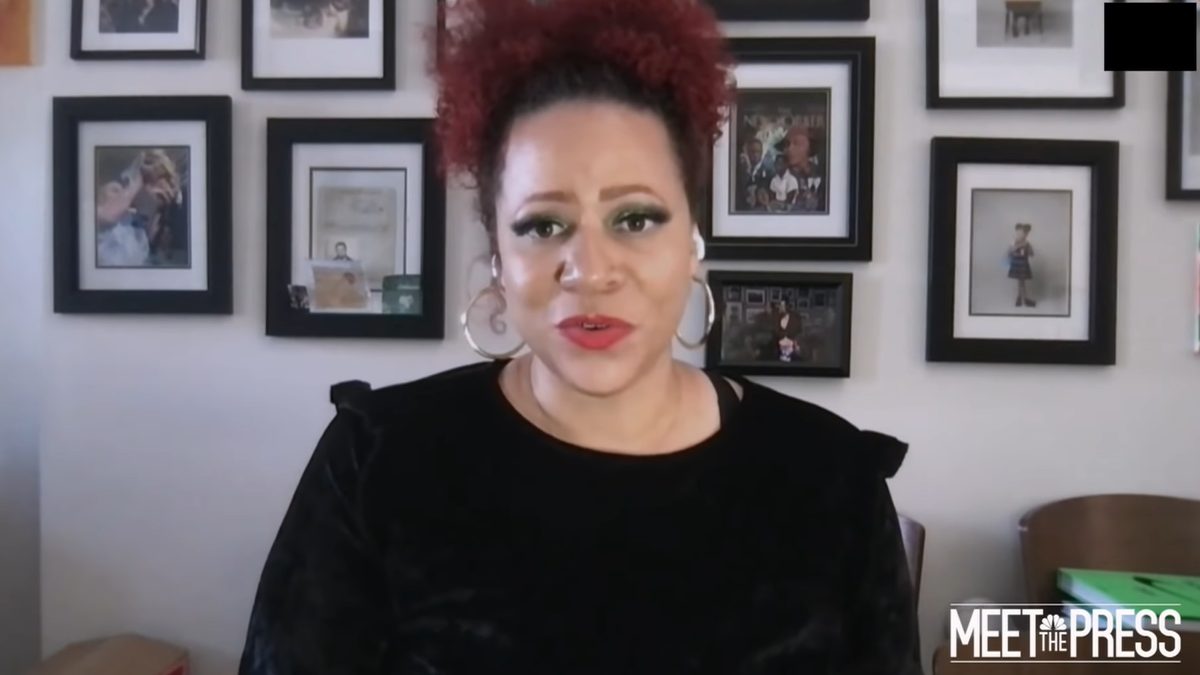
The creator of the 1619 Project chose to enroll her daughter in one of New York City’s worst public schools — and the results were entirely predictable.
Nikole Hannah-Jones, in a sprawling essay for The New York Times Magazine, chronicles the deliberate decision to send her daughter, Najya, to a violent, failing school that didn’t assign homework and didn’t actually teach students.
Why? Hannah-Jones said she and her husband “felt an obligation to make educational decisions based on the collective good and not just our individual advantage.”
Translation: they refused to let their daughter attend good schools because they had too many white kids.
The essay reveals years of shocking neglect. Hannah-Jones describes violent and chaotic lunch hours with no adult supervision, no homework, and no real classroom instruction.
“At one point, Hannah-Jones recounts her realization that her daughter thought she could do basic math but in fact could not, and that her writing assignments ‘were rife with uncorrected punctuation, capitalization and grammar errors.’ Her teacher was simply not checking her work.”
Yet years went by without Hannah-Jones asking what her daughter was reading, asking to look at her schoolwork, or pressing the school about not assigning homework.
When she finally did press the school and saw that teachers were not grading her daughter’s work — which was riddled with errors — she didn’t pull her out. She kept her commitment to the “collective good” even at the expense of her child’s education.
By the time Najya was admitted to a decent high school, Hannah-Jones writes that her daughter felt like she was “drowning.”
“She had homework for the first time, and she was suddenly inundated with pages of nightly reading for her classes. She did not know how to manage the crush of assignments, and the effort that used to earn her A’s no longer cut it. Najya had never been taught the skills of independent study, and suddenly the child whose identity had been the nerdy honors student was working harder than she ever had and barely keeping up.”
Najya had never been taught the skills of independent study.
Hannah-Jones discovered in high school that her daughter was never actually taught Algebra — despite failing the statewide Algebra exam in eighth grade.
“I enrolled Najya in algebra tutoring. After an assessment, the center’s director called me in and told me that Najya knew very little algebra and had huge gaps in many of the building blocks of math that she should have learned in elementary school, like mastery of long division and fractions.”
The essay lays the blame for New York’s failed public school system at the feet of white people who, unlike Hannah-Jones, choose not to send their kids to violent, failing schools.
But it also reveals something Hannah-Jones likely didn’t intend: she is not really interested in education as such, but only as a credentialing mechanism.
In classical terms, the purpose of education is to impart not just knowledge but virtue. An educated student is formed in truth, goodness, and beauty.
Hannah-Jones seems to reject — or be completely unaware of — all this. For her, education is a way of gaining credentials and another system to tear down as part of the cultural revolution.
The actual content of her daughter’s education is strangely neglected, despite all her agonizing over the racial and political aspects of the school system.
For parents who do understand the purpose of education, doing what Hannah-Jones did is unthinkable. That’s why so many families today are walking away from failing schools — either by starting or enrolling their kids in charter schools, private schools, or homeschooling.
The advent of artificial intelligence will likely transform education so thoroughly that the older, classical understanding will become the only one that retains coherence or relevance.
If the point of school is not the formation of the student’s soul and the inculcation of virtue through exposure to the good, the true, and the beautiful, then there isn’t much point to it.
Unless you’re in the business of selling racial grievances. In that case, what Hannah-Jones did makes all the sense in the world.