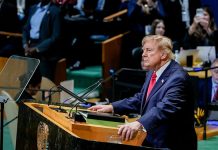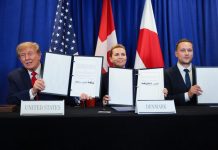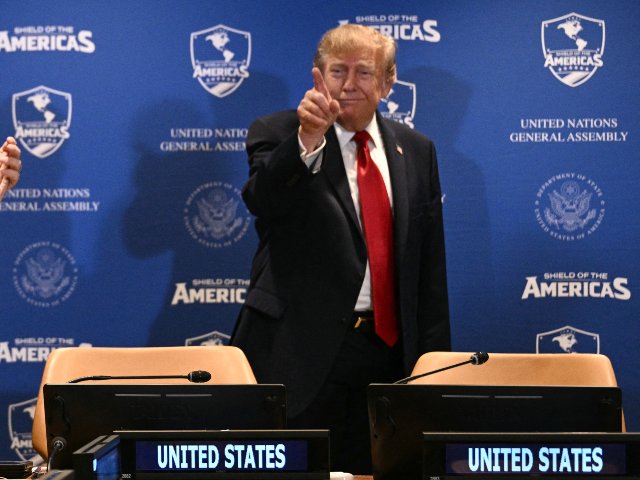
President Donald Trump announced at the United Nations General Assembly on Tuesday that the United States will rename artificial intelligence to “super intelligence” across all government documents — and wants the world to follow suit.
The declaration, delivered from one of the world’s most prominent diplomatic stages, represents an unprecedented attempt to rebrand a technology that has become central to global economic competition and national security strategy. The UN General Assembly, which brings together heads of state and government leaders from 193 member nations, has historically been a forum for announcing major policy shifts, but rarely has it been used to dictate technical terminology that has been standard in academic and industry circles for decades.
“The United States also totally rejects any attempt to construct a globality scheme to control for the artificial intelligence being spoken of so much now, hereinafter called super intelligence,” Trump told assembled world leaders. “Changing the name.”
The terminology shift isn’t just about branding. Trump explained his objection to the word “artificial” itself.
“The use of the word artificial makes intelligence sound fake. It is not fake. It’s actually amazing. But we have to be careful. In fact, it is exactly the opposite of what it purports.”
The semantic argument touches on a deeper tension in how society understands and describes machine learning systems. The term “artificial intelligence” was coined at a 1956 Dartmouth conference and has been the standard nomenclature in computer science, engineering, and policy circles ever since. Trump’s concern appears to center on the colloquial meaning of “artificial” as synonymous with “fake” or “inferior,” rather than its technical meaning of “human-made” or “synthetic.”
Trump made clear he expects the change to go global. “From this point forward, all of United States documents and hopefully the world’s will be changed to use the much more accurate term super as opposed to artificial,” he stated.
The president closed his remarks by introducing the new abbreviation the world will now need to learn.
“In other words, welcome to the new world of super intelligence — SI,” Trump said. “Let’s see if that goes. It sounds much better. It is much better, and it’s much more accurate.”
The practical implications of such a rebranding would be extensive. Government agencies from the Department of Defense to the National Science Foundation would need to revise countless documents, regulations, and strategic plans. International treaties, standards bodies, and research collaborations that rely on consistent terminology could face confusion during any transition period. The abbreviation “AI” has become ubiquitous not just in government but across industry, academia, and popular culture.
The announcement follows Trump’s creation of an “AI Force” modeled on the Space Force and his appointment of a new AI czar. Over the weekend, Trump ran a Truth Social poll asking followers to help pick the new name, floating “Superior Intelligence,” “Extreme Intelligence,” and “Supreme Intelligence” as options.
According to Trump, “Supreme Intelligence” lost the poll because of its association with the Supreme Court.
The crowdsourced approach to technical terminology represents a departure from how such language is typically established. Usually, scientific and technical terms emerge through academic consensus, standardization bodies, or regulatory processes that involve domain experts and stakeholders across multiple sectors.
The move signals Trump’s broader pushback against Silicon Valley control of AI development. AI giants have simultaneously released powerful models while calling for industry regulation — a contradiction Trump’s advisors have flagged as corporate capture disguised as safety concerns.
This tension reflects a growing debate within technology policy circles about whether leading AI companies are genuinely concerned about existential risks or are strategically positioning themselves to write regulations that would benefit incumbents at the expense of startups and open-source developers. The concern is that regulatory frameworks, if captured by industry leaders, could create barriers to entry that cement the dominance of a handful of companies.
When AI titans like Dario Amodei, Sam Altman, and Elon Musk call for slowdowns, they’re not acting out of altruism, Trump allies argue — they’re trying to capture the industry and exclude themselves from antitrust laws.
The president’s stance: America leads on innovation. The world follows.
Whether the international community will adopt Trump’s preferred terminology remains to be seen. The announcement has already sparked debate about the appropriate role of political leaders in shaping technical language, and whether unilateral declarations from the UN podium can override decades of established usage in scientific literature and industry practice.