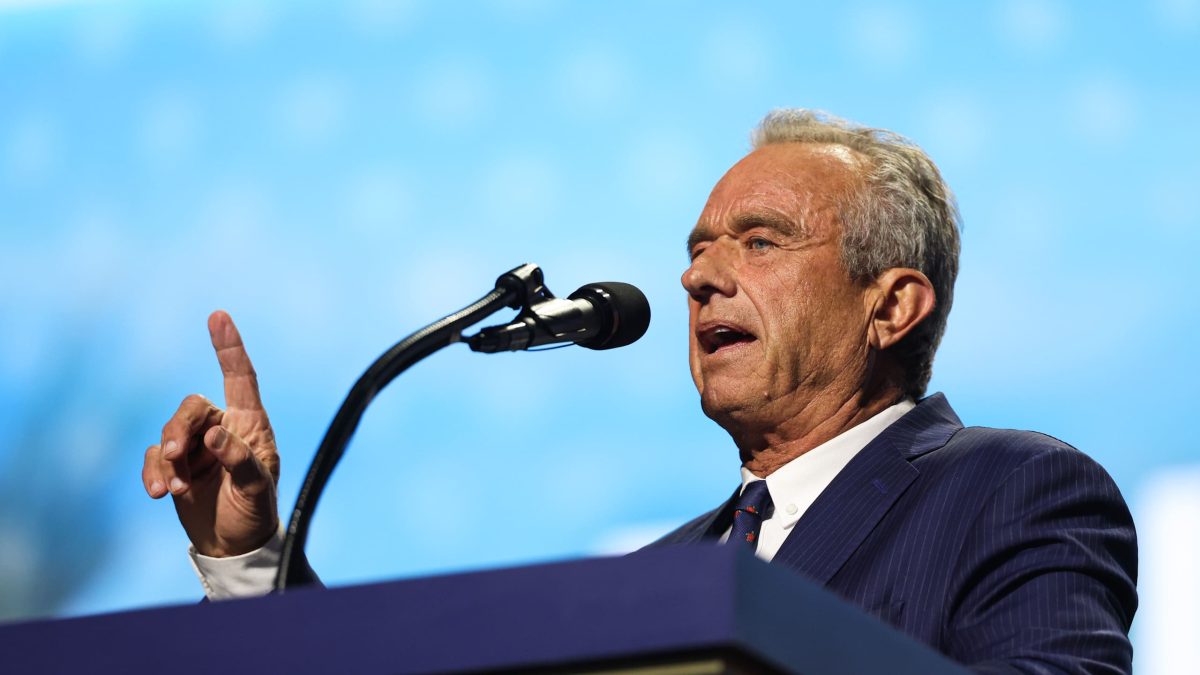
Robert F. Kennedy Jr. stood in front of a room full of Republicans this week and delivered a line nobody would’ve predicted a decade ago: his father and his uncle “would not recognize the Democratic Party of today.”
He said it at the Republican National Committee’s first-ever midterm convention in Dallas. The crowd roared.
That one sentence tells you where American politics stands in September 2026. The party of Franklin Roosevelt and Jack Kennedy has narrowed itself to a handful of mandatory positions — so narrow even a Kennedy can’t fit anymore. Meanwhile, the GOP’s governing coalition now includes a former Soros hedge fund executive, a Teamster’s daughter, and a former Hawaii congresswoman who ran for president as a Democrat.
“The Republican Party has become the big tent. The Democratic Party has become the circus.”
Republicans had never held a midterm convention before in the party’s history. They used it to roll out a populist economic pitch — including a proposed $5,000 dividend check for American households — aimed squarely at union households and working-class voters Democrats used to own.
You don’t build a program like that to please the country-club wing. You build it to keep pulling people out of the other party’s base.
RFK Jr. didn’t tiptoe around it in Dallas. He told the crowd Democrats had become defined by “blind hatred” of Donald Trump. He spent a chunk of his half hour walking through what he called the party’s wartime abandonment — COVID being the war — of free speech, religious liberty, due process, and medical autonomy.
His argument lands because it isn’t partisan spin. It’s a man watching his own family’s coalition trade “question authority” for “trust the science, citizen.”
Then look at who’s actually running the government’s business.
Treasury Secretary Scott Bessent spent more than two decades as a top lieutenant at Soros Fund Management, helped George Soros make a billion dollars breaking the Bank of England, and wrote checks to Al Gore, John Kerry, Hillary Clinton, and Barack Obama long before he ever wrote one to Trump. He runs the U.S. Treasury today.
Former Labor Secretary Lori Chavez-DeRemer is the daughter of a Teamster who co-sponsored a union bill so aggressive it made half the Republican conference wince. The Senate confirmed her with seventeen Democratic votes because organized labor asked for her by name.
For a year and a half, the president’s own director of national intelligence was Tulsi Gabbard, a four-term Democratic congresswoman and former Democratic presidential candidate, until she announced her resignation in May, citing her husband’s health.
Trump himself spent roughly eight years as a registered Democrat in the 2000s, writing checks to the very people he now beats in elections.
The traffic runs both directions: Pennsylvania Democratic Senator John Fetterman popped up by video during the Dallas program to praise Republican Senate candidate Dave McCormick — a courtesy no sitting Democrat would have extended a decade ago.
Add it up, and you get a governing coalition built in part out of people the Democratic Party used to call its own.
This isn’t a party demanding ideological purity at the door. It’s a party that opened the flap and said, “Come on in. We’ll sort the seating chart later.”
To be fair, a big tent has its own headaches. Republicans go at each other over tariffs, over Ukraine, over spending — hard enough to make a family Thanksgiving look tame. A coalition this wide doesn’t move in lockstep, and it shouldn’t pretend to.
Reagan understood the trade-off better than anyone. His eleventh commandment — “thou shalt not speak ill of a fellow Republican” — was built for exactly this kind of noisy, disagreeable coalition. He’d rather have the argument inside the tent than lose the voter outside it.
“Democrats have a choice heading into this year’s midterms: widen the tent or keep running the circus.”
The Democratic Party made the opposite bet. It spent the last several years primarying its own moderates, running litmus tests on gender ideology and border policy that shift every eighteen months, and treating disagreement as evidence of moral failure rather than a normal feature of a governing coalition.
There’s a real difference between a party arguing about direction and a party that cancels its own candidates for failing a test nobody wrote down. One is a family dinner. The other is a struggle session.
A party that eats its own comedians for old jokes and its own biologists for stating a chromosome count isn’t enforcing values. It’s enforcing fear. And fear is a lousy long-term recruiting strategy.
The circus used to be the greatest show on earth. Then it stopped adapting, the crowds thinned, and the whole operation eventually folded the tent for good.
Political coalitions aren’t exempt from that math. One that keeps recruiting former Democrats, former Soros lieutenants, and Teamsters’ daughters isn’t winning by accident.
It’s winning because it’s the only tent left with room to grow.