Sen. Ted Cruz is sounding the alarm: college athletics are heading toward total collapse without immediate federal intervention.
The Texas Republican warned that unchecked spending wars, unlimited player transfers, and a legal free-for-all are pushing the system toward a “super league” controlled by a handful of wealthy schools — leaving everyone else behind. The warning comes as college sports continue to reel from a cascade of changes that began with landmark court decisions and state-level NIL legislation, creating a patchwork regulatory environment that many administrators say has become impossible to navigate.
“Without federal action, the system risks collapsing into a super league or mini-NFL dominated by the wealthiest schools.”
Cruz points to ongoing antitrust litigation, out-of-control name-image-likeness (NIL) deals, revenue-sharing chaos, conference realignment, and unlimited transfers as the main culprits driving the crisis. These issues have compounded rapidly since the NCAA’s longstanding compensation restrictions were struck down, creating what critics describe as a regulatory vacuum where schools, conferences, and collectives operate with little coordination or oversight.
The fallout? More than 400 college sports programs canceled or gutted in recent years. Over 100 teams eliminated. More than 1,000 scholarships or roster spots wiped out. The cuts have accelerated as athletic departments struggle to balance budgets amid rising costs and new financial obligations to athletes, forcing difficult decisions about which programs can be sustained.
Cruz argues the damage extends beyond football and basketball. Non-revenue sports, women’s teams, and the pipeline feeding U.S. Olympic squads are all at risk. These programs have historically operated on cross-subsidization models, where revenue generated by marquee sports funds the broader athletic department. As financial pressures intensify on football and basketball programs, that traditional funding model is breaking down.
Many schools are hemorrhaging tens of millions of dollars trying to keep pace in football and basketball — and cutting everything else to survive. Athletic directors across the country have described an unsustainable arms race, where competitive pressure forces spending increases even as revenues fail to keep pace, creating budget shortfalls that ripple across entire departments.
.@SenTedCruz says the chaos in college sports threatens athletic programs, scholarships, women’s sports, and Olympic sports.
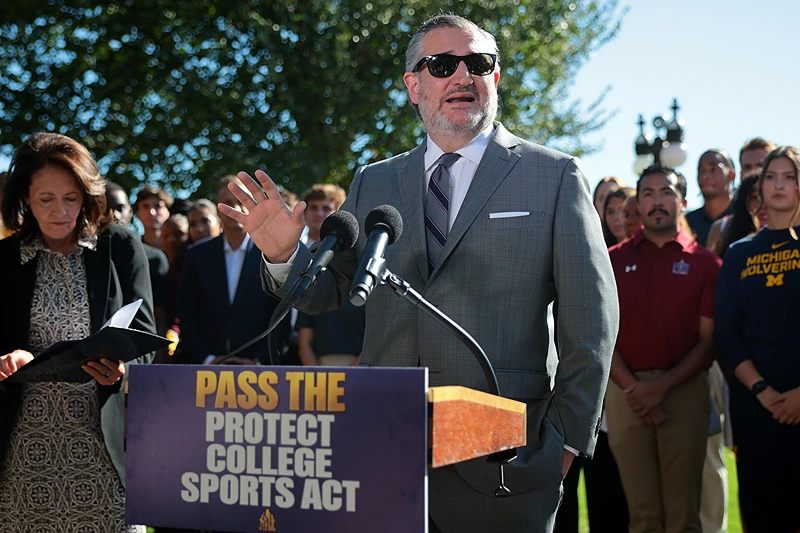
Cruz says the bipartisan Protect College Sports Act would establish common-sense rules and bring stability to college athletics.
Watch OAN on OAN Live… pic.twitter.com/hAPMxvxrOv
— One America News (@OANN) September 14, 2026
Cruz introduced the Protect College Sports Act of 2026 (S. 4668) with bipartisan backing — including Senate Commerce Ranking Member Maria Cantwell, Sen. Eric Schmitt, and Sen. Chris Coons. The bipartisan nature of the legislation reflects growing consensus in Congress that the current situation has become untenable and that federal lawmakers must step in where the NCAA and individual states have failed to create workable solutions.
The legislation would create a national framework for college sports with enforceable rules on transfers, eligibility, recruiting, and tampering. It sets national NIL standards, curbs abuse, and provides limited antitrust protections so schools can actually enforce the rules. The antitrust provisions are designed to shield reasonable regulations from legal challenge, addressing a core problem that has paralyzed the NCAA’s ability to maintain consistent standards across member institutions.
The bill also includes athlete safeguards: scholarship continuity and healthcare protections. These provisions respond to concerns that rapid changes in college sports have left athletes vulnerable to having scholarships revoked or finding themselves without adequate medical coverage for sports-related injuries.
For women’s and Olympic sports, the legislation establishes minimum team and roster requirements for higher-revenue schools. It allows optional media-rights pooling with anti-consolidation guardrails designed to block a breakaway super league. The pooling provisions aim to distribute media revenue more equitably while preventing the wealthiest programs from forming a closed competition that would exclude the majority of colleges and universities.
Cruz emphasized that the cuts endanger female athletes and threaten America’s traditional edge in Olympic competition. Unlike other nations that fund specialized athletic academies, the U.S. relies on the collegiate system to develop Olympic talent. This unique American model has produced generations of world-class athletes across dozens of sports, but its viability depends on universities maintaining robust programs in non-revenue sports that would otherwise lack professional development pathways.
Texas Senator @SenTedCruz highlights college sports as a uniquely American institution that brings people together and creates educational opportunities for hundreds of thousands of student-athletes.
Watch OAN on OAN Live for updates. pic.twitter.com/GqBS4T6quf
— One America News (@OANN) September 14, 2026
Cruz argues earlier federal laws and court rulings created the current mess, so only Congress can establish clear, enforceable national rules to stabilize the system and preserve the traditional structure of college sports. The senator contends that because federal antitrust law and judicial interpretations dismantled previous regulatory structures, a legislative solution is now required to rebuild a sustainable framework with proper legal foundation.
The bill aims to protect student-athletes, stop the spending arms race, and prevent college athletics from fracturing into an unrecognizable professional minor league controlled by a few elite programs. Whether the legislation can gain sufficient momentum to pass remains uncertain, but its introduction signals that federal policymakers are taking seriously the structural threats facing an institution that has been central to American higher education for over a century.