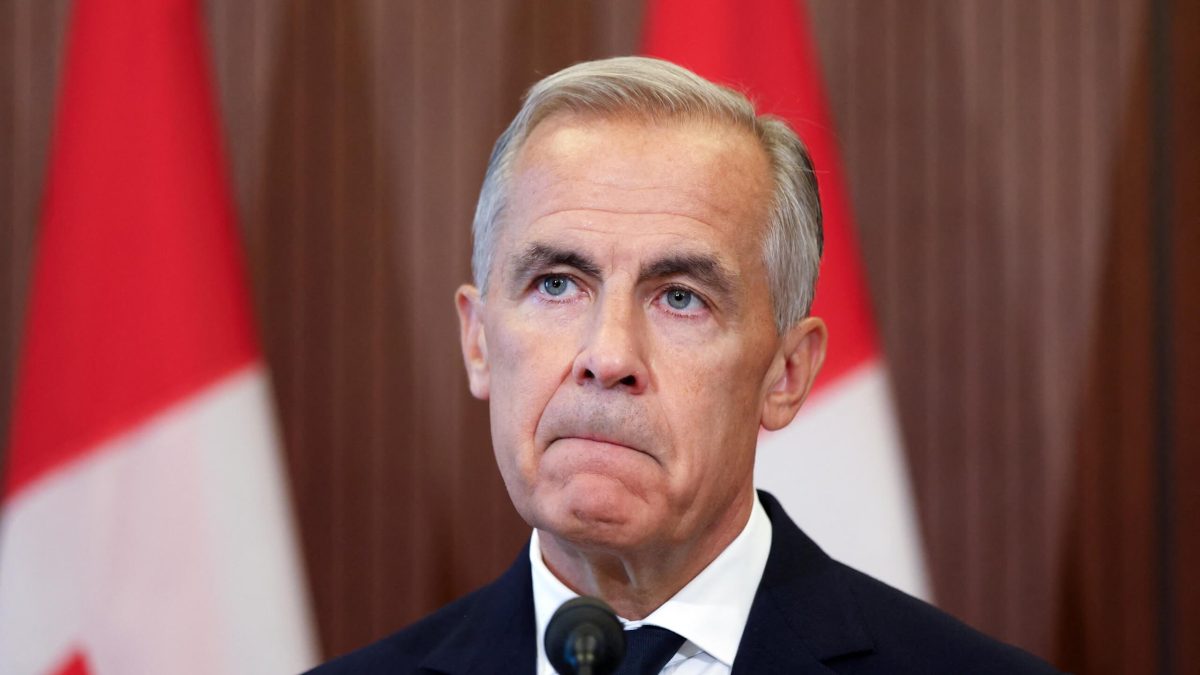
Canadian Prime Minister Mark Carney thinks he can beat Donald Trump by waging economic war on America. He’s discovering the hard way that Canada — not the United States — is the one paying the price.
At the eleventh hour, Carney stormed out of a nearly-completed tariff deal that would have privileged Canada over almost all of America’s other trading partners. Canada has enjoyed a $50 billion goods trade surplus with the United States for years in a supposedly free North American trade zone. Carney walked away anyway.
His stated reason? American proposals allegedly stripped away Canadian sovereignty and quashed French-Canadian culture. Yet he has not released the documents detailing the bilateral offers he rejected. Nor has he allowed his representatives to explain why Canada blew up negotiations at the last minute.
Carney’s ever-changing excuses, explanations, and invectives about what happened are incoherent and contradictory.
Analysts on both sides of the border now concede that American digital-media companies do not customarily pay special taxes, as Carney demands, to promote local culture while operating in Canada — any more than Canadian companies would be taxed for those purposes in the United States.
The China Factor
Canada and the United States both agree that China dumps cheap steel and aluminum into Canada, allowing Canadian manufacturers to use that cost advantage to export assembled vehicles to the vast U.S. market at prices below those of American vehicles. In that way, Canada’s new partnership with China circumvents America’s tariffs on Beijing.
China will also send nearly 50,000 electric cars and trucks into Canada under a meager tariff, ensuring that the Canadian EV market is increasingly dominated by Chinese vehicles.
But Carney’s ploy goes beyond helping the communist Chinese dictatorship gain trade leverage over his own NATO neighbor. He has eagerly concluded a comprehensive Chinese-Canadian pact involving travel, visas, food safety, energy, and public security. Carney has grandly described these new agreements with Beijing as part of a new paradigm in which “middle powers” like Canada play China against the United States.
How ironic that Carney attacks his neighbor, the United States, for trade unfairness while warming to the communist dictatorship in China. Communist China, after all, is history’s greatest violator of trade protocols — guilty of manipulating its currency, dumping products to secure market share, violating copyright and patent laws, and imprisoning a million Uyghurs.
Canada’s new partner is a totalitarian police state that infected the world with its manufactured gain-of-function COVID-19 virus, which killed more than 1.5 million North Americans. China stonewalled inquiries and never offered details about the pandemic’s origins in its Wuhan lab.
The Weakness Behind the Bluster
What drives Carney’s hubristic fantasies? Has Canada’s natural wealth in oil, gas, timber, and minerals made it a military and economic dynamo?
Hardly.
Canada’s population is 11.8 percent of America’s. Its economy is barely one-thirteenth the size of America’s. Canadian GDP per capita is only 60 percent of America’s.
Canada quietly relies on the U.S. military to deter foreign powers from North America, whether by fending off challenges to Canada’s extensive Arctic claims or by keeping Canadian skies free of foreign combat aircraft and missiles. Canada’s navy — once one of the world’s preeminent surface fleets — has been reduced to fewer than 30 ships. Its 89 American-made jets are more than 40 years old.
Paradoxically, Carney’s dreams derive not from confidence and strength but from insecurity and defensiveness. Carney and former Prime Minister Justin Trudeau nearly ruined the Canadian economy despite the country’s treasure trove of natural resources. Canada has only half the GDP of California — a state currently decaying under neo-socialist governance — despite having roughly the same population.
Nearly 45 percent of Canadians are either foreign-born or the children of foreign-born parents. These often-impoverished immigrants impose gargantuan social-welfare costs that Canada’s European-style socialist economy simply cannot support. While Carney lectures on “Canadian values,” Canada’s fertility rate of 1.25 is among the lowest in the Western world, while euthanasia accounts for 5 percent of all deaths, the highest rate in the West.
Nevertheless, Carney now claims the United States bullies Canada — even as Canada runs trade surpluses with America, relies on the American economy for 72 percent of its exports, and depends on the American military for its safety. That asymmetry indirectly subsidizes Canada’s disastrous energy, immigration, defense, regulatory, and tax policies.
The Hypocrisy of a Globalist Banker
Carney has melodramatically characterized his tiff with the United States as a “fight” and even a “war.” Yet, oddly for such an anti-American Canadian hyper-nationalist, Carney is a globalist banker who, until he became prime minister, held citizenship in three nations.
The Canadian prime minister who urges Canada’s vulnerable working classes to decouple from America is himself deeply entwined with the United States. Some 91 percent of Carney’s investments are in U.S.-based companies, and two of his four children, like their father, attended college in the United States. Both now reside in America, along with nearly one million other Canadians.
Apparently, Carney is so eager for a veritable economic, cultural, and political war with the United States that 91 percent of his holdings remain invested in the homeland of his enemy.
But why, from a position of such hypocrisy and vulnerability, has Carney blown up the trade agreement, ginned up anti-American Canadian nationalism — and done so now?
Only in this way, Carney believes, can he stop autonomy referenda in Alberta and Quebec. And only in this way can he openly interfere in the U.S. midterm elections by targeting new tariffs at red and purple border states while working directly with left-wing Democratic politicians to help Democrats regain control of Congress.
His anti-American screeds have certainly worked at home. Canadians now boo at the mere sound of “The Star-Spangled Banner.” They brag of a new “elbows up” policy to stop U.S. “aggression.” Some three-quarters of the country has bought into Carney’s fantasies.
The Reckoning
But this will not end well for Canada, for at least five reasons.
First, America certainly is not the cause of Canada’s maladies, other than by subsidizing its suicidal domestic choices for years. Canada’s self-destructive socialist and globalist policies are its government’s doing alone. The United States did not force Canada to adopt European-style socialist policies of mass unvetted immigration, subsidized green energy, near-disarmament, and unsustainable social-welfare spending. America did not urge Canadians to stop having children or enlist their government to help them euthanize themselves.
Second, the American public has so far been mostly indifferent to the spat. But now that the North American media has begun revealing the extent of Canada’s anti-American venom, along with Carney’s brinkmanship and disingenuous rhetoric, anger is rising. Carney has no idea that he is reframing the dispute not as a conflict with Trump but as an affront to the American people themselves — who have long memories.
Third, for all his globalist background, Carney is alone on the world stage. Europe may applaud his defiance, but it has no desire to join his anti-American campaign. When the United States finally insisted on symmetrical trade, only communist China and Canada — the latter enjoying the most generous entrée into the American economy of any country in the world — slapped counter-tariffs on the United States.
Fourth, Canada is far more vulnerable than the United States if Carney’s “war” continues. Canada relies on the United States for 72 percent of its exports, while America relies on Canada for only 15 percent of its own exports. Last month, even before the full effect of the new tariffs was felt, Canada lost 42,000 jobs while the United States gained 160,000. The damage will only grow, ever more asymmetrically, as tariffs mount on Canadian businesses.
Nearly a million Canadians reside in the United States, but only 350,000 Americans live in Canada. And it is easier for a Canadian to obtain an expedited U.S. work visa than for an American to do the same in Canada. Indeed, Canadians do not appreciate that they are nearly the only visitors in the world granted six months of residence in the United States without a visa.
Fifth, since Carney walked out at the last minute, it will be incumbent upon him to resume talks — especially as the damage he has done to Canadian workers and small businesses worsens. But should Carney seek to renew negotiations immediately after the Canadian provincial elections and the U.S. midterms, he will be exposed as a disingenuous politico who ginned up the fight to manipulate both Canadian and American balloting to benefit himself and his party.
If that happens, he may learn that the American friendship train has left the station. He will also discover that China treats obsequious outreach from Western “middle powers” as weakness to exploit, not magnanimity to reciprocate.
Carney’s political disingenuousness will eventually earn the animus of Canadians and Americans alike — who may ironically unite in their distaste for Mark Carney and his fantasy house.