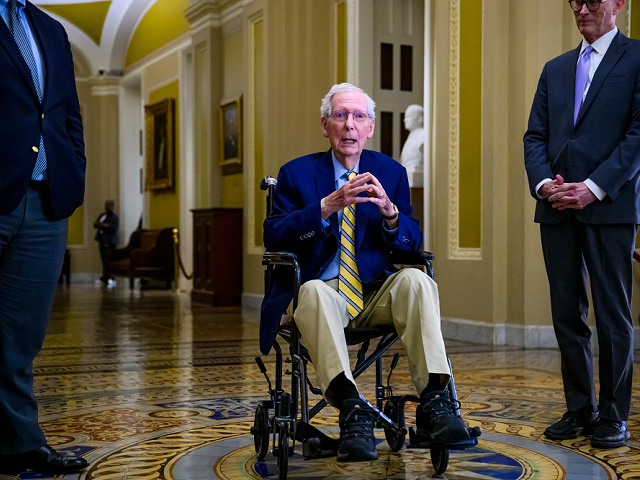
Sen. Mitch McConnell (R-KY) returned to the Capitol on Monday after a months-long absence, speaking noticeably slower as he addressed reporters following a fall in June. The return marks a significant moment for the long-serving senator, who has been a fixture in Republican leadership for decades and whose prolonged absence had raised questions about both his personal health and the political implications for the GOP caucus.
The Kentucky Republican has been out since suffering the fall, which sparked intense speculation about his condition over the summer. His extended recovery period represented one of the longest absences of his career, during which time the Senate continued to navigate key legislative priorities and internal Republican Conference decisions without his direct participation on the floor.
“After two years — two decades — of dodging your questions, I wasn’t sure how many of you would be here today,” McConnell joked at the start of his remarks.
The self-deprecating humor was characteristic of McConnell’s approach to media interactions over his lengthy Senate career, though observers noted the slower cadence of his delivery. McConnell delivered a brief statement and said he remains committed to passing the farm bill and holding Russia accountable. These legislative priorities reflect ongoing concerns in his home state of Kentucky, where agricultural interests remain central to the economy, as well as his consistent foreign policy stance on countering Russian aggression that has defined much of his recent tenure.
“My recovery has been a long and often frustrating process, and the lingering effects of childhood polio haven’t made it any easier. I’m still not quite back to 100%, but I’ve assured Leader Thune that, as I continue with physical therapy on the advice of my doctors, I will do my best to be present for tough votes when our Conference needs me.”
The acknowledgment of his childhood polio provides important context for understanding McConnell’s current health challenges. The disease, which he contracted as a young child, left lasting effects that have compounded the difficulties of his recent recovery. His reference to assuring Leader Thune underscores the transition in Senate Republican leadership that occurred after McConnell stepped down from his leadership position, though he remains an influential voice within the conference.
Prior to his return, McConnell announced he would cast his first Senate vote since the June fall. The announcement was carefully coordinated to manage expectations and signal his gradual re-engagement with Senate business.
“Today, I’ll cast my first Senate vote since I took a bad fall back in June. I’m really looking forward to being back on the Senate floor and seeing my colleagues,” McConnell said in a statement released by his office.
The statement reflected a measured approach to his return, focusing on the social and institutional aspects of Senate service rather than making sweeping promises about his level of activity. McConnell thanked supporters for their well wishes and said he was glad to resume his Senate duties.
“Elaine and I are very grateful for all the continued well wishes from our fellow Kentuckians, and I’m glad to get back to more of business as usual on their behalf this month,” he said.
The reference to his wife Elaine and their gratitude to Kentuckians emphasized the personal toll of his recovery while reinforcing his identity as a representative of his home state. In July, conservative activist Laura Loomer and journalist Desiree Townsend cited unnamed sources claiming McConnell had been declared “brain dead.” These claims circulated widely on social media during the height of uncertainty about McConnell’s condition and his potential return to the Senate.
“High level source close to the White House tells me Mitch McConnell is officially brain dead. He’s not coming back,” Loomer wrote on X at the time.
The unfounded claims were never verified by credible medical sources or official channels, and McConnell’s office did not directly address the speculation at the time. His return to the Capitol effectively refutes such assertions, though the episode illustrates the intensity of public interest and political speculation surrounding his health status.
McConnell’s health has been the subject of intense scrutiny in recent years, particularly after multiple freeze-ups during press conferences before he stepped down as Senate Republican leader. These incidents, which were widely covered by national media, raised concerns about his neurological health and ability to continue serving effectively. The episodes occurred at critical moments in the legislative calendar and contributed to discussions within the Republican Conference about leadership succession and the future direction of Senate Republicans.
“After two years — two decades — of dodging your questions, I wasn’t sure how many of you would be here today,” McConnell joked at the outset
His speech was noticeably slower https://t.co/1X5A3GXuWB
— Andrew Desiderio (@AndrewDesiderio) September 14, 2026
Mitch Mcconnell was in high spirits as he made his return to work after nearly 100 days absent
— CHARLIE COTTON (@hicharliecotton) September 14, 2026