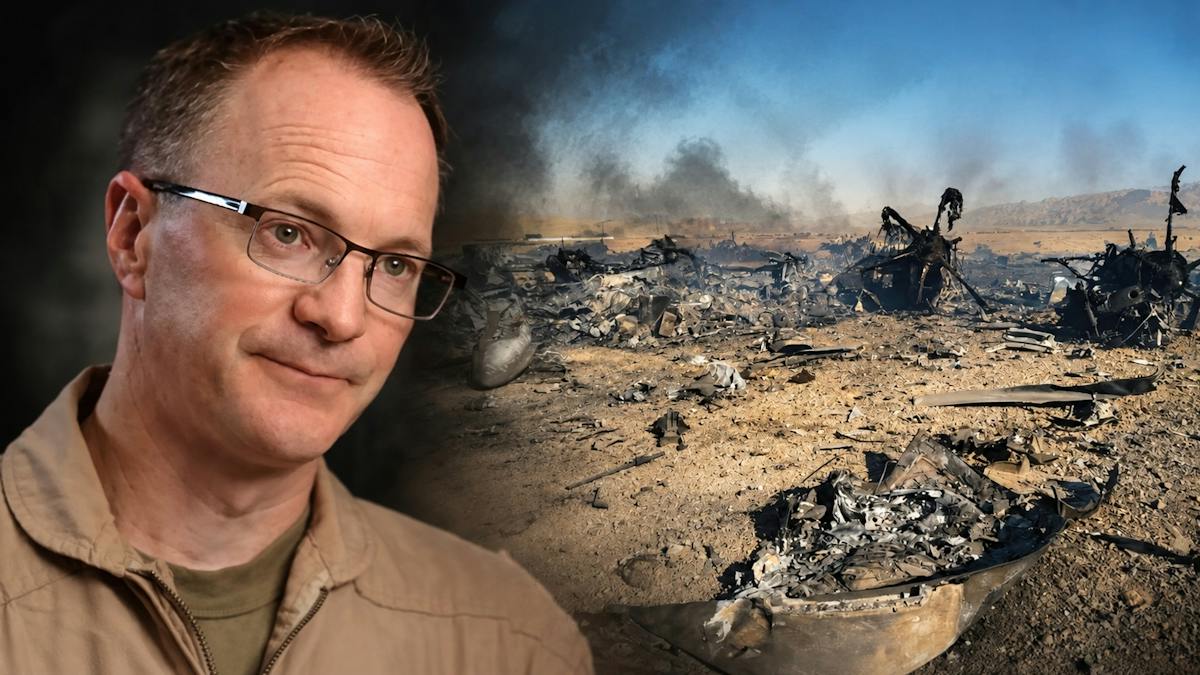
A U.S. Air Force colonel survived a 100 mph freefall into the Iranian desert, climbed a 7,000-foot ridge with a broken back, and evaded enemy search parties for two days — before a CIA-backed rescue operation brought him home. In his first public interview with 60 Minutes, the weapons systems officer known only as “Bravo” described the harrowing April mission that ended with his F-15E Strike Eagle getting struck by an Iranian shoulder-fired missile over Isfahan.
“I THINK THE BEST WAY I’VE BEEN ABLE TO DESCRIBE THAT MOMENT WAS GETTING HIT BY A FREIGHT TRAIN.”
“We do all we can to try to save the aircraft. It was evident that that wasn’t possible, and soon thereafter we ejected and found ourselves floating over the heart of Iran,” Bravo told the program. “I will be thankful to my dying day, for my pilot and crewmate Alpha, for saving our lives and ejecting us.”
The explosion shredded Bravo’s parachute. When he looked up into the night sky, he saw nothing above him — and knew he was falling to earth with no canopy.
“At one point, when I looked up and saw no parachute … that was the most terrifying thing I’ve ever seen. So I paused right then and I prayed, ‘Lord, your will be done. But if I’m getting through this, I need help,'” he said.
Experts estimate Bravo hit the desert terrain at speeds between 70 and 100 mph. The impact broke his back, arm, and shoulder, sprained his ankle, and left him bleeding from head wounds. Despite the catastrophic injuries, his survival training kicked in immediately.
“A modern-day miracle,” Bravo said. “I believe that it’s a testament to God’s provision in my life to bring me through that moment in a way that didn’t prevent injuries but prevented any catastrophic injuries that would have affected my ability to survive.”
With Iranian search parties assembling and a bounty placed on his head, Bravo made the decision to climb. He scaled a 7,000-foot ridge to seek higher ground and evade capture — all with a broken back and shattered limbs.
“NEVER LET A LACK OF MOTIVATION PUT YOU ON IRANIAN TV.”
“Given the terrain that I faced, I think you’d find it surprising what I was able to overcome given those injuries. But I did it because of a warrior ethos that we talk about,” he said. “I owed it to them to show the same warrior ethos in my situation and walk the same walk that I’d been talking for months.”
Bravo spent nearly 50 hours dodging search parties in extreme temperatures with minimal water. Hours into his ordeal, he watched from his ridgeline perch as U.S. forces successfully rescued his pilot, Alpha, in a risky daylight operation.
“It was the proudest dad moment of my life. With apologies to my kids,” he told 60 Minutes. “To see it firsthand made me incredibly proud of them and of Americans like them that continue to raise their hand and say, ‘Here I am. Send me.’ It was a boon to my survival to know that America keeps its promise.”
After two days of evading the enemy, CIA deception operations and military strikes cleared a path for Air Force Pararescue Operators to reach his position. When the rescuers arrived, Bravo kept his message simple: “Let’s go.”
Reflecting on the complex 50-hour operation that brought him home, Bravo directed all credit to his rescuers.
“This is not a story about what I went through. Instead, it’s a story of the teamwork, the training, of the faith, of the decisions and leadership to do something that will live in history as an example of what America is willing to do in order to uphold our promise and leave no man behind,” he said.
Asked if he ever doubted the U.S. military was coming for him, Bravo answered without hesitation.
“Never a doubt. It’s what we do. I have great faith in my Creator. Second only to that is my faith in the men and women of the United States military to do what we say we’re going to do.”
When asked if he would serve again after putting his life on the line, Bravo’s answer was immediate: “I intend to continue to serve in whatever capacity I can. And when we swear an oath to defend this nation and our Constitution, I think it’s easier to do so knowing that we’re doing it as a team. That you have warriors on the left and right of you that are going to continue to fight and answer the call.”