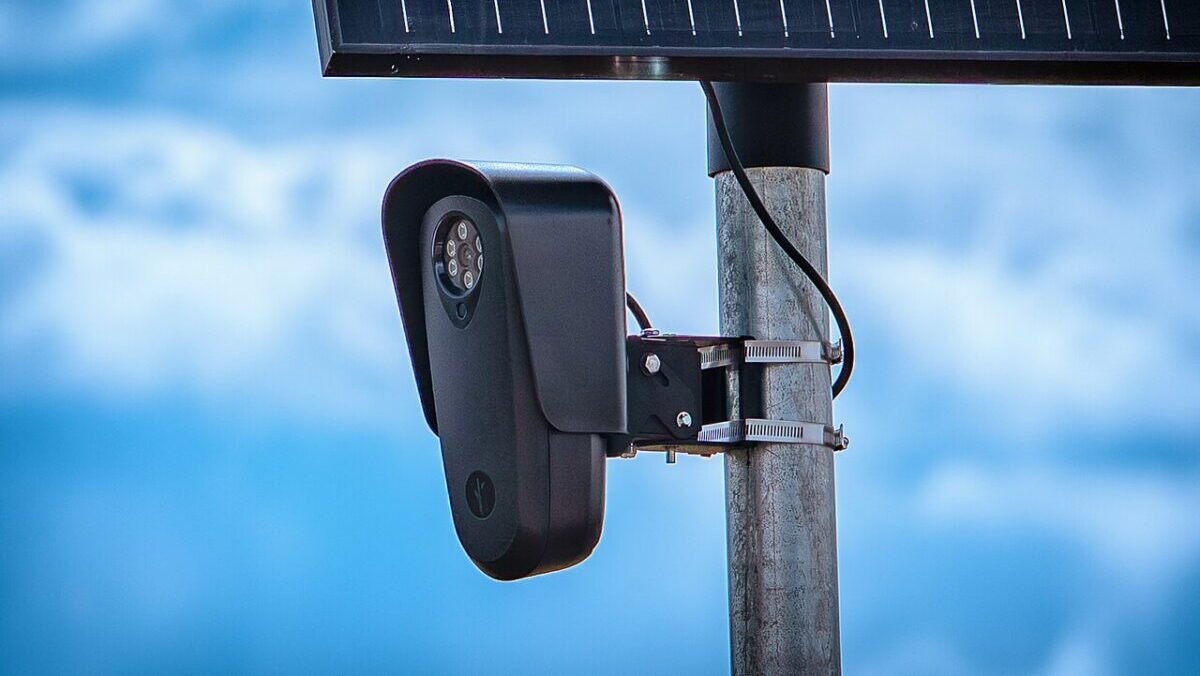
AI-powered cameras log every car that passes. Police departments across the country query the data — no warrant, no court order, no oversight.
That’s the reality more than 6,000 law enforcement agencies have built using Flock Safety cameras, the largest automated license-plate reader vendor in the country. The technology traces back to the same post-9/11 surveillance architecture Congress built a generation ago — and the federal grant dollars that still fund it.
The connection runs through the Department of Homeland Security. After Congress passed the Patriot Act 45 days after the September 11 attacks, it created DHS the following year. With DHS came the Homeland Security Grant Program, funneling federal money to state and local police for so-called counterterrorism purposes.
That same grant program, run through DHS-supported intelligence fusion centers, is today one of the primary funding channels agencies use to buy automated license-plate readers.
“AN AI-POWERED CAMERA ON YOUR STREET CORNER CAN LOG YOUR DAILY MOVEMENTS INTO AN INTERCONNECTED, NATIONWIDE DATABASE THAT LAW ENFORCEMENT CAN SEARCH WITHOUT A WARRANT.”
Section 215 of the Patriot Act gave the FBI authority to collect Americans’ business records simply because they were relevant to a counterterrorism investigation. That provision expired in March 2020 when Congress failed to renew it — the only time before this year Congress let a major post-9/11 surveillance power simply lapse.
But the surveillance appetite didn’t expire. It migrated.
The vehicle is Flock Safety. The company’s cameras now cover nearly every state. Flock maintains that participating agencies control their own data and sharing settings. In practice, the data can be searched through an extensive interagency network — including a nationwide lookup feature state and federal agencies can query.
In Norfolk, Virginia, a lawsuit revealed that 176 cameras logged one driver’s location 526 times in four months. In California, a class action alleges Flock let out-of-state and federal agencies — including ICE — search plate data through what internal audit logs described as a side door, in apparent violation of the state’s sanctuary and license-plate privacy laws.
More than 30 cities have canceled their Flock contracts since last year. The ACLU has filed a Fourth Circuit brief arguing the technology upends the privacy expectations the Fourth Amendment protects.
The double-edged sword cuts both ways. An independent academic study published in August using national FBI crime data across 216 agencies found vehicle theft fell about 11 percent and arrests for motor vehicle theft rose nearly 16 percent in the year after fixed cameras went live. The same study found no statistically detectable improvement in whether stolen vehicles were actually recovered.
The technology helps close cases. It does not follow that it helps in every way the vendor advertises, or that the tradeoff is free. Some Americans have taken to physically destroying the cameras — an ugly response but a real gauge of how little public buy-in this system has earned.
It was built by default, through thousands of municipal contracts, with none of the sunset clauses, minimization procedures, or court oversight the Patriot Act had to survive.
The centerpiece of Congress’ post-9/11 response is Section 702 of FISA, created by the 2008 FISA Amendments Act. It lets the government collect foreigners’ communications abroad without a warrant. Because Americans talk to foreigners, their messages get swept into the same database, and the FBI can search it using American identifiers — a practice known as the backdoor search.
Here’s what should trouble anyone who thinks judicial review prevents abuse: it has happened, repeatedly, in a system built for exactly that oversight.
In 2019, Justice Department Inspector General Michael Horowitz found 17 significant errors and omissions across four FISA applications targeting Trump campaign associate Carter Page, including one in which FBI lawyer Kevin Clinesmith altered a document to hide that Page had been a source for another U.S. agency. Clinesmith later pleaded guilty to a federal crime.
And in 2023, declassified Foreign Intelligence Surveillance Court opinions revealed the FBI had run more than 278,000 Section 702 queries between 2020 and 2021 that violated the FBI’s own legal standard, including searches on more than 100 Black Lives Matter protesters, 19,000 donors to a single congressional campaign, and 23,000 people connected to the January 6 Capitol riot.
The FISC itself called the pattern persistent and widespread.
When Congress reauthorized Section 702 in April 2024, an amendment requiring a warrant before the FBI could search Americans’ data failed in a 212-to-212 vote. A last-second switch from yes to no by House Speaker Mike Johnson is what actually ended it. The main reauthorization bill then passed.
Every one of these programs had a court reviewing it, a statute governing it, and a reauthorization debate scheduled for it. None of that stopped the abuse. Judicial and congressional oversight caught this only after the fact. They did not prevent it.
The doctrinal question is whether the Fourth Amendment still applies once your information passes through someone else’s hands — the so-called third-party doctrine. Justice Antonin Scalia narrowed that doctrine’s reach months before 9/11 in Kyllo v. United States, ruling that police use of a thermal-imaging device to detect heat inside a home was a search requiring a warrant. In 2018, the court extended that logic to cellphones in Carpenter v. United States, holding that police need a warrant for multi-day cell-site location records.
Neither ruling has yet been extended to license plates.
The Constitution does not enforce itself. It only means what a citizenry insists it means when government programs outgrow their oversight.