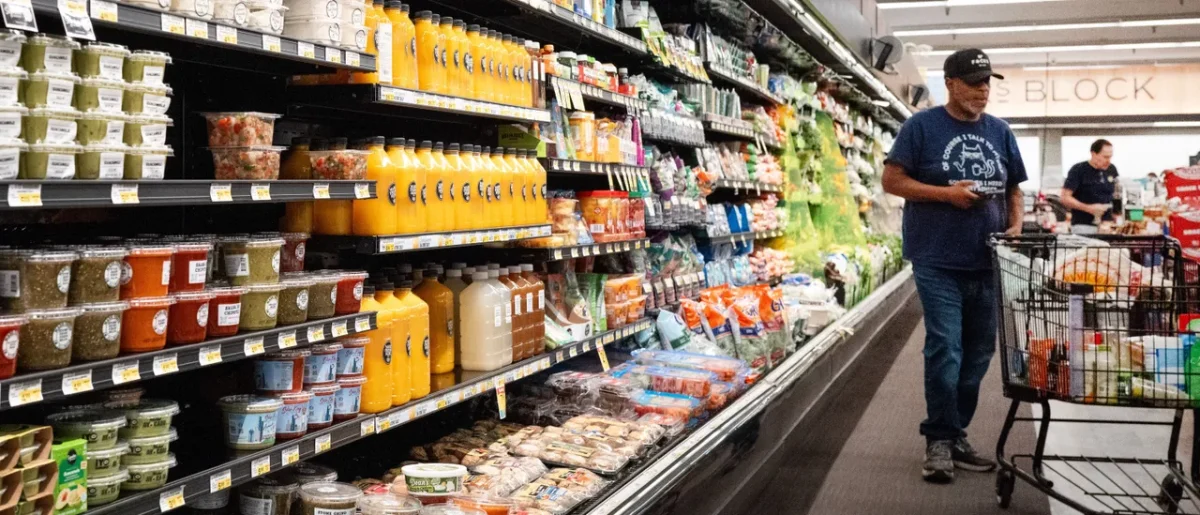
Diesel just hit $6.00 per gallon — a new national record — and American families are about to feel the pain at the grocery store checkout line.
The Iran war launched Feb. 28 has thrown global petroleum markets into chaos. Two critical oil-shipping chokepoints — the Strait of Hormuz and Bab al-Mandab — are under threat from the conflict and Houthi attacks, driving fuel costs to levels that will directly hit household budgets.
“Diesel is one of trucking’s largest operating expenses, so an increase of this magnitude creates immediate pressure on motor carriers, who run on tight margins. When families spend more at the pump, they have less to spend elsewhere, and that can translate into weaker demand for the goods trucks move.”
That’s Henry Hanscom, chief advocacy and public affairs officer at the American Trucking Association, explaining why diesel prices matter even to Americans who never personally fill up a diesel vehicle.
Trucks moved 11.27 billion tons of freight in 2024 — accounting for 72.7% of domestic freight tonnage. When diesel costs soar, groceries, fertilizer, and every other good moved by the trucking industry gets more expensive.
Food prices are already climbing. Grocery costs rose 2.2% from a year earlier in August, fruits and vegetables jumped 3.2%, and nonalcoholic beverages climbed 3.7%, according to Bureau of Labor Statistics data.
Richard Volpe, agricultural economics professor at Cal Poly, says the worst is still ahead.
“Given that most retailers operate on thin profit margins to begin with (1-2%), it would surprise me not to see food price inflation tick up in the next couple of CPI releases as the high energy prices, driven mostly by crude oil and diesel, increase operating costs at all stages of the supply chain,” Volpe told the Daily Caller News Foundation.
Diesel stood at roughly $3.72 per gallon before the Iran war began in February — meaning prices have surged roughly 60% in a little over six months.
the rise in prices is not slowing down- national average price of gasoline continues to rise alongside diesel, which continues to climb further into record territory. LIVE GasBuddy data (not yesterday’s data sold as today): pic.twitter.com/gYDvfejxCj
— Patrick De Haan (@GasBuddyGuy) September 11, 2026
The Iran conflict has disrupted shipping through the Strait of Hormuz while Houthi attacks have choked traffic around the Red Sea and Bab al-Mandab — putting two of the Middle East’s most important oil corridors under severe pressure.
Energy analyst Stuart Turley, president and CEO of the Sandstone Group, says the disruption won’t balance out anytime soon.
“The price of Diesel will be the inflationary problem for the Trump administration that the Fed nor the U.S. Treasury can impact. The disruption in the oil markets will take 6 to 8 months to balance out,” Turley said.
“Tanker daily rates just crossed $800K per day and insurance is at an all-time high, that impacts physical delivery prices to refineries. The diesel crack spread is around the $200 per barrel of diesel mark. None of this balances before the midterm elections, and will roll in to Q1 2027.”
Farmers are getting squeezed from both ends. They use diesel to operate agricultural equipment, and fertilizer costs are soaring because nearly one-third of seaborne fertilizer production comes from the Gulf and transits through the Strait of Hormuz.
U.S. farm spending on fertilizer, lime, and soil conditioners is projected to jump 15.3% in 2026 — roughly $5.3 billion — according to the U.S. Department of Agriculture.
Nitrogen fertilizer has been hit particularly hard. Anhydrous ammonia averaged $828 per ton in the six months before the conflict but had climbed to $1,123 per ton by April 17 — an increase of nearly 36%.
Roughly 20% of global petroleum liquids consumption moved through the Strait of Hormuz in the first half of 2025, according to the U.S. Energy Information Administration. The Strait’s importance stretches well beyond Iran — and the chaos there is now reaching American checkout lines.
Families may also cut back on eating out and other non-essential purchases as higher fuel costs ripple through household budgets, University of Cincinnati economics professor Debashis Pal told UC News in March.
The Iran war isn’t just a foreign policy problem. It’s about to hit every American family where it hurts — at the gas pump and the grocery store.