
Democrats are inching closer to flipping the House this November — and the economy is driving the shift.
A fresh Fox News Power Rankings analysis shows Democrats now hold 212 seats to the GOP’s 206, with seventeen toss-up races that could swing the outcome. On a strong night for Team Blue, that means 229 seats and a Democratic majority.
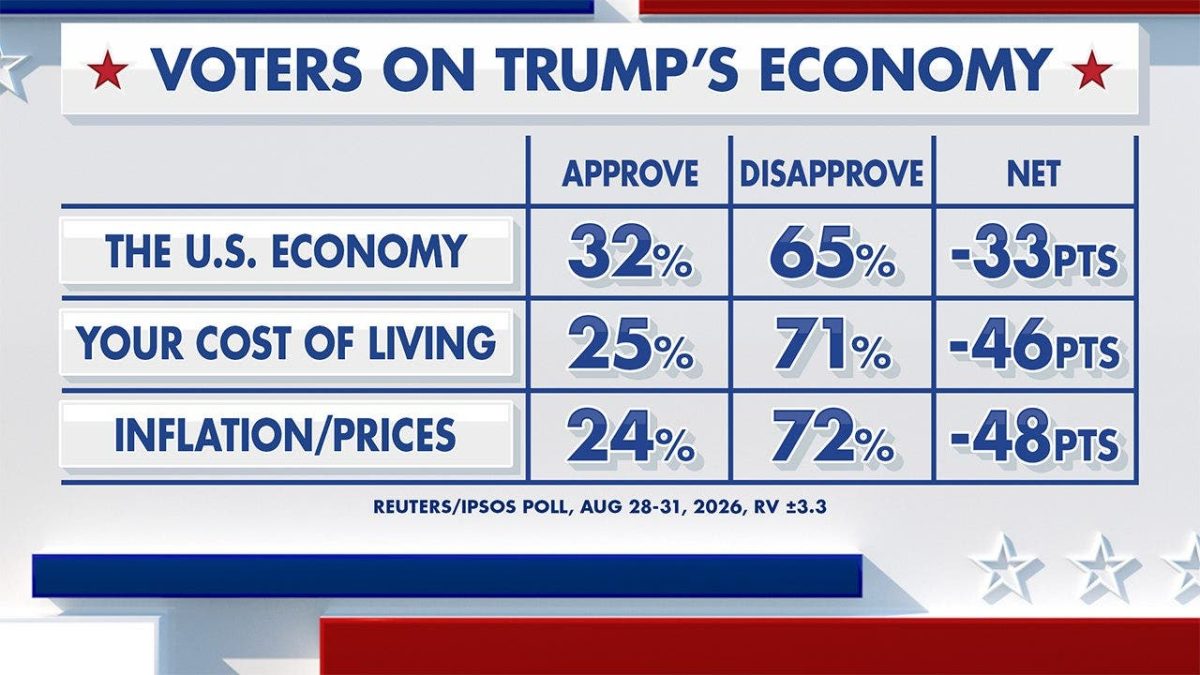
The culprit? President Trump’s economic approval rating sits at -33 points, dragged down by voter fury over inflation and cost of living — even as headline jobs numbers look strong.
“TRUMP’S NET APPROVAL ON THE ECONOMY CURRENTLY SITS AT -33 POINTS.”
According to a recent Reuters/Ipsos poll, only 32% of voters approve of Trump’s handling of the economy. Worse: just 25% approve of his performance on cost of living, and 24% on inflation and prices.
Those numbers echo the 2022 midterms, when President Biden faced similar voter anger over $3.75 gas and 8% inflation. Biden’s net approval on the economy sat at -23 points — and Democrats lost nine House seats.
Today, inflation is down to 3.4%, but gas prices have climbed to $4.15. Trump’s economic net approval is ten points worse than Biden’s was at the same stage.
Vice President Vance told reporters last week that gas prices could be worse without the administration’s policies — a line that echoes the optimistic spin Biden officials tried in 2022. Voters rejected that messaging then. Fox’s Gillian Turner noted the similarities on Special Report.
Janelle King, co-chair of Let’s Win for America Action, said voters are feeling “immediate financial heat” despite Trump touting long-term benefits. She warned of “emotional voting” driven by pocketbook pain.
But here’s the twist: Democrats aren’t winning voters over either. The same Reuters/Ipsos poll shows 36% of voters trust Republicans more on the economy, while 37% prefer Democrats — a statistical tie within the poll’s ±3.3-point margin of error.
Democrats are offering competing visions: some candidates like Abdul El-Sayed and Troy Jackson want Medicare for All and higher taxes on the wealthy. Others want to undo Trump’s agenda while keeping the economic system intact.
The Fox News analysis warns that “voters see through economic optimism” — a lesson from 2022, when Biden officials celebrated “zero percent inflation” month-over-month while annual inflation stayed near 8%. Voters didn’t buy it then. They’re not buying Trump’s version now.
Health care is also looming as a sleeper issue. In the 2018 midterms, health care (26%) and immigration (23%) finished ahead of the economy (18%) as top voter concerns. Republicans lost 42 seats that year.
Democratic strategist James Carville’s famous “the economy, stupid” rule from the ’90s had two other orders: “don’t forget health care” and “change vs more of the same.” This year, health care ranks close behind the economy in most surveys.
Two key states tightened this week:
In Missouri, the state Supreme Court unanimously blocked GOP-backed congressional maps that would have flipped Democrat Emanuel Cleaver’s Kansas City-based 5th District into Republican hands. The ruling restores the existing map, keeping Cleaver’s seat in the Solid D column. Missouri has appealed to the U.S. Supreme Court.
In Ohio, three races shifted left. Republican Rep. Max Miller’s 7th District moved from Likely R to Toss Up after his ex-wife accused him of physically abusing her and their young daughter. Miller denies the allegations and says his ex-wife’s father — Ohio Sen. Bernie Moreno — is trying to destroy his career.
Meanwhile, Ohio’s 10th and 15th Districts (held by GOP Reps. Mike Turner and Mike Carey) moved from Solid R to Likely R as Democrat Sherrod Brown’s strong Senate campaign — up 8 points at 53% in recent Fox News Polls — threatens to pull down-ballot races leftward.
The Power Rankings forecast: Democrats remain favorites to take the House, but a good GOP night could still preserve the current Republican majority. The seventeen toss-up seats will decide it.
Polls consistently show the economy is the top issue by a wide margin. But as the 2018 and 2022 midterms proved, related issues — health care, cost of living, inflation — can drive the final outcome just as much as headline jobs numbers.
Patriots know the drill: when voters feel financial pain at the pump and the grocery store, they vote with their wallets. November 5 will show whether Trump’s “could be worse” message was enough — or whether Democrats’ mixed economic visions connected.